Provenance
Louis-Fidel Debruge Duménil [d. 1838], Paris; (Debruge-Dumenil sale, Paris, 23 January-9 February and 4-12 March 1850, no. 1146). Prince Petr Soltykoff [c. 1801-1889], Paris; (his sale, Paris, 8 April-1 May 1861, no. 698, as by Xanto). (Roussel, Paris). Perhaps Baron Achille Seillière [1813-1873], Paris, and Chateau de Mello.[1] Maurice Kann [1839-1906], Paris; purchased 1908 with the entire Kann collection by (Duveen Brothers Inc., London, Paris, and New York); purchased February 1910 by Peter A. B. Widener, Elkins Park, Pennsylvania; inheritance from the Estate of Peter A. B. Widener by gift through power of appointment of Joseph E. Widener, Elkins Park, 1942.
[1] Alfred Darcel, "Le moyen age et la renaissance au Trocadéro: XIV: Les faïences italiennes," _Gazette des beaux-arts_, 2d ser., 18 (1878): 974, mentions a lustered plate with Hero and Leander having been exhibited in the 1878 exhibition, and another plate with "Pyrrhus sauvé," attributed to Xanto, in the collection of "MM. Seillière." These are probably the National Gallery of Art plate and the Metabus and camilla plate at Luton Hoo(Bedfordshire, England, home of the Wernher family collection). The owner was perhaps Baron Achille Seillière, but neither piece was included in his estate sale in Paris, 5-10 May 1890.
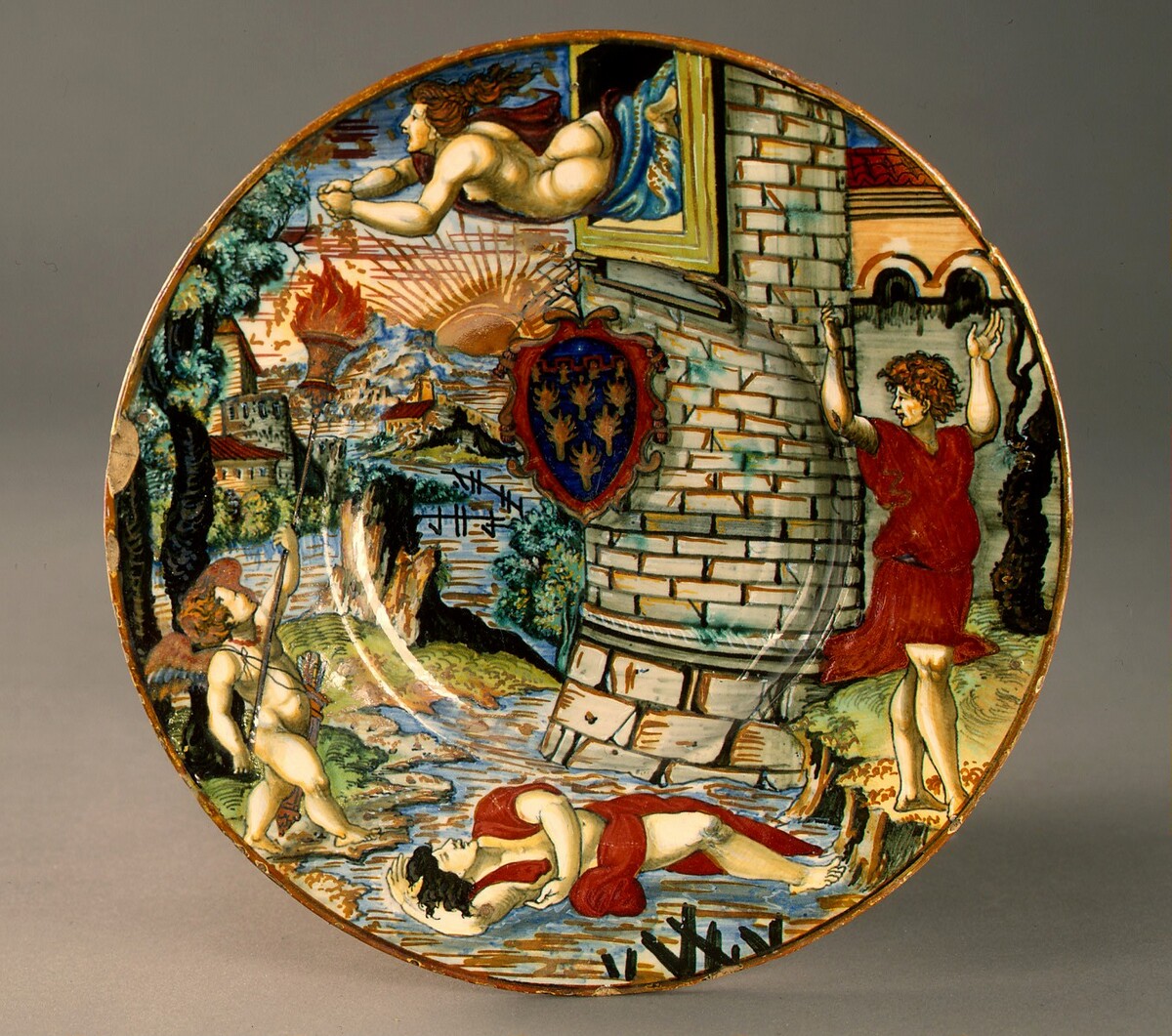
Plate with Hero leaping to her death from her tower and the drowned Leander; in the center, a shield of arms
1538
Accession Number
1942.9.337
Medium
tin-glazed earthenware (maiolica)
Dimensions
overall (diameter): 26.7 cm (10 1/2 in.)
Classification
Decorative Art
Credit Line
Widener Collection
Related Artworks
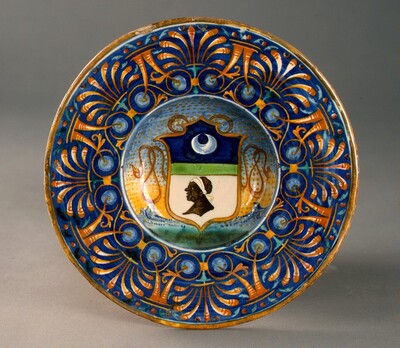
Broad-rimmed bowl with palmette and cornucopia border; in the center, shield of arms of the Saracinelli of Orvieto
Andreoli of Gubbio, Giorgio, Maestro
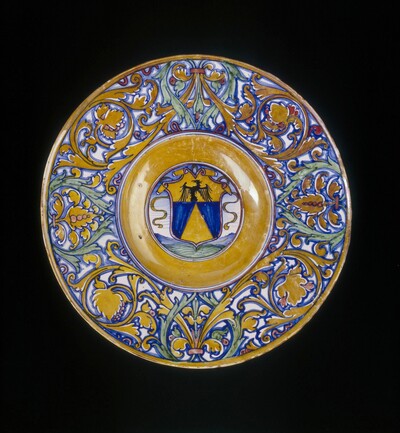
Plate with border of foliate scrollwork; in the center, shield of arms of Vigerio of Savona
Andreoli of Gubbio, Giorgio, Maestro
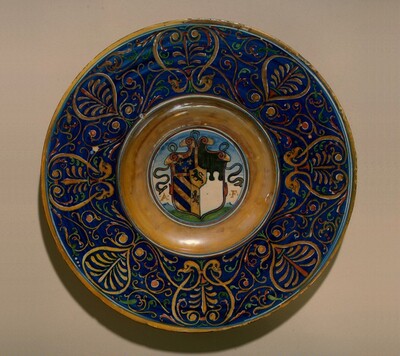
Plate with border of palmettes and scrollwork; in the center, a shield of arms and the initials A.F.
Andreoli of Gubbio, Giorgio, Maestro
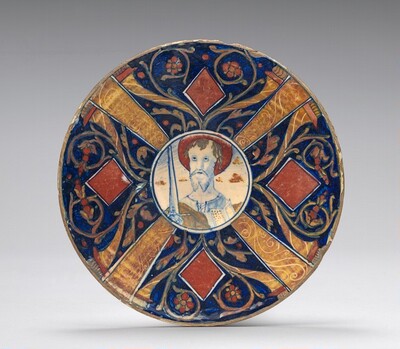
Small flat plate with border of cornucopias, scrollwork, and lozenges in four sections; in the center, a bust of Saint Paul with raised sword
Andreoli of Gubbio, Giorgio, Maestro