Provenance
Possibly Tommaso Puccini [1749-1811], Villa a Scornio, near Pistoia.[1] possibly (Sangiorgi, Rome), early 1900s.[2] Achillito Chiesa, Milan.[3] (Piero Tozzi [1882-1974], New York), by 1925 until at least 1927.[4] Percy S. Straus, New York, by 1932.[5] (Bachstitz Gallery, The Hague), by 1934.[6] (Duveen Brothers, Inc., London, New York, and Paris), by 1937;[7] sold 1940 to the Samuel H. Kress Foundation, New York;[8] gift 1943 to NGA.
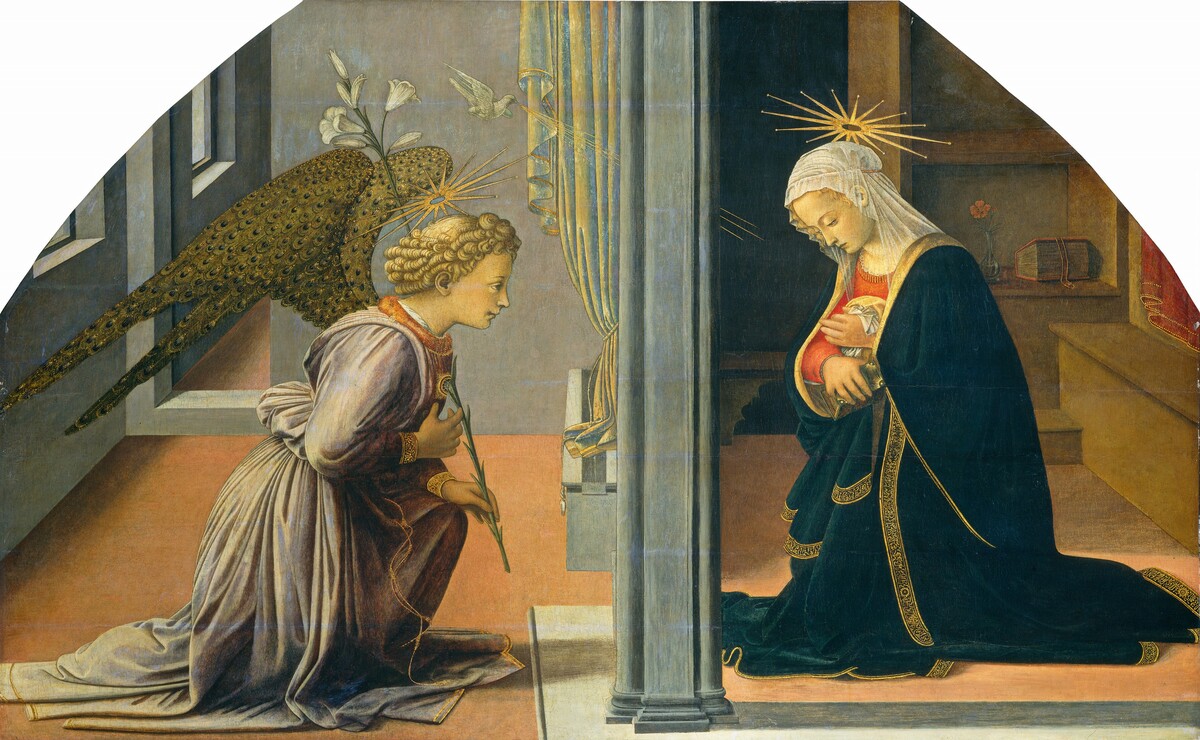
[1] In commentary on Filippo Lippi, Tommaso Puccini writes ("Dialoghi sulle Vite del Vasari," Archive of the Gallerie Fiorentine, Florence, c. 1800, Ms. no. 46, fol. 199): "Io possiedo di questo Autore un quadretto conservatissimo esprimente l'Annunziata...Genuflette davanti alla Vergine, assorta in contemplazione del S. Spirito che viene a deporla nel seno il Messia, bianco vestito, con un giglio in mano, un grazioso Angeletto che non tocca coi ginocchi il terreno, ma sta sull'ali sospeso. Il fondo rappresenta l'interno della Camera con una prospettiva intesa a meraviglia..." ("I possess by this author a very well preserved little picture representing the Annunciate...Kneeling before the Virgin, rapt in contemplation of the Holy Spirit who comes to place the Messiah in her womb, dressed in white, with a lily in his hand, a lovely little angel who does not touch the ground with his knees but floats on wings. The background represents the interior of a room with a perspective which is marvelously understood"). Apart from the detail concerning the knees which do not touch the floor, the description is quite similar to the NGA painting, but it may refer, of course, to some other of Lippi's paintings on this subject.
[2] The name "S. Giorgi" is written on the back of a photograph of the painting belonging to the Biblioteca Berenson at Villa I Tatti near Florence and coming from Bernard Berenson's files, indicating the panel's earliest known location. This was Berenson's customary abbreviation for the name of the Roman dealer Sangiorgi.
[3] The art collection of Achille Chiesa in Milan, inherited after his death by his son Achillito, was sold at the American Art Association Galleries in New York at various sales between 1925 and 1927. The NGA painting, however, which is not listed in the auction catalogues, must have been sold privately sometime earlier.
[4] According to Odoardo H. Giglioli, "Una pittura ignota di Fra Filippo Lippi," _BdA_, n.s. 6 (1925-1926): 553, the painting was brought to Florence for restoration. Records of the Florentine Soprintendenza dei Beni Artistici e Storici (_pratica_ no. 630 of 27 January 1925) show that the panel, belonging to the dealer Tozzi, entered Italy in January 1925 and left for New York in March 1927. No records concerning this painting have been discovered in The Tozzi Archive, housed in The Onassis Library for Hellenic and Roman Art, Department of Greek and Roman Art, The Metropolitan Museum of Art, New York.
[5] See Berenson Berenson, _Italian Pictures of the Renaissance_, Oxford, 1932: 288. Possibly the painting passed through various hands before entering, sometime around 1930, the Straus collection. The annotation on Berenson's photograph, cited in note 2, also records the Florence dealer Albrighi as owner.
[6] The painting was illustrated in 1934, in a partially cleaned state, in an advertisement of the Bachstitz Gallery in the December issue of _The Burlington Magazine_ 65, xvi.
[7] See Robert Oertel, _Fra Filippo Lippi_, Vienna, 1942: 67.
[8] Fern Rusk Shapley, _Catalogue of the Italian Paintings_, 2 vols., Washington, D.C., 1979: 1:263. See also The Kress Collection Digital Archive, https://kress.nga.gov/Detail/objects/2061.
Accession Number
1943.4.35
Medium
tempera on panel
Dimensions
overall: 100 x 161 cm (39 3/8 x 63 3/8 in.)
Classification
Painting
Credit Line
Samuel H. Kress Collection
Tags
Painting Renaissance (1400–1599) Tempera Panel Painting Italian
Background & Context
Background Story
Fra Filippo Lippi (c. 1406-1469) was a Florentine painter of the early Renaissance, a Carmelite friar whose religious paintings combine devotional clarity with the graceful, linear manner that would influence his pupil Sandro Botticelli and define the Florentine Renaissance. The Annunciation from c. 1435-40 depicts the biblical episode in which the angel Gabriel announces to the Virgin Mary that she will bear Christ, rendered in the tempera on panel medium that was standard for Florentine devotional painting before the adoption of oil. The c. 1435-40 date places this in Lippi's early maturity, when he was developing the graceful manner that would make him one of the most influential painters of the early Florentine Renaissance.
Cultural Impact
Lippi's Annunciation is important in the history of Florentine Renaissance painting because it demonstrates the graceful, linear manner that he transmitted to his pupil Botticelli and that would define the Florentine Renaissance at its most refined. The painting's combination of devotional clarity and decorative elegance—clear religious narrative with graceful line and beautiful color—established the manner that would make Lippi's influence felt throughout the Florentine Renaissance.
Why It Matters
The Annunciation is Lippi's early Renaissance grace at work: the angel Gabriel announcing to the Virgin in the tempera medium of Florentine devotional painting, with the clarity of religious narrative and the decorative elegance that would influence Botticelli. The c. 1435-40 painting established the graceful manner that defined the Florentine Renaissance.
![Saint Bernard and Saint Catherine of Alexandria with the Virgin of the Annunciation [right panel]](https://api.nga.gov/iiif/e6890364-4d99-4684-a62b-5060ee3c3446/full/400,/0/default.jpg)