Provenance
Lodewijck van Ludick [1607-1669], Amsterdam, by 1662.[1] Probably Ferdinand Bol [1616-1680], by 1669.[2] Probably Isaak van den Blooken, The Netherlands, by 1707; (his sale, Jan Pietersz. Zomer, Amsterdam, 11 May 1707, no. 1). Duke of Ancaster; (his sale, March 1724, no.18); Andrew Hay; (his sale, Cock, London, 14-15 February 1745, no. 47);[3] John Spencer, 1st earl Spencer [1734-1783], Althorp, Northamptonshire; by inheritance through the earls Spencer to John Poyntz, 5th earl Spencer [1835-1910], Althorp;[4] (Arthur J. Sulley & Co., London); Peter A.B. Widener, Lynnewood Hall, Elkins Park, Pennsylvania, by 1912; inheritance from Estate of Peter A.B. Widener by gift through power of appointment of Joseph E. Widener, Elkins Park, Pennsylvania; gift 1942 to NGA.
[1] On 18 August 1662 Rembrandt and Van Ludick drew up a contract to address the artist's debts, in the second part of which is revealed that sometime earlier Rembrandt had sold the painting to Van Ludick. See: Walter L. Strauss and Marjon van der Meulen, _The Rembrandt Documents_, New York, 1979: doc. 1662/6, 499–502; Paul Crenshaw, _Rembrandt's bankruptcy: the artist, his patrons, and the art market in the seventeenth-century_, Cambridge and New York, 2006: 30, 84, 107, 179 n. 200.
[2] Albert Blankert, _Ferdinand Bol (1616-1680): Rembrandt's Pupil_, translated by Ina Rike, Doornspijk, 1982: 76-77, no. 14 in an inventory of 8 October 1669.
[3] For the Ancaster and Hay sales, see Frank Simpson, "Dutch Paintings in England before 1760," _The Burlington Magazine_ 95 (January 1953): 41. The Duke of Ancaster who sold the painting in 1724 would have been Peregrine Bertie, 2nd duke of Ancaster and Kesteven (1686-1742); it is possible he was selling paintings that had been in the collection of his father, Robert Bertie, the 1st duke, who had died the year before (he lived 1660-1723).
[4] The painting is listed in Spencer collection catalogues and inventories in 1746, 1802, and 1822, and was lent by the earls Spencer to exhibitions in 1868, 1898, and 1899.
Accession Number
1942.9.60
Medium
oil on canvas
Dimensions
overall: 56.5 x 75 cm (22 1/4 x 29 1/2 in.) | framed: 81.3 x 99 x 8.2 cm (32 x 39 x 3 1/4 in.)
Classification
Painting
Credit Line
Widener Collection
Tags
Painting Baroque (1600–1750) Oil Painting Canvas Dutch
Background & Context
Background Story
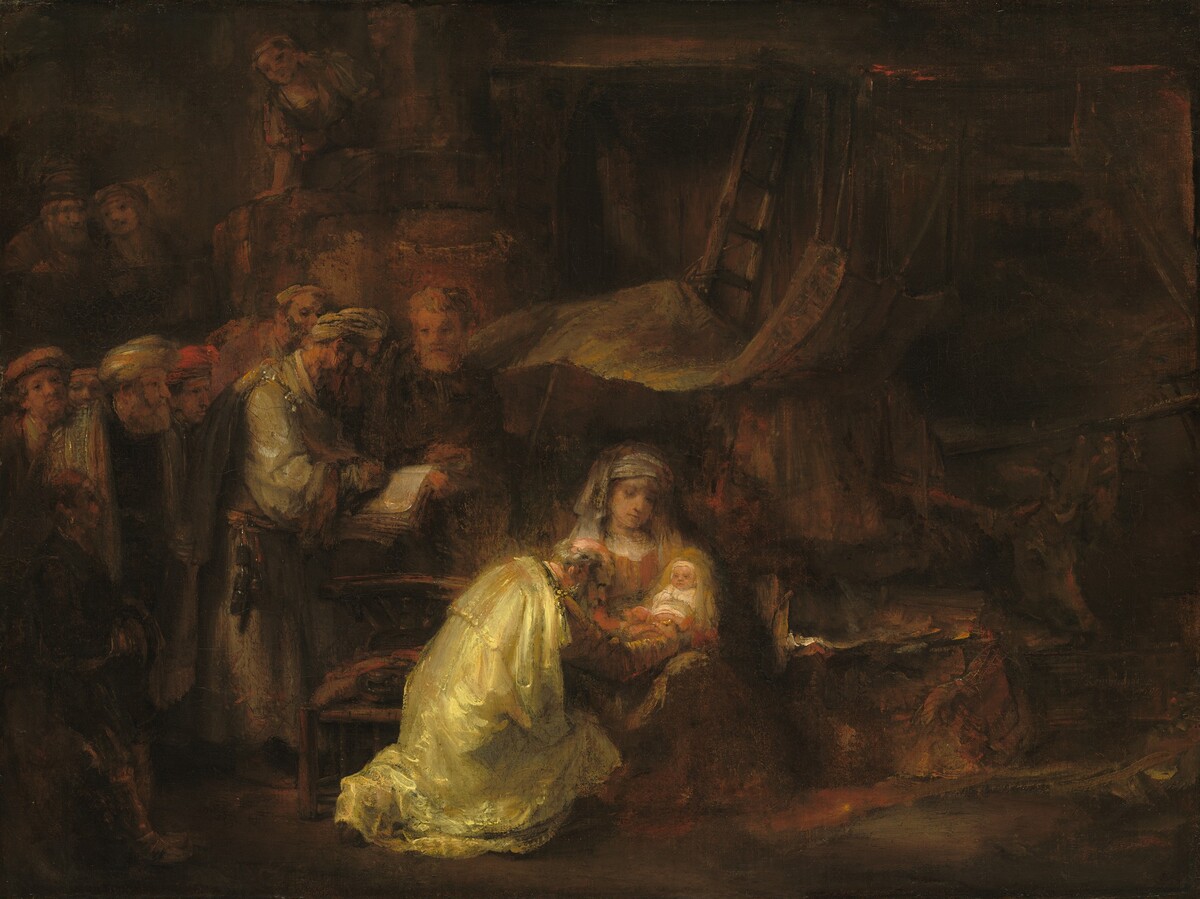
The Circumcision (c. 1661) belongs to Rembrandt's late series of religious paintings—works of extraordinary spiritual depth that he produced during the period when his personal circumstances were most difficult. The circumcision of Christ, celebrated on January 1 as the Feast of the Circumcision, was one of the minor events in the infancy narrative, but Rembrandt's treatment elevates it to a subject of profound spiritual significance: the moment when the infant Jesus is marked as a member of God's covenant with the Jewish people, and when his blood is first shed—.prefiguring of the crucifixion blood that would be shed for humanity's salvation. The 1661 date places this during Rembrandt's most difficult period: his bankruptcy in 1656 had forced the sale of his house and collections, and his personal losses—the deaths of his wife, his mistress, and several of his children—had deepened the spiritual seriousness of his religious work. His treatment of the circumcision demonstrates the method that distinguishes his late religious paintings: the divine is revealed through the ordinary, and the spiritual is expressed through the physical. The infant Christ, subjected to the ritual that marks him as a member of the covenant, is rendered with the tenderness that Rembrandt brought to all his depictions of children, while the ritual itself—the cutting, the blood, the covenant enacted on the body—carries the theological significance that gives the scene its spiritual weight.
Cultural Impact
Rembrandt's late religious paintings influenced how biblical narratives were represented in art, replacing the spectacular with the intimate and the theological with the human. The paintings influenced later religious artists who similarly sought spiritual truth in physical immediacy rather than divine spectacle. The Circumcision influenced how the Incarnation's bodily reality was represented, connecting the divine to the physical ritual that marked Christ's membership in the Jewish covenant.
Why It Matters
This painting matters because it renders the Incarnation's bodily reality with the tenderness and theological seriousness that distinguish Rembrandt's late religious work—the infant Christ, subjected to the covenant ritual on his body, embodies the Christian mystery of a God who entered human experience completely, including the physical pain and the cultural ritual that marked human belonging.