Provenance
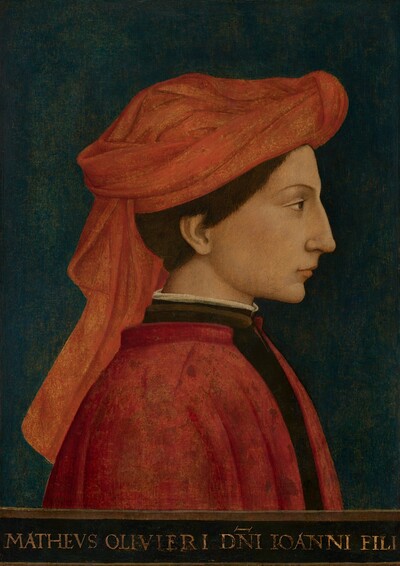
Mameli, Rome.[1] William Jones, Clytha Park, Gwent, Wales; (his sale, Christie & Manson, London, 8 May 1852, no. 65).[2] (Thomas [Tomás] Harris, London), by 1930;[3] purchased by Godfrey Locker-Lampson [1875-1946], Barlborough Hall, Derbyshire, and London, by 1937;[4] purchased by (Count Alessandro Contini Bonacossi, Florence);[5] sold September 1938 to the Samuel H. Kress Foundation, New York;[6] gift 1939 to NGA.
[1] Fern Rusk Shapley, _Paintings from the Samuel H. Kress Collection: Italian Schools, XV-XVI Century_, London, 1968: 48-49, and _Catalogue of the Italian Paintings_, 2 vols., Washington, D.C., 1979: 1:535-536, lists this owner, without citing a source. There is no further information in NGA curatorial files.
[2] _Catalogue of the Important Collection of Capital Pictures, by Italian, Flemish, and English Masters, Acquired Chiefly during a Long Residence in Italy, by William Jones, Esq., of Clytha_. No. 65 is described as "Vivarini: St. Paul the Hermit, seated, with a book in his hand, near a rocky cave, with a lake in the background." On Jones and his collection, see Francis Russell, "Documents for the History of Collecting: 17," _Burlington Magazine_ 136 (1994): 90.
[3] Tancred Borenius, "An Unpublished Work by Alvise Vivarini," _Der Cicerone_ 22 (1930): 500, repro. 501.
[4] Robert Langton Douglas, _A Few Italian Pictures Collected by Godfrey Locker-Lampson_, London, n.d.: 44, repro. 45. Although no date is printed, the catalogue is reliably dated to 1937 on the following evidence, kindly provided by Charles Sebag-Montefiore in a letter of 2 September 2001 (in NGA curatorial files): a manuscript note by Ellis Waterhouse in his own copy of the catalogue (Ellis K. Waterhouse notebooks and research files, 1801-1987, bulk 1924-1979; Getty Research Institute, Los Angeles), and a reference by Denys Sutton in "Robert Langton Douglas. Connoisseur of Art and Life (Part IV)," _Apollo_ CX, no. 209, new series (July 1979): 30. Douglas probably handled Locker-Lampson pictures after Locker-Lampson's death in 1946.
[5] According to Charles Sebag-Montefiore's _A Bibliography of the British as Collectors_ (forthcoming; copy of the entry for Godfrey Locker-Lampson in NGA curatorial files, kindly provided by the author), the 1937 catalogue was likely "prepared as a record of the collection before its dispersal." Contini Bonacossi purchased four paintings from the collection, in either 1937 or 1938.
[6] The bill of sale to the Kress Foundation, for a total of twenty-eight paintings including the Vivarini, is dated 16 September 1938 (copy in NGA curatorial files). See also The Kress Collection Digital Archive, https://kress.nga.gov/Detail/objects/1854.
Accession Number
1939.1.311
Medium
tempera on panel
Dimensions
overall: 31.4 x 25.1 cm (12 3/8 x 9 7/8 in.) | framed: 47.2 x 41.6 x 5.1 cm (18 9/16 x 16 3/8 x 2 in.)
Classification
Painting
Credit Line
Samuel H. Kress Collection
Tags
Painting Renaissance (1400–1599) Tempera Panel Painting Italian
Background & Context
Background Story
Alvise Vivarini's "Saint Jerome Reading" (c. 1476) depicts the most learned of the Latin Church Fathers in the act of study — a subject of profound significance in the Renaissance, when humanist scholarship was transforming European intellectual life. Saint Jerome (c. 347–420), translator of the Bible into Latin (the Vulgate), sits absorbed in his text, surrounded by the attributes that identify him: his cardinal's hat, his lion (from whose paw he famously removed a thorn), and the rock with which he beat his breast in penitence.
Alvise Vivarini (c. 1446–1505) was a member of the Vivarini family of painters — one of the two great dynasties (alongside the Bellini) that dominated painting in fifteenth-century Venice. His father Antonio Vivarini and uncle Bartolomeo Vivarini established the family workshop, which produced altarpieces and devotional panels for Venetian churches and private patrons. Alvise, the last and most talented of the family's painters, developed a style that combined the inherited Vivarini tradition of clear, enamel-like color with a new awareness of Antonello da Messina's oil technique and Giovanni Bellini's atmospheric landscape.
"Saint Jerome Reading" dates from Alvise's early maturity, when he was absorbing these new influences while maintaining the family's characteristically Venetian approach to color and light. The painting shows Jerome in a study filled with books — an appropriately scholarly setting for the man who was considered the patron saint of scholars. The saint's focused absorption in his text, furrowed brow, and gesture of contemplation convey the intensity of intellectual pursuit.
The painting's significance extends beyond its devotional function. In fifteenth-century Venice, the veneration of Saint Jerome served to legitimize humanist scholarship — the same rigorous textual study that Jerome applied to scripture, Venetian humanists applied to classical authors. By depicting Jerome as a scholar surrounded by books rather than a penitent in the wilderness, Alvise connects religious devotion to intellectual discipline, a synthesis that was fundamental to the Renaissance project.
Cultural Impact
The Vivarini workshop played a crucial role in developing the Venetian painting tradition that would culminate in Giovanni Bellini, Giorgione, and Titian. Alvise's integration of oil technique with the Vivarini color tradition represents a key step in the evolution of Venetian art.
Why It Matters
This painting of Saint Jerome demonstrates the Vivarini workshop's contribution to Venetian art — combining devotional intensity with a new awareness of oil technique and atmospheric depth, bridging the gap between early Venetian tempera painting and the golden age of the Venetian Renaissance.


![Saint Bernard and Saint Catherine of Alexandria with the Virgin of the Annunciation [right panel]](https://api.nga.gov/iiif/e6890364-4d99-4684-a62b-5060ee3c3446/full/400,/0/default.jpg)