Provenance
Granville Edward Harcourt Vernon [1816-1861], Grove Hall, Nottinghamshire; by inheritance to his wife, Lady Selina Vernon [later Lady Hervey], Grove Hall, Nottinghamshire;[1] (sale, Christie, Manson & Woods, London, 17-18 June 1864, 2nd day, no. 270, as _Two Monks embracing at the Foot of a Mountain_ by P. Laurenti); purchased by Anthony;[2] Wentworth Blackett Beaumont, 1st baron Allendale [1829-1907], London; by inheritance to his son, Wentworth Canning Blackett Beaumont, 1st viscount and 2nd baron Allendale [1860-1923], London; by inheritance to his son, Wentworth Henry Canning Beaumont, 2nd viscount and 3rd baron Allendale [1890-1956], London;[3] sold 1937 to (Duveen Brothers, Inc., London, New York, and Paris); sold June 1938 to the Samuel H. Kress Foundation, New York;[4] gift 1939 to NGA.
[1] See Ellis Waterhouse, "Sassetta and the Legend of St. Anthony Abbot," _The Burlington Magazine_ (September 1931): 113, note 7; and a letter of 15 December 1964 from Ellis Waterhouse to the Kress Foundation (copy in NGA curatorial files), discussed in Fern Rusk Shapley, _Catalogue of the Italian Paintings_, 2 vols., Washington, D.C., 1979: 1:319 n. 2. According to Algernon Graves (_A Century of Loan Exhibitions, 1813-1912_, 5 vols., London, 1913-1915: 1:23, 439; 2:768, 883; 3:995, 1247), Harcourt Vernon allowed various early Italian pictures in his collection to be exhibited as early as 1857, at the _Art Treasures_ exhibition in Manchester.
[2] Shapley 1979, 1:319. According to Ellis Waterhouse's 1964 letter (see note 1), the painting "was bought by the dealer Anthony for 1.2 Pounds. It was probably bought by W.B. Beaumont...soon after."
[3] Ellis Waterhouse, in a letter of 4 March 1965 (in NGA curatorial files) to Fern Rusk Shapley, noted that he had "discovered" the painting "in a bathroom" on 29 October 1930. He adds that "the picture was never, I fancy, in Northumberland [Bretton Hall, Viscount Allendale's country estate], but in London, at 144 Piccadilly..." The year of the panel's acquisition by Duveen is given in the same letter.
[4] The Duveen Brothers letter confirming the sale of eight paintings, including NGA 1939.1.293, is dated 21 June 1938; the provenance is given as "Lord Allendale" (copy in NGA curatorial files; Box 474, Folder 5, Duveen Brothers Records, accession number 960015, Research Library, The Getty Research Institute, Los Angeles. See also The Kress Collection Digital Archive, https://kress.nga.gov/Detail/objects/2243.
Accession Number
1939.1.293
Medium
tempera on poplar panel
Dimensions
painted surface: 46.5 x 33.4 cm (18 5/16 x 13 1/8 in.) | overall: 47 x 33.6 cm (18 1/2 x 13 1/4 in.) | framed: 61.6 x 125.4 x 7.6 cm (24 1/4 x 49 3/8 x 3 in.)
Classification
Painting
Credit Line
Samuel H. Kress Collection
Tags
Painting Renaissance (1400–1599) Tempera Panel Painting Italian
Background & Context
Background Story
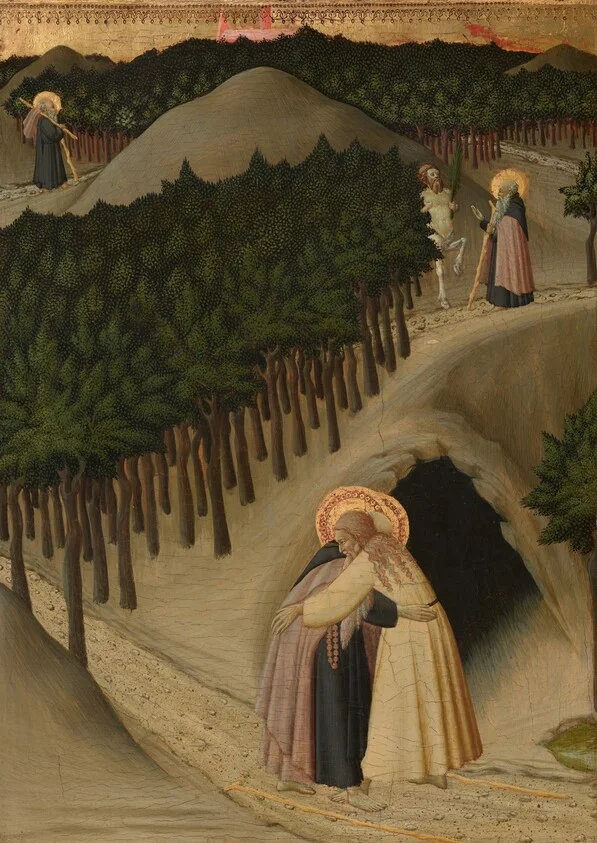
The Master of the Osservanza (active c. 1430-1450) was a Sienese painter known as one of the most important painters of the early Sienese Renaissance, whose devotional panels in the refined, decorative manner of the Sienese tradition make him one of the most distinctive painters of the period. The Meeting of Saint Anthony and Saint Paul from c. 1430/1435 depicts the legendary meeting of the two desert saints in the refined, decorative manner that distinguishes the Master of the Osservanza's best work from the more naturalistic painting of the Florentine Renaissance. The c. 1430/1435 date places this in the Master's most productive period, when he was producing the refined devotional panels that are his most accomplished works.
Cultural Impact
The Meeting of Saint Anthony and Saint Paul is important in the history of Sienese painting because it demonstrates the refined, decorative manner that the Master of the Osservanza brought to devotional subjects as one of the most important painters of the early Sienese Renaissance. The Sienese tradition—emphasizing decorative refinement over the naturalistic observation of the Florentine Renaissance—produced some of the most beautiful devotional panels of the early Renaissance, and the c. 1430/1435 painting shows this tradition at its most refined.
Why It Matters
The Meeting of Saint Anthony and Saint Paul is the Master of the Osservanza's refined Sienese devotional painting: the legendary meeting of desert saints rendered in the decorative manner of one of the most important painters of the early Sienese Renaissance. The c. 1430/1435 panel shows the Sienese tradition emphasizing decorative refinement over Florentine naturalism.