Provenance
Hastings (or Hasting) collection, England.[1] possibly (David M. Koetser Gallery, New York).[2] (Count Alessandro Contini Bonacossi, Florence); sold 26 June 1935 to the Samuel H. Kress Foundation, New York;[3] gift 1939 to NGA.
[1] The bill of sale to the Kress Foundation (see note 3) says the painting was "formerly in the Hasting's[sic] Collection, England." It has not yet been determined which collection this was; see notes in NGA curatorial files.
The Getty Provenance Index Database of the contents of sale catalogues lists a Christie's sale of 24-27 June 1833, held in Bath, England, of the large collection of "John Pura, Esq., deceased" (sale catalogue Br-13849). Lot number 130 of this sale, sold on the second day of the sale to "Rickets," was described as a painting by Tintoretto, "The Worshipping the Molten Calf, -- a grand composition of many figures." As there are no dimensions, further description, or illustration in the catalogue, it is not possible to determine if this was the NGA painting.
[2] See the letter of 27 October 1948, in NGA curatorial files, from Stephen Pichetto, Kress Foundation conservator, to John Walker, then NGA curator, in which Walker wrote that Koetser said he had once owned the painting. Koetser told Walker the painting had been purchased "at Christie's or at Sutherland's in three parts and that there was a fourth part that they did not succeed in acquiring." Walker suggested the fourth part "must have been the trees at the top."
[3] The bill of sale was for seven paintings and a number of decorative art objects (copy in NGA curatorial files). See also The Kress Collection Digital Archive, https://kress.nga.gov/Detail/objects/2357.
Accession Number
1939.1.180
Medium
oil on canvas
Dimensions
overall: 158.8 × 272.2 cm (62 1/2 × 107 3/16 in.) | framed: 187.6 x 300.7 x 12.7 cm (73 7/8 x 118 3/8 x 5 in.)
Classification
Painting
Credit Line
Samuel H. Kress Collection
Tags
Painting Renaissance (1400–1599) Oil Painting Canvas Italian
Background & Context
Background Story
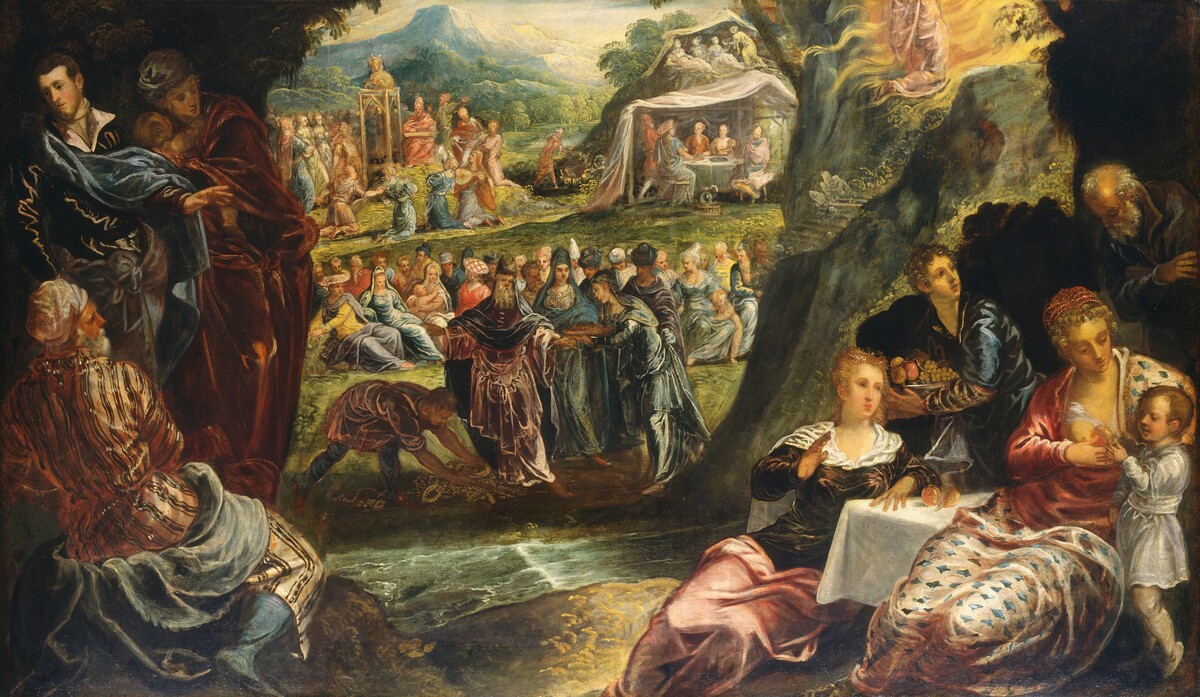
The Worship of the Golden Calf from the Workshop of Jacopo Tintoretto (c. 1594) is a workshop version of one of Tintoretto's most dramatic Old Testament compositions. Jacopo Tintoretto (1518-1594) revolutionized Venetian painting with his dramatic, sweeping compositions and dynamic figures, and the Worship of the Golden Calf was one of his most dramatic subjects, depicting the Israelites worshipping the golden calf while Moses receives the Ten Commandments on Mount Sinai. The c. 1594 date places this in the final year of Tintoretto's life, when the workshop was producing versions of the master's most successful compositions to meet the enormous demand for Tintoretto's dramatic religious subjects.
Cultural Impact
The Worship of the Golden Calf is important in the history of Venetian painting because it demonstrates the workshop system that disseminated Tintoretto's dramatic compositions throughout Venice and beyond. Tintoretto's dramatic, sweeping manner—combining dynamic figures with dramatic lighting in compositions that anticipate the Baroque—was among the most sought-after in late 16th-century Venice, and workshop versions spread this revolutionary approach beyond the master's own hand.
Why It Matters
The Worship of the Golden Calf is a Workshop of Tintoretto version of one of the master's most dramatic Old Testament compositions. The c. 1594 painting shows how Tintoretto's revolutionary dramatic manner—dynamic figures and sweeping compositions—was disseminated through the workshop system in the final year of his life.
![The Crucifixion [left plate]](https://api.nga.gov/iiif/64c85195-4d12-43e3-a94c-3e02761bd65c/full/400,/0/default.jpg)
![The Crucifixion [center plate]](https://api.nga.gov/iiif/8f302ce1-3577-4602-9440-df736f234650/full/400,/0/default.jpg)
![The Crucifixion [right plate]](https://api.nga.gov/iiif/5c3722ec-1372-4986-a17e-1650e7a5c240/full/400,/0/default.jpg)