Provenance
(Italian art market, probably Venice), by 1902.[1] Achillito Chiesa, Milan, early twentieth century;[2] (Count Alessandro Contini Bonacossi, Florence); sold July 1934 to the Samuel H. Kress Foundation, New York;[3] gift 1939 to NGA.
[1] In his article of 1912, Roger Fry reproduces the painting together with another, similarly attributed to the school of Semitecolo, explaining that it was present “some years ago in the market in Italy” (Roger Fry, "Exhibition of Pictures and the Early Venetian School at the Burlington Fine Arts Club," _The Burlington Magazine for Connoisseurs_ 21 [1912]: 47, pl. 2). Fry had probably seen it in October 1902; in fact, in a letter dated 10 October 1902, written to his wife from Venice, he reports, “I’ve had great luck today, managed to get to see some pictures by Semitecolo what I’ve never managed before”; _Letters of Roger Fry_, ed. Denys Sutton, 2 vols., New York, 1972: 1:196.
[2] The collection of Achillito Chiesa, which the great art dealer Luigi Bellini calls the “più importante e intelligente collezione di oggetti d’arte italiana fondata in questi ultimi cinquant’anni in Italia” ("the most important, and intelligent, collection of Italian art objects formed in Italy within the last fifty years") (Luigi Bellini, _Nel mondo degli antiquari_, Florence, 1947: 223–224), was dispersed between 1925 and 1931 because of the collector’s financial difficulties; see Elisabeth E. Gardner, _A Bibliographical Repertory of Italian Private Collections_, 3 vols., ed. Chiara Ceschi and Katharine Baetjer, Vicenza, 1998: 1:227-228.
[3] The bill of sale is dated 13 July 1934 (copy in NGA curatorial files). See also The Kress Collection Digital Archive, https://kress.nga.gov/Detail/objects/2114.
Accession Number
1939.1.143
Medium
tempera on panel
Dimensions
painted surface: 31 x 38 cm (12 3/16 x 14 15/16 in.) | overall: 33.85 x 41.1 cm (13 5/16 x 16 3/16 in.) | framed: 37.2 x 45.4 x 5.7 cm (14 5/8 x 17 7/8 x 2 1/4 in.)
Classification
Painting
Credit Line
Samuel H. Kress Collection
Tags
Painting Medieval (500–1399) Tempera Panel Painting Italian
Background & Context
Background Story
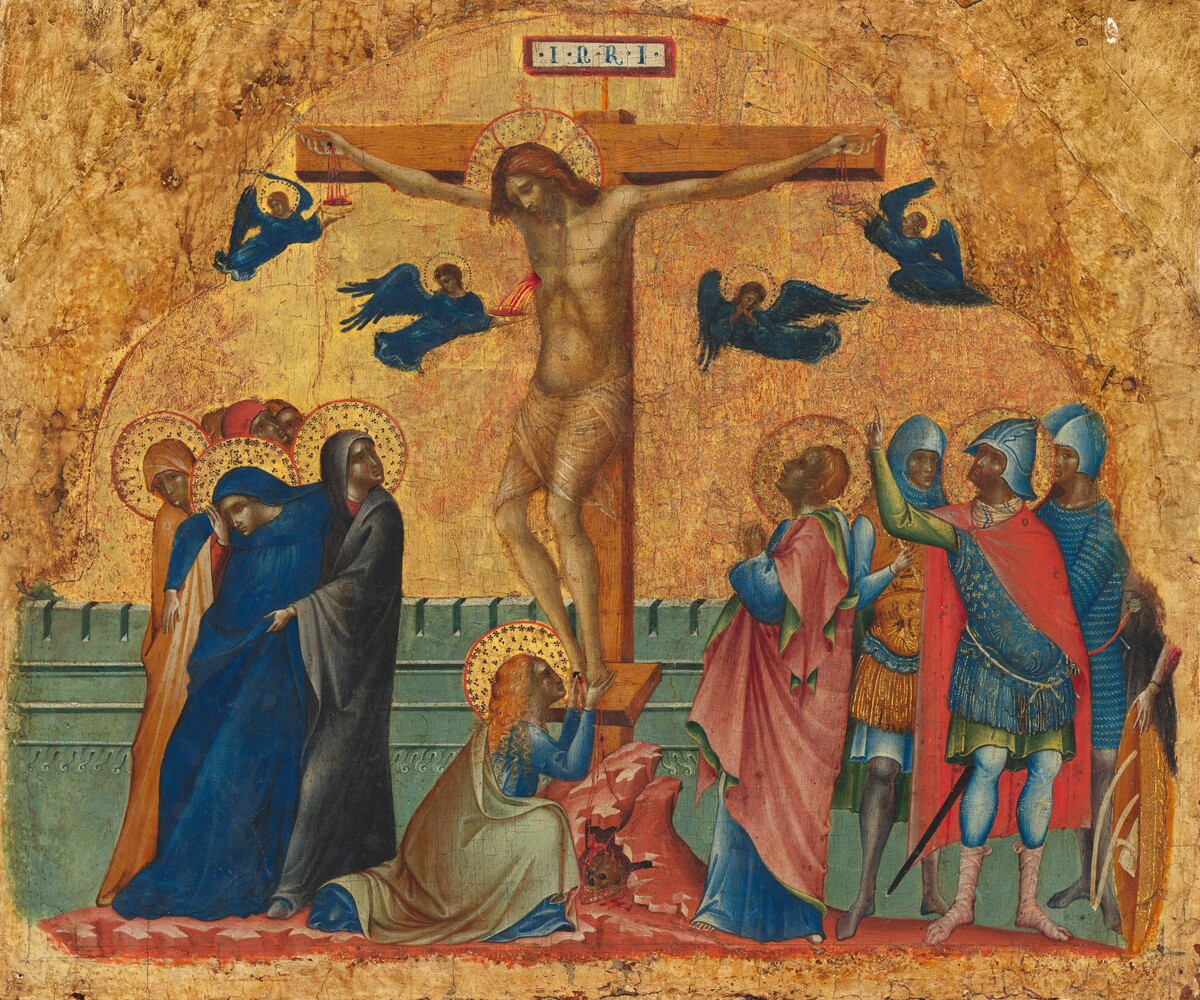
Paolo Veneziano (active 1333-1362) was the leading painter of 14th-century Venice, known for the Byzantine-influenced style that defines Venetian painting before the Renaissance. The Crucifixion from c. 1340-45 depicts the biblical subject in the gold ground and hieratic manner of the Byzantine tradition, with the tempera and gold on panel medium that was standard for Venetian painting before the adoption of oil. The c. 1340-45 date places this in Paolo's mature period, when he was producing the altarpieces that established the Venetian painting tradition that would eventually lead to Bellini and the Venetian Renaissance.
Cultural Impact
The Crucifixion is important in the history of Venetian painting because it demonstrates the Byzantine-influenced style that defines Venetian painting before the Renaissance. Paolo Veneziano's gold ground and hieratic figures represent the tradition from which Bellini and the Venetian Renaissance would emerge, and the painting shows the Byzantine tradition at its most accomplished in Venice—the gold ground, the hieratic figures, and the tempera and gold on panel medium that would give way to oil painting in the 15th century.
Why It Matters
The Crucifixion is Paolo Veneziano's Byzantine Venice at its most accomplished: gold ground, hieratic figures, and tempera and gold on panel in the Byzantine-influenced style that defines Venetian painting before the Renaissance. The c. 1340-45 altarpiece shows the tradition from which Bellini and the Venetian Renaissance would eventually emerge.

![Saint Bernard and Saint Catherine of Alexandria with the Virgin of the Annunciation [right panel]](https://api.nga.gov/iiif/e6890364-4d99-4684-a62b-5060ee3c3446/full/400,/0/default.jpg)