Provenance
Possibly Contessa Giustiniani, Genoa;[1] (Count Alessandro Contini Bonacossi, Rome); sold July 1930 to the Samuel H. Kress Foundation, New York;[2] gift 1939 to NGA.
[1] Of the members of various branches of the Giustiniani family in Genoa in 1930, Vincenzo, Paolo, and Giovanni Battista are recorded as having the title of _Conte_ (see Vittorio Spreti, _Enciclopedia storico-nobiliare italiana_, Milan, 1930: 3:497). Presumably the collection that included the NGA painting belonged to one of them and was a recently formed one. Fern Rusk Shapley (_Paintings from the Samuel H. Kress Collection: Italian Schools XVI-XVIII Century_, London, 1973: 429) lists in the index of former owners five paintings that passed from Contessa Giustiniani through Contini Bonacossi to the Kress Collection in 1930. (The bill of sale that includes these paintings [see following note] lists two others that are also referred to on the bill as "from the Collection of Countess Giustiniani, Genoa," although they are indexed in Shapley under Max Bondi and not Giustiniani.) Two of the five paintings indexed under the Giustiniani name appear to have been on the market just a few years before they passed to the Kress Collection: the _Virgin and Child with Saints_, attributed to the Master of San Lucchese (attributed to Jacopo di Cione by Shapley and to Giottino on the bill of sale), which now belongs to the De Young Memorial Museum in San Francisco (no. 61-44-2), was sold with other paintings of the Max Bondi collection (including the two mentioned above that Shapley indexes under Bondi) only in 1929 (Milan, Galleria Lurati, 9-20 December, no. 44); and the _Sleeping Girl_ by Giuseppe Angeli (listed as by Giovanni Piazzetta on the bill), now in the Chazen Musem of Art, University of Wisconsin-Madison, no. 61.4.2, was still exhibited in 1925 in Berlin as part of the Grabowsky collection (Kaiser-Friedrich-Museum Verein, _Gemälde Alter Meister aus berliner Besitz_, June-August 1925, Berlin, no. 229).
[2] The bill of sale for several paintings, including the NGA 1939.1.45, is dated 15 July 1930 (copy in NGA curatorial files); see also The Kress Collection Digital Archive, https://kress.nga.gov/Detail/objects/2113.
Accession Number
1939.1.45
Medium
tempera on poplar panel
Dimensions
overall: 24.1 x 33.6 cm (9 1/2 x 13 1/4 in.) | framed: 33 x 44.1 x 4.3 cm (13 x 17 3/8 x 1 11/16 in.)
Classification
Painting
Credit Line
Samuel H. Kress Collection
Tags
Painting Renaissance (1400–1599) Tempera Panel Painting Italian
Background & Context
Background Story
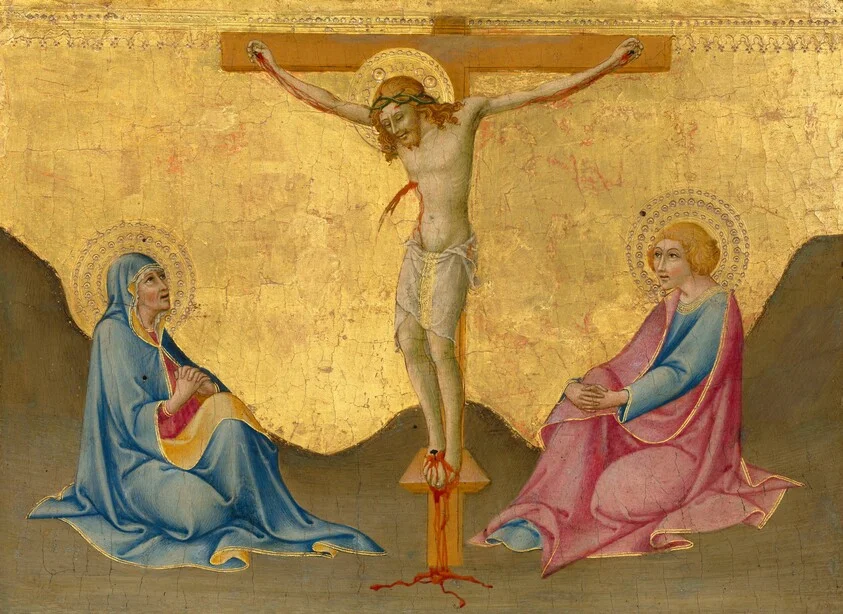
Sano di Pietro (1406-1481) was a Sienese painter known for his devotional paintings in the International Gothic style that defines the Sienese tradition at its most refined. The Crucifixion from c. 1445-50 depicts the biblical subject in the gold ground, elegant line, and refined color that distinguish Sienese painting from the more monumental Florentine tradition. The c. 1445-50 date places this in Sano di Pietro's mature period, when he was producing the devotional paintings that are among the most refined examples of the Sienese tradition, and the Crucifixion subject allows him to exercise his talent for combining devotional intensity with the decorative elegance that defines Sienese painting.
Cultural Impact
The Crucifixion is important in the history of Sienese painting because it demonstrates the International Gothic style that defines the Sienese tradition at its most refined. Sano di Pietro's gold ground, elegant line, and refined color represent the Sienese tradition that maintained its distinctive character throughout the 15th century, and the painting shows the devotional intensity combined with decorative elegance that distinguishes Sienese painting from the more monumental Florentine tradition.
Why It Matters
The Crucifixion is Sano di Pietro's Sienese refinement: gold ground, elegant line, and refined color in the International Gothic style that defines the Sienese tradition. The c. 1445-50 painting combines devotional intensity with the decorative elegance that distinguishes Sienese painting from the more monumental Florentine tradition.