Provenance
This panel, along with NGA 1939.1.41 and 1939.1.43, are stated to have come from the collection of a contessa Giustiniani, Genoa;[1] (Count Alessandro Contini Bonacossi, Rome); sold July 1930 to the Samuel H. Kress Foundation, New York;[2] gift 1939 to NGA.
[1] See the bill of sale described in note 2. No documented collection of the conti Giustiniani at Genoa seems to have existed, at least in the early years of the twentieth century. The works that Elisabeth Gardner (_ A Bibliographical Repertory of Italian Private Collections_, ed. Chiara Ceschi and Katharine Baetjer, 4 vols., Vicenza, 1998-2011: 2(2002):183) cites as formerly the property of the contessa Giustiniani almost all seem to have been purchased on the art market shortly before 1930, when Contini Bonacossi sold them to Samuel H. Kress. The contessa is thus more likely to have been a dealer, or agent, than a collector. See also Miklós Boskovits and David Alan Brown, _Italian Paintings of the Fifteenth Century_, National Gallery of Art Systematic Catalogue, Washington and New York, 2003: 616 n. 3.
[2] The painting is included on a bill of sale dated 15 July 1930 that included eight paintings from the Giustiniani collection (copy in NGA curatorial files); see also The Kress Collection Digital Archive, https://kress.nga.gov/Detail/objects/2260.
Accession Number
1939.1.42
Medium
tempera on poplar panel
Dimensions
painted surface: 44.2 × 32.5 cm (17 3/8 × 12 13/16 in.) | overall: 46.7 × 33.9 × 0.6 cm (18 3/8 × 13 3/8 × 1/4 in.) | framed: 48.3 x 36.8 x 4.1 cm (19 x 14 1/2 x 1 5/8 in.)
Classification
Painting
Credit Line
Samuel H. Kress Collection
Tags
Painting Renaissance (1400–1599) Tempera Panel Painting Italian
Background & Context
Background Story
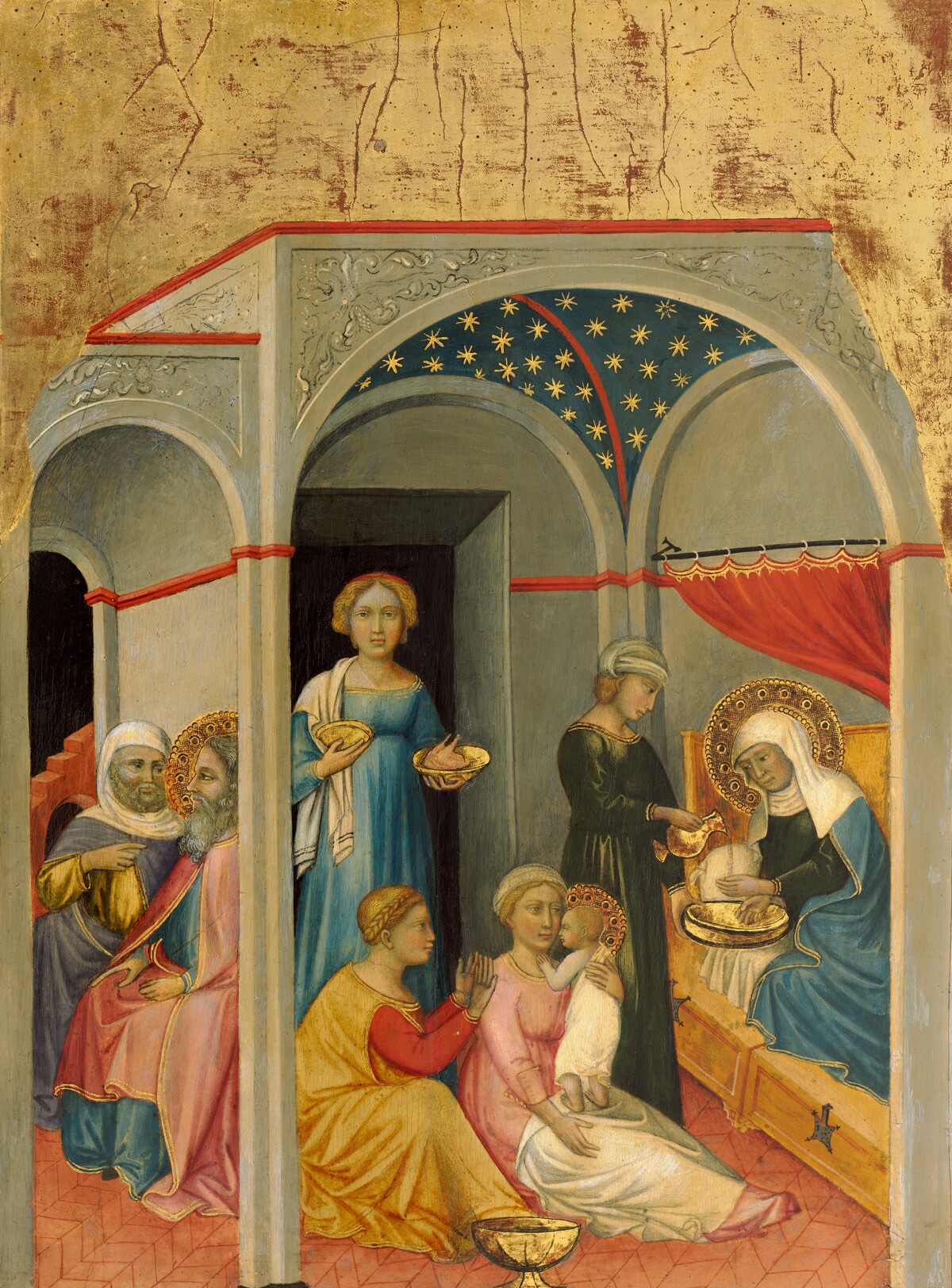
The Nativity of the Virgin from c. 1400-1405 depicts the birth of the Virgin Mary, a subject that was particularly important in Sienese painting because Siena was dedicated to the Virgin and claimed her special protection. Andrea di Bartolo's treatment follows the Sienese nativity tradition established by his father Bartolo di Fredi and earlier masters like Duccio: the scene is organized in a shallow architectural setting that emphasizes the narrative clarity of the event, and the figures are rendered with the elegant drapery and refined gestures that distinguish the Sienese Gothic style from the more monumental Florentine tradition.
Cultural Impact
The Nativity of the Virgin was one of the most important subjects in Sienese painting because it celebrated the birth of the city's patron saint. Andrea di Bartolo's version participates in a tradition that includes some of the greatest Sienese paintings, and its narrative clarity and decorative elegance demonstrate the continuity of the Sienese Gothic style at the turn of the 15th century—a moment when Florentine painters were developing the new Renaissance style that would eventually eclipse it.
Why It Matters
The Nativity of the Virgin is Sienese devotion in paint: the birth of the city's patron saint rendered with the narrative clarity and decorative elegance of the Sienese Gothic tradition. The c. 1400-05 date places this at the moment when the Sienese Gothic style was at its peak of refinement, just before the Florentine Renaissance style began to challenge its dominance.
![Madonna of Humility, The Blessing Christ, Two Angels, and a Donor [obverse]](https://api.nga.gov/iiif/f38ca59b-b629-4268-bf64-f5d089c8cf06/full/400,/0/default.jpg)
![Christ on the Cross [reverse]](https://api.nga.gov/iiif/ba6cc0b7-8f4a-481d-9da5-f6347181902c/full/400,/0/default.jpg)