Provenance
The Dowager Countess of Norfolk;[1] (Christie, Manson & Woods, London, 20 November 1925, no. 69); bought by (William Sabin, London);[2] sold presumably by him to (Count Alessandro Contini Bonacossi, Rome); purchased October 1927 by Samuel H. Kress [1863-1955], New York;[3] gift 1939 to NGA.
[1] Oral communication from Charles Beddington, Christie's, 17 March 1993.
[2] _Art Prices Current_, n.s. 5 (1925-1926): 29, no. 618.
[3] The bill of sale for sculpture, maiolica, furniture, antique velvet, and several paintings, including NGA 1939.1.24, is dated 5 October 1927 (copy in NGA curatorial files. See also The Kress Collection Digital Archive, https://kress.nga.gov/Detail/objects/1109). The Panini was the first non-Renaissance Italian painting acquired by Kress (see Edgar Peters Bowron, "The Kress Brothers and Their 'Bucolic Pictures': The Creation of an Italian Baroque Collection", in _A Gift to America: Masterpieces of European Painting from the Samuel H. Kress Collection_, Exh. cat. North Carolina Museum of Art, Raleigh, 1994: 43, fig. 2).
Accession Number
1939.1.24
Medium
oil on canvas
Dimensions
overall: 128 x 99 cm (50 3/8 x 39 in.) | framed: 144.1 x 114.3 cm (56 3/4 x 45 in.)
Classification
Painting
Credit Line
Samuel H. Kress Collection
Tags
Painting Baroque (1600–1750) Oil Painting Canvas Italian
Background & Context
Background Story
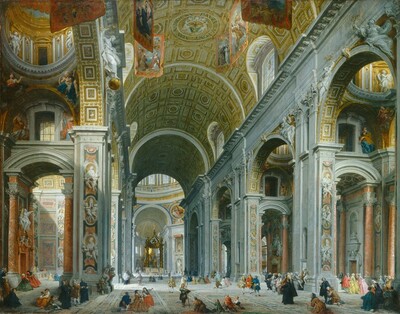
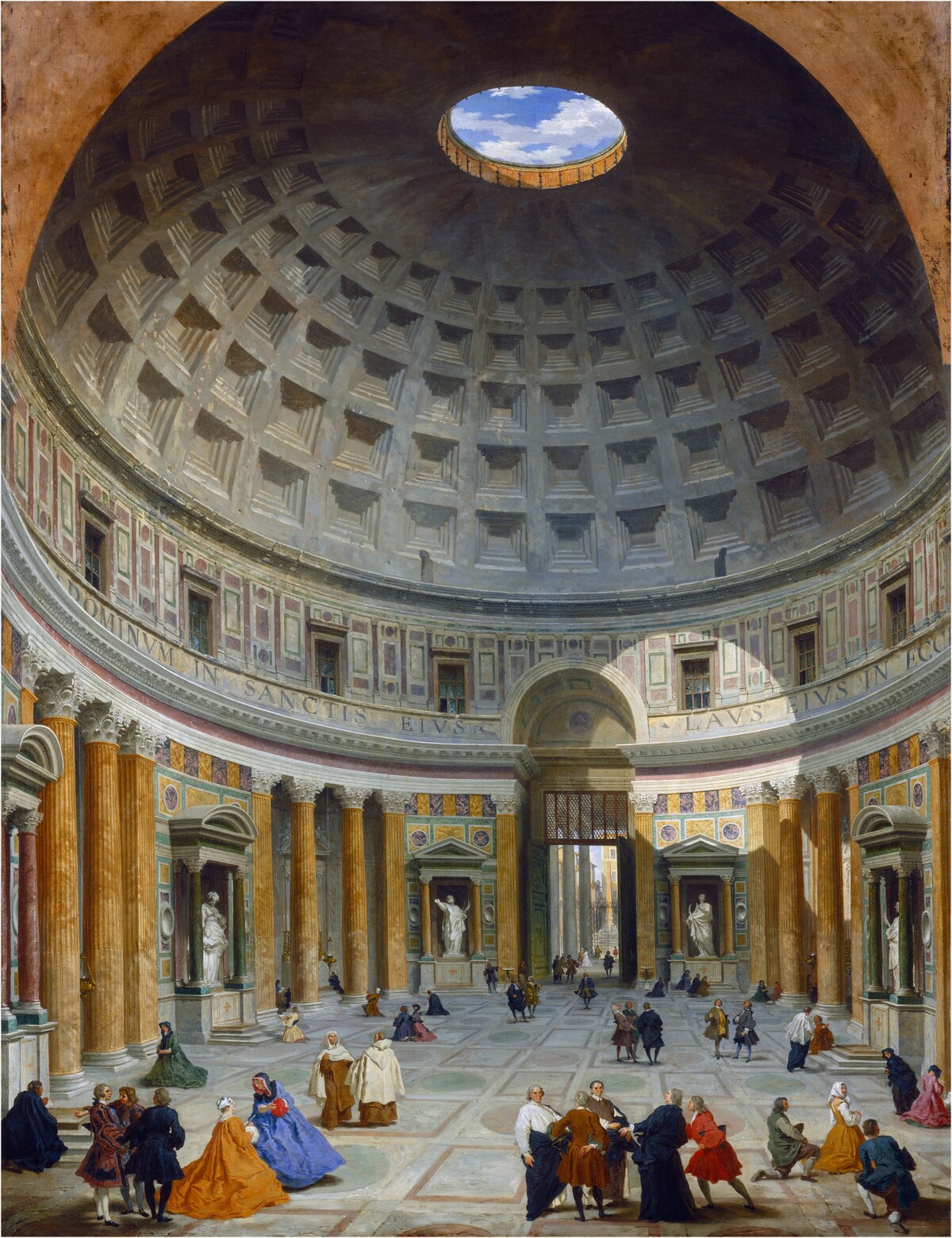
Giovanni Paolo Panini (1691-1765) was an Italian painter known for his vedute (view paintings) of Rome, particularly his interiors of Roman churches and his picture galleries that combine multiple paintings within a single composition. Interior of the Pantheon, Rome from c. 1734 depicts the interior of the Pantheon—the ancient Roman temple converted to a Christian church—with the precise architectural rendering and atmospheric lighting that distinguish Panini's best church interiors. The c. 1734 date places this in Panini's most productive period, when he was producing the Roman vedute that made him one of the most popular painters for Grand Tour visitors to Rome.
Cultural Impact
Panini's Pantheon interiors are among the most important vedute of 18th-century Rome because they record the appearance of one of the most famous buildings in the world with the precise architectural rendering that Grand Tour visitors expected. Interior of the Pantheon demonstrates Panini's ability to combine architectural precision with atmospheric lighting, creating a painting that is both a visual document of one of Rome's most important buildings and a work of art that satisfies the aesthetic expectations of his aristocratic patrons.
Why It Matters
Interior of the Pantheon is Panini's vedute at their most architecturally precise: the interior of Rome's most famous ancient building rendered with the precise rendering and atmospheric lighting that Grand Tour visitors expected. The c. 1734 painting combines architectural documentation with the aesthetic satisfaction that made Panini one of the most popular painters for visitors to Rome.