Provenance
Craufurd Tait, Edinburgh [d. 1832], the sitter's only son; by descent through John Tait [d. 1877], the child in the portrait, to Mrs. Frederick Pitman, née Tait, Edinburgh, by 1901; her eldest son, Archibald Robert Craufurd Pitman, Edinburgh; sold October 1918 to (Robert Langton Douglas, London and New York);[1] purchased February 1919 by Andrew W. Mellon, Pittsburgh and Washington, D.C.; [2] deeded December 1934 to The A.W. Mellon Educational and Charitable Trust, Pittsburgh; gift 1937 to NGA.
[1] John S. Pitman (Archibald Pitman's brother), undated letter to Langton Douglas, in NGA curatorial files. See letter from Douglas to Fowles dated 1 May 1941, Duveen Brothers Records, Box 244 (reel 299).
[2] M. Knoedler & Co. stock books (Helmut Ripperger to Ross Watson, 28 September 1969, in NGA curatorial files).
Accession Number
1937.1.103
Medium
oil on canvas
Dimensions
overall: 126 x 100 cm (49 5/8 x 39 3/8 in.)
Classification
Painting
Credit Line
Andrew W. Mellon Collection
Tags
Painting Neoclassical & Romantic (1751–1850) Oil Painting Canvas Scottish
Background & Context
Background Story
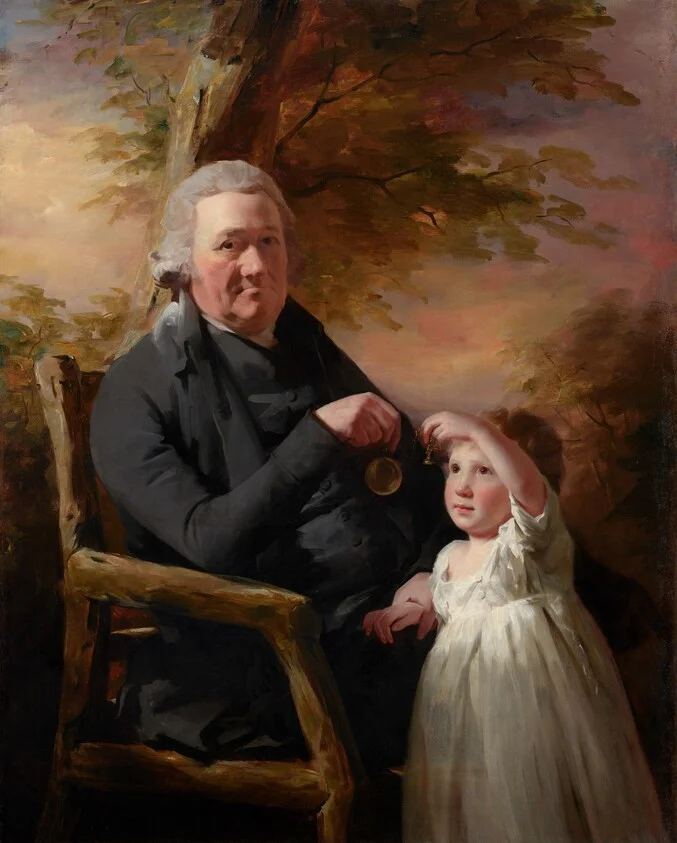
John Tait and His Grandson is one of Raeburn's most beloved double portraits, depicting an elderly man and his grandson in a composition that conveys the warmth of their relationship through pose and gesture rather than through the sentimental treatment that a lesser painter would have applied. The grandfather sits with the child standing beside him, their hands linked in a gesture of affection that is both natural and touching. The additions from around 1800 suggest that Raeburn returned to the painting to modify it—possibly enlarging the child, who may have grown between the initial sittings and the final version.
Cultural Impact
Double portraits of grandparents and grandchildren were common in the 18th century because they served both a personal and a dynastic function: they documented the continuity of the family across generations while celebrating the bond between the oldest and youngest members. Raeburn's version is distinguished by its refusal of sentimentality—the relationship is conveyed through natural gesture rather than emotional display, and the grandfather's face shows the same honest observation that Raeburn brought to all his portraits.
Why It Matters
John Tait and His Grandson is Raeburn's family portraiture at its most warmly observed: an elderly man and a child linked by hands and affection, rendered with the same honest observation that distinguishes his individual portraits. The additions from 1800 show Raeburn returning to the painting to adjust the relationship—the portrait was a living document, not a fixed record.