Provenance
Painted for the sitter's father,[1] William Urquhart, 2nd Laird of Craigston, Craigston Castle, Turriff, Aberdeenshire [Scotland]; by descent to Captain Michael Bruce Pollard-Urquhart [1879-1940], Craigston Castle and Castle Pollard; (sale, Christie, Manson & Woods, London, 20 December 1918, no. 144); bought by (Arthur J. Sulley & Co., London). (M. Knoedler & Co., London), probably from whose New York branch it was purchased 5 October 1920 by Andrew W. Mellon, Pittsburgh and Washington, D.C.; deeded December 1934 to The A.W. Mellon Educational and Charitable Trust, Pittsburgh; gift 1937 to NGA.
[1] Painting executed c. 1793; receipt dated January 1794.
Accession Number
1937.1.101
Medium
oil on canvas
Dimensions
overall: 75 x 62 cm (29 1/2 x 24 7/16 in.) | framed: 101.6 x 90.2 x 12.7 cm (40 x 35 1/2 x 5 in.)
Classification
Painting
Credit Line
Andrew W. Mellon Collection
Tags
Painting Neoclassical & Romantic (1751–1850) Oil Painting Canvas Scottish
Background & Context
Background Story
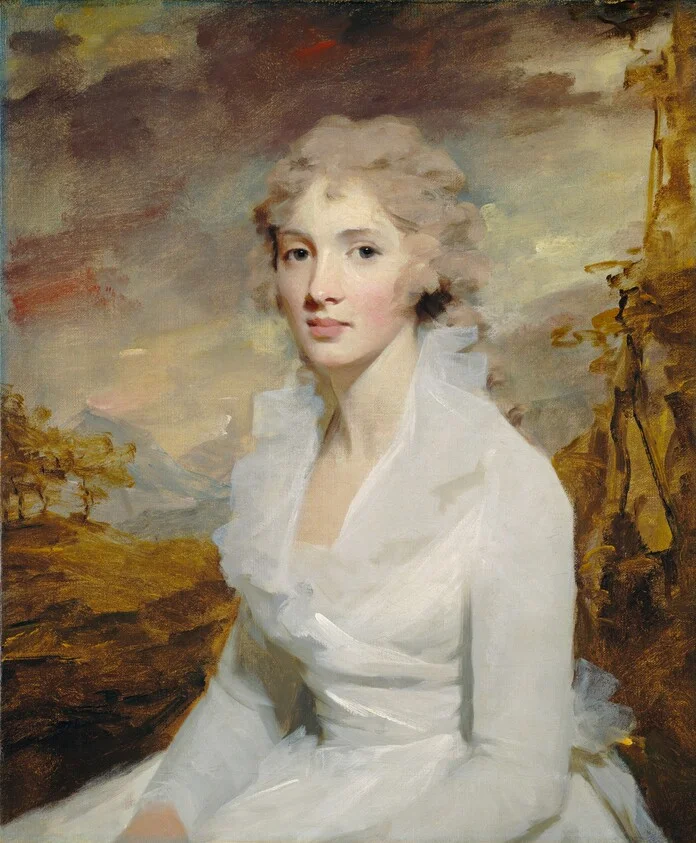
Miss Eleanor Urquhart is one of Raeburn's most charming female portraits, depicting a young woman with the direct gaze and relaxed pose that distinguish his best work. The c. 1793 date places this in Raeburn's most productive period, when he was painting the Scottish aristocracy and bourgeoisie with a frankness and vigor that set his portraits apart from the more conventionally flattering work of his English contemporaries. Miss Urquhart's expression is alert, intelligent, and slightly amused—the kind of characterization that suggests Raeburn found his sitter's personality as interesting as her appearance.
Cultural Impact
Raeburn's female portraits are notable for their refusal to idealize or flatter in the manner that was expected of portrait painters. Where English portraitists like Reynolds and Gainsborough idealized their female sitters according to conventional standards of beauty, Raeburn painted them as individuals with specific personalities. Miss Urquhart's direct gaze and relaxed pose suggest a woman who is comfortable being looked at but not defined by the viewer's gaze.
Why It Matters
Miss Eleanor Urquhart is Raeburn's portraiture at its most perceptive: a young woman painted as an individual rather than an ideal, with a direct gaze and relaxed pose that suggest intelligence and self-possession. The portrait proves that Raeburn could paint women with the_same honest observation he brought to men.