Provenance
Ugo Bardini, Paris; sold 1925 to (Thomas Agnew & Sons, Ltd., London); sold 1925 to (Arthur J. Sulley & Co., London).[1] Otto H. Kahn [1867-1934, Mogmar Art Foundation], New York, by 1927; (Duveen Brothers, Inc., London and New York); purchased 26 April 1937 by The A.W. Mellon Educational and Charitable Trust, Pittsburgh;[2] gift 1937 to NGA.
[1] Ugo Bardini was the son of the dealer Stefano Bardini, Florence (1836-1922); it is possible that the painting had been owned by the father. The painting is listed in Agnew's stock book, no. 6494, as "Mantegna, St. Jerome," no dimensions, with seller and purchaser (reference provided by the Getty Provenance Index). Alfred M. Frankfurter, "Paintings by Andrea Mantegna in America," _The Antiquarian_ 13, no. 4 (November 1929): 88, states that the painting "came to America from a moderately well known English collection."
[2] Kahn is identified as the owner in the following: Lionello Venturi, "Un opera inedita di Andrea Mantegna," _L'Arte_ 30 (1927): 32; Alfred M. Frankfurter, "Paintings by Andrea Mantegna in America," _Antiquarian_ 13, no. 4 (November 1929): 33; Lionello Venturi, _Pitture italiane in America_, Milan, 1931: 9, and English ed., New York, 1933: 31; Bernard Berenson, _Italian Pictures of the Renaissance_, Oxford, 1932: 328, and Italian ed., Milan, 1936: 291); Roberto Longhi, "Risarcimento di un Mantegna," _Pan_ II, no. 3 (March 1934): 512; Hans Tietze, _Meisterwerke europäischer Malerei in Amerika_, Vienna, 1935: 327, and English ed., 1939: 311. The Duveen prospectus states that the painting, then said to be by Mantegna, was "discovered in an English private collection in 1927, when it was acquired by...Kahn...in whose collection it remained until 1936" (copy in NGA curatorial files). However, letters in the Duveen Brothers Records indicate the painting was not purchased from the Mogmar Art Foundation until 14 April 1937, and that payment was made to the Foundation on April 28, just after Duveen Brothers sold the painting to the Mellon Trust (copies in NGA curatorial files; Box 473, Folder 1, Duveen Brothers Records, accession number 960015, Research Library, The Getty Research Institute, Los Angeles).
Accession Number
1937.1.32
Medium
tempera on poplar panel
Dimensions
painted surface: 78.4 x 53 cm (30 7/8 x 20 7/8 in.) | support: 80.7 x 55 cm (31 3/4 x 21 5/8 in.) | framed: 102.6 x 76.2 cm (40 3/8 x 30 in.)
Classification
Painting
Credit Line
Andrew W. Mellon Collection
Tags
Painting Renaissance (1400–1599) Tempera Panel Painting
Background & Context
Background Story
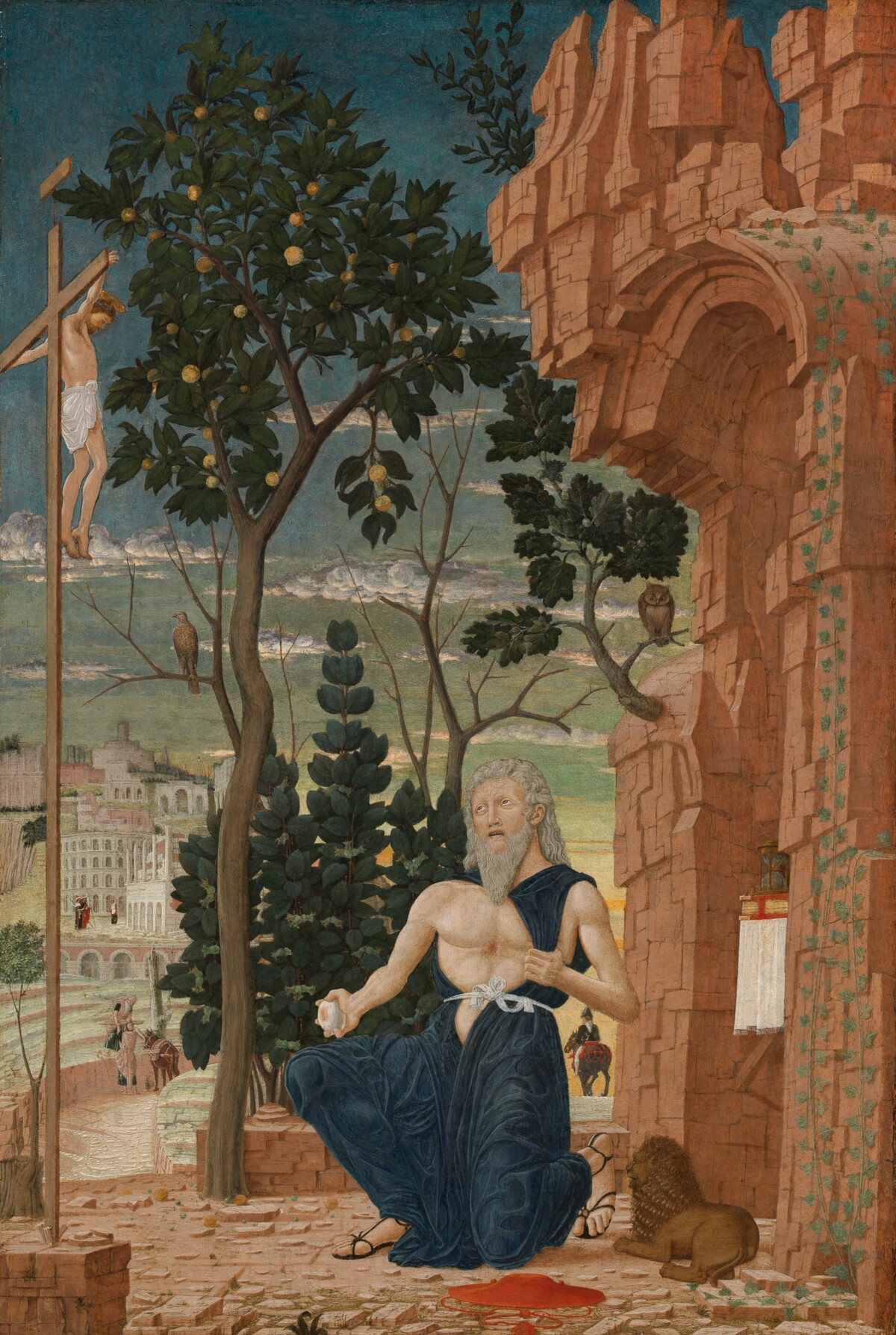
This painting of Saint Jerome in the Wilderness is attributed to a Follower of Andrea Mantegna (c. 1431-1506), the Italian painter known for the precisely observed, sculptural manner that makes him one of the most important painters of the early Italian Renaissance. Saint Jerome in the wilderness was a popular subject in the early Renaissance, representing the saint's penitential retreat from civilization, and Mantegna produced several versions of the subject in his precisely observed, sculptural manner. The c. 1475 date places this in the period when Mantegna's style was at its most influential in Northern Italy, and the follower's version demonstrates how Mantegna's precisely observed, sculptural manner was adopted and adapted by his followers.
Cultural Impact
Saint Jerome in the Wilderness is important in the history of Italian Renaissance painting because it demonstrates how Mantegna's precisely observed, sculptural manner was adopted and adapted by his followers in Northern Italy. Mantegna's manner—combining precise observation of nature with the sculptural treatment of figures that is his most distinctive contribution—was enormously influential in Northern Italy, and the c. 1475 painting shows how this manner was adopted by followers who helped spread Mantegna's influence.
Why It Matters
Saint Jerome in the Wilderness by a Follower of Mantegna: the penitential saint rendered in the precisely observed, sculptural manner of one of the most important painters of the early Italian Renaissance. The c. 1475 painting shows how Mantegna's distinctive manner was adopted and adapted by his followers in Northern Italy.