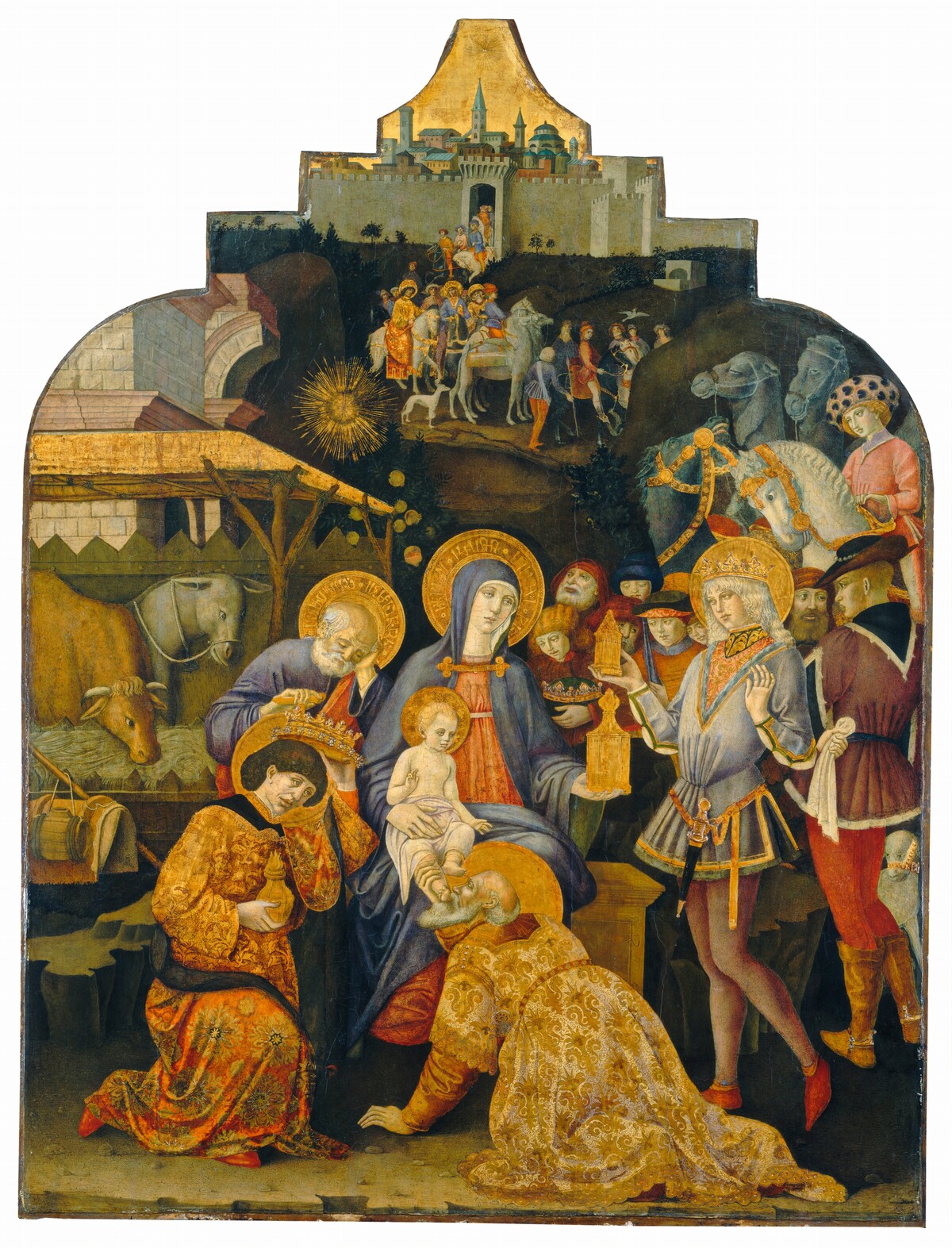
Provenance
Giuseppe Toscanelli [1828-1891], Pontedera and Pisa;[1] (Toscanelli sale, Sambon, Florence, 23 April 1883, no. 137, as by Gentile da Fabriano); Sir William Neville Abdy, 2nd bt. [1844-1910], The Elms, Newdigate, Dorking; by inheritance to his daughter, Florence, Lady Abdy [d. 1922], Dorking and London; (her sale, Christie, Manson & Woods, London, 5 May 1911, no. 139, as by Gentile da Fabriano); (Wallis & Son, London).[2] (Charles Sedelmeyer, Paris), by 1913;[3] sold August 1919 to (Duveen Brothers, Inc., London and New York);[4] on approval to Carl W. Hamilton [1886-1967], New York, by 1920, and returned 1921;[5] purchased 15 December 1936 by The A.W. Mellon Educational and Charitable Trust, Pittsburgh;[6] gift 1937 to NGA.
[1] In his _Elogio del pittore Gentile da Fabriano_ (Macerata, 1829: 21-23), Amico Ricci describes an _Adoration of the Magi_ at that time in possession of a certain Captain Craglietto of Venice, attributing it to Gentile da Fabriano. That work subsequently became part of the collections of the Gemäldegalerie in Berlin (no. 5), where Crowe and Cavalcaselle saw it and assigned it to Antonio Vivarini (Sir Joseph Archer Crowe, and Giovanni Battista Cavalcaselle, _A New History of Painting in Italy, from the Second to the Sixteenth Century_, 3 vols., London, 1864-1866: 3[1866]:99). Gaetano Milanesi, who is his edition of Vasari's _Lives_ (Vasari, ed. Milanesi, 1878: 3:21) limits himself to reporting Ricci's attribution, in the catalogue of the Toscanelli collection expresses the doubt that the painting later in Berlin was the same as the Craglietto _Adoration_, and implies that the panel described by Ricci was actually the one in the Toscanelli collection. Although the Berlin catalogues point out that their _Adoration_ was acquired directly from the heirs of Gaspare Craglietto, the erroneous provenance suggested by Milanesi for the ex-Toscanelli panel was picked up by Salomon Reinach (_Répertoire de Peintures de Moyen Age et de la Renaissance_, 6 vols., Paris, 1905-1923: 1[905]:72), and subsequently by Fern Rusk Shapley (_Catalogue of the Italian Paintings_, 2 vols., Washington, D.C., 1979: 1:64). It is possible that the painting was acquired only after 1878, as at this time Milanesi apparently did not yet know it.
[2] See F., "Stattgehabte Auktionen. Die Abdy Auktion," _Der Cicerone_ 3 (1911): 401.
[3] See Galerie Sedelmeyer [Charles Sedelmeyer], _Illustrated Catalogue of the Twelfth Series of 100 Paintings by Old Masters of the Dutch, Flemish, Italian, French, and English Schools, Being a Portion of the Sedelmeyer Gallery_, Paris, 1913: 60.
[4] The Duveen Brothers Records also list a commission paid to Dr. Sirén (copy in NGA curatorial files; X Book, Reel 422, Duveen Brothers Records, accession number 960015, Research Library, The Getty Research Institute, Los Angeles).
[5] According to Colin Simpson, _Artful Partners: Bernard Berenson and Joseph Duveen_, New York, 1986: 196-198, the painting was acquired by Hamilton from Duveen's Paris stock in 1919-1920. Edward Fowles (_Memories of the Duveen Brothers_, London, 1976: 127-129) discusses Hamilton and the large collection of Italian paintings that Duveen offered to him on approval. However, Hamilton did not purchase them and returned them to Duveen the following year.
[6] The original Duveen Brothers invoice is in Gallery Archives, copy in NGA curatorial files.
Accession Number
1937.1.10
Medium
tempera on poplar panel
Dimensions
overall: 182 x 137 cm (71 5/8 x 53 15/16 in.) | framed: 207.7 x 150.5 x 11.4 cm (81 3/4 x 59 1/4 x 4 1/2 in.)
Classification
Painting
Credit Line
Andrew W. Mellon Collection