Accession Number
2008.34.1
Medium
oil on linen
Dimensions
overall: 365.8 x 236.2 cm (144 x 93 in.)
Classification
Painting
Credit Line
Gift of the Collectors Committee
Tags
Painting Contemporary (after 1950) Oil Painting American
Background & Context
Background Story
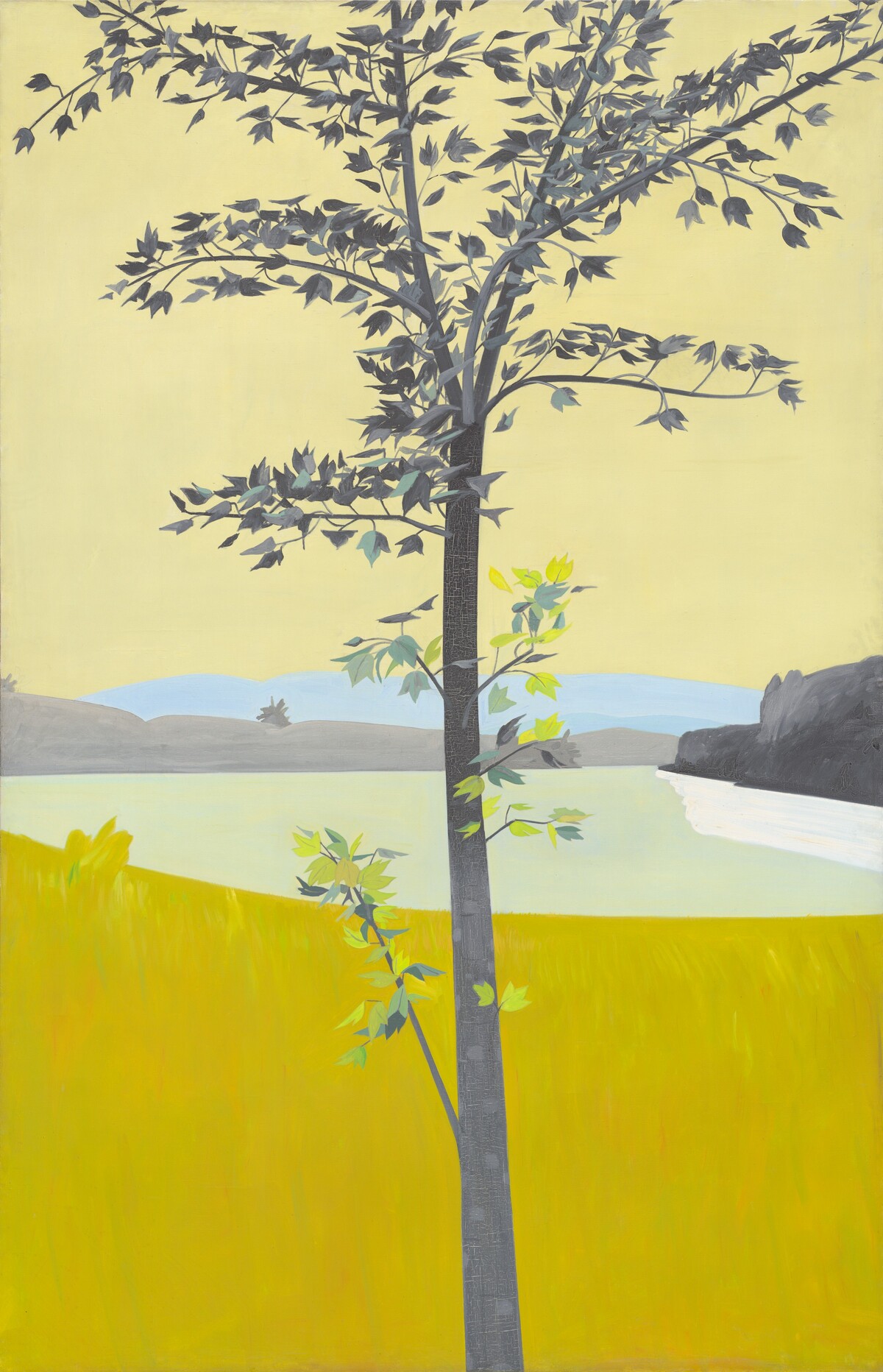
Alex Katz's "Swamp Maple (4:30)" (1968) is a landmark work in the development of contemporary landscape painting. Measuring 6 by 12 feet, this panoramic canvas captures a stand of swamp maples in the forests of Lincolnville, Maine — where Katz has spent summers since 1954 — rendered in the bold, flat color and simplified forms that have become his instantly recognizable signature.
The parenthetical "4:30" in the title is significant: Katz has always insisted that his landscapes are not generalized impressions but precise records of specific moments. The particular quality of late-afternoon light at 4:30 on a specific day — the warm glow on the turning leaves, the deepening shadows in the gaps between trunks, the particular angle of the sun — is what the painting aims to capture, not an idealized or composite impression of autumn foliage.
Katz (born 1927) emerged in the 1950s as an independent figure — too cool and reductive for the Abstract Expressionists, too figurative for the Minimalists, too flat for the representational painters. His work exists in a category of its own, combining the scale and ambition of Abstract Expressionism with the immediacy of observation and the graphic boldness of commercial art. His landscapes, which he began painting seriously in the late 1950s, apply the same principles as his portraits: extreme simplification of form, elimination of visible brushwork, and a chromatic intensity that pushes toward the condition of pure color.
"Swamp Maple" demonstrates this approach at its most immersive. The painting's enormous scale is crucial — it is designed to surround the viewer, eliminating peripheral vision and creating the sensation of standing inside the landscape rather than looking at it. The individual tree trunks and autumn leaves are simplified to flat shapes of color, yet the cumulative effect is uncannily real: the viewer feels the cool autumn air, the rustle of dry leaves, the particular quality of late-afternoon light that Katz has frozen in time. This paradox — that radical simplification can produce a more intense experience of reality than meticulous detail — is the central discovery of Katz's art, and it connects him to both the Impressionist tradition of perceptual painting and the Pop Art sensibility of the 1960s.
Cultural Impact
Katz's fusion of Abstract Expressionist scale, Pop Art graphic clarity, and plein-air observation created a new kind of landscape painting that influenced artists from David Hockney to the contemporary New Figuration movement.
Why It Matters
"Swamp Maple (4:30)" captures a specific moment of autumn light with monumental scale and radical simplicity — a landscape that is simultaneously abstract in technique and overwhelmingly real in sensation.