Provenance
Commissioned by the sitter's parents, The Reverend and Mrs. George Alexander Strong, Boston; by inheritance to their daughter, the sitter, Margaret Wendell Strong Withers [1892-1973] and her husband, Captain Clarke Withers [d. 1983], Massachusetts and St. Michael's, Maryland; by bequest 1983 to Captain Wither's first cousin once removed, Elizabeth Clarke Hayes [Mrs. Francis W. Hayes], St. Michael's, Maryland; gift 1992 to NGA.
Accession Number
1992.66.1
Medium
oil on canvas
Dimensions
overall: 76.8 x 64.2 cm (30 1/4 x 25 1/4 in.) | framed: 90.8 x 78.1 x 3.2 cm (35 3/4 x 30 3/4 x 1 1/4 in.)
Classification
Painting
Credit Line
Gift of Elizabeth Clarke Hayes
Tags
Painting Early Modern (1901–1950) Oil Painting Canvas American
Background & Context
Background Story
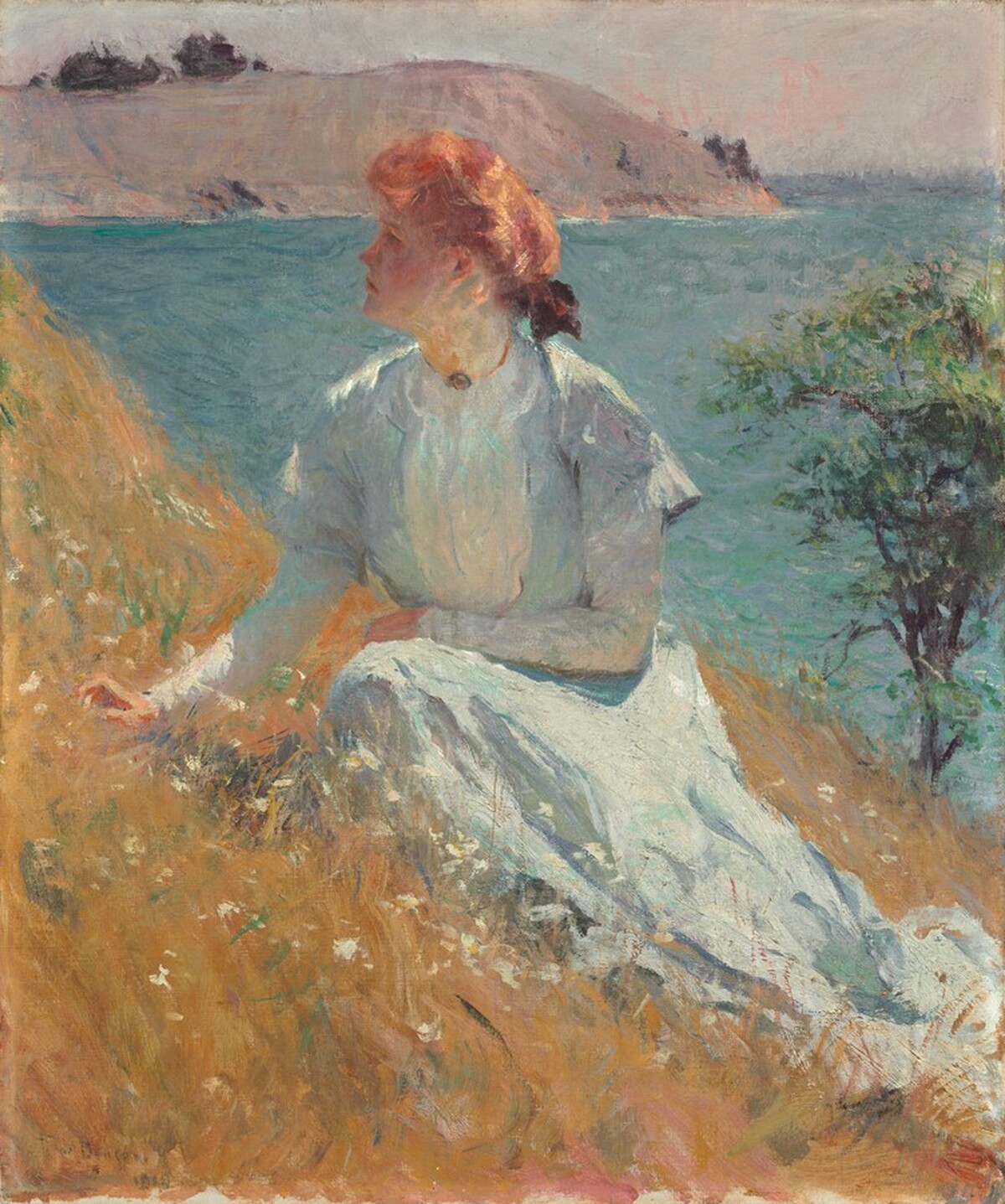
Margaret (Gretchen) Strong from c. 1909 is a portrait of Benson's characteristic type: a young woman rendered in the bright, luminous palette that distinguishes Boston School Impressionism from its French counterpart. The portrait demonstrates Benson's ability to combine figurative precision with atmospheric luminosity—the sitter's face and figure are rendered with the careful observation of a trained portraitist, while the light-filled background and the reflections on the white dress demonstrate the Impressionist handling of light that was Benson's particular contribution to American painting.
Cultural Impact
Benson's portraits of young women in light-filled settings are among the most characteristic works of the Boston School, and Margaret Strong exemplifies the type: a seated woman in a white dress, surrounded by reflected light, rendered with the combination of figurative precision and atmospheric luminosity that distinguishes Boston Impressionism from the more radical French variety. The portrait's appeal lies in this combination—beautiful without being superficial, luminous without being vague.
Why It Matters
Margaret (Gretchen) Strong is Benson's Boston Impressionism at its most appealing: a young woman in a white dress, surrounded by reflected light, rendered with the figurative precision and atmospheric luminosity that distinguish the Boston School. The portrait is beautiful without being superficial, luminous without being vague—the Boston School formula at its best.