Provenance
Purchased 1913 from the artist by Joseph Müller [d. 1977], Solothurn, Switzerland; purchased 1978 from Müller's estate through (Galerie Beyeler, Basel) by NGA.
Accession Number
1978.48.1
Medium
oil on canvas
Dimensions
overall: 140.7 x 119.7 cm (55 3/8 x 47 1/8 in.)
Classification
Painting
Credit Line
Ailsa Mellon Bruce Fund
Background & Context
Background Story
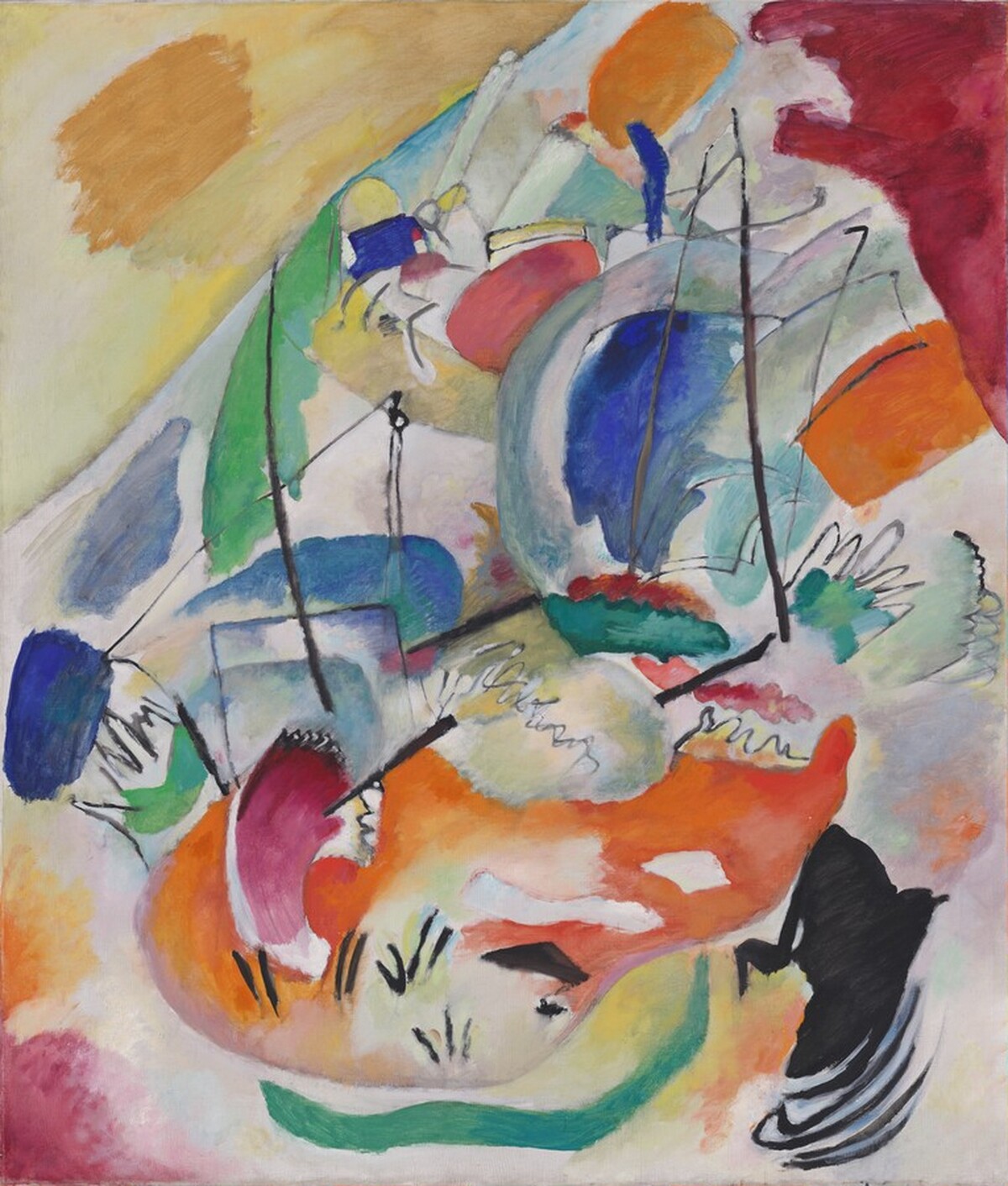
Improvisation 31 (Sea Battle) from 1913 is one of Wassily Kandinsky's (1866-1944) most accomplished Improvisations, a series of paintings that he described as 'largely unconscious, spontaneous expressions of inner character' in his seminal text Concerning the Spiritual in Art (1911). The painting's title 'Sea Battle' refers to the martial imagery that Kandinsky saw emerging from the abstract composition—ships, cannons, and waves suggested by the interplay of line and color rather than described. The 1913 date places this at the peak of Kandinsky's pre-World War I period, when he was producing the radically abstract paintings that would make him one of the founders of non-objective painting.
Cultural Impact
Improvisation 31 (Sea Battle) is important in the history of abstract painting because it demonstrates the radical abstraction that Kandinsky achieved in the years before World War I. The painting's martial imagery—ships, cannons, waves—is suggested rather than described, and the abstract composition demonstrates Kandinsky's conviction that line and color could express inner spiritual states without reference to the visible world, making this painting one of the founding documents of non-objective painting.
Why It Matters
Improvisation 31 (Sea Battle) is Kandinsky's radical abstraction at its peak: ships, cannons, and waves suggested by the interplay of line and color rather than described, a composition of pure form that demonstrates his conviction that abstract painting could express inner spiritual states. The 1913 painting is one of the founding documents of non-objective painting.