Provenance
Alexis-François Artaud de Montor [1772-1849], Paris, acquired probably during his stay in Florence between 1805 and 1808;[1] (his sale, Hôtel des vents mobilières, Paris, 16-17 January 1851, no. 115, as by Masaccio). (John Hahn, Paris).[2] (Jules Féral, Paris); purchased June 1936 by (Duveen Brothers, Inc., London and New York);[3] purchased 15 December 1936 by The A.W. Mellon Educational and Charitable Trust, Pittsburgh;[4] gift 1937 to NGA.
[1] After a stay in Rome, where he worked at the French embassy and was in contact with the collector François Cacault, Artaud de Montor served as a secretary in the French embassy in Florence between 1805 and 1808. His collection was probably formed largely during that time; in 1808 it already numbered 110 pieces and two years later 150 works (see J. Perot, "Canova et les diplomates français à Rome: François Cacault et Alexis Artaud de Montor," _Bulletin de la Société de l'Histoire de l'Art français_ [1980]: 221-222). A certain number of his paintings came, as he himself stated (Alexis-François Artaud de Montor, _Peintres primitifs. Collection de tableaux rapportée d'Italie_, Paris, 1843: 14 n. 1), from the collection of an Englishman who used to live in Florence and had created his collection about sixty years earlier. According to the hypothesis of Tancred Borenius ("The Rediscovery of Primitives," _The Quarterly Review_ 239 [April 1923]: 258-271), the unnamed person could be the Florentine painter of English origin Ignazio Hugford (Pisa 1703-Florence 1778), whose vast collection also included paintings of the fourteenth and fifteenth centuries; on him, see F. Borroni Salvadori, "Ignazio Enrico Hugford, collezionista con vocazione del mercante," _Annali della Scuola Normale Superiore di Pisa_ 13 (1983): 1025-1056.
[2] According to a statement by Agnes Hahn Brodie, daughter of John Hahn (recorded 1974 in NGA curatorial files), the painting was "discovered" by her father, "a small dealer," in Paris.
[3] According to the correspondence between Edward Fowles of the Paris office of Duveen Brothers, Inc. and Bernard Berenson (copies in NGA curatorial files), on the basis of a photograph, Berenson recognized the painting as a work by Masaccio and suggested its acquisition on 4 June 1936. A letter to Berenson of 30 June announces that the painting was acquired from Féral.
[4] The original Duveen Brothers invoice is in Gallery Archives, copy in NGA curatorial files.
Accession Number
1937.1.14
Medium
tempera on panel
Dimensions
overall: 42.4 x 32.5 cm (16 11/16 x 12 13/16 in.) | framed: 69.2 x 61.6 x 6.4 cm (27 1/4 x 24 1/4 x 2 1/2 in.)
Classification
Painting
Credit Line
Andrew W. Mellon Collection
Tags
Painting Renaissance (1400–1599) Tempera Panel Painting Italian
Background & Context
Background Story
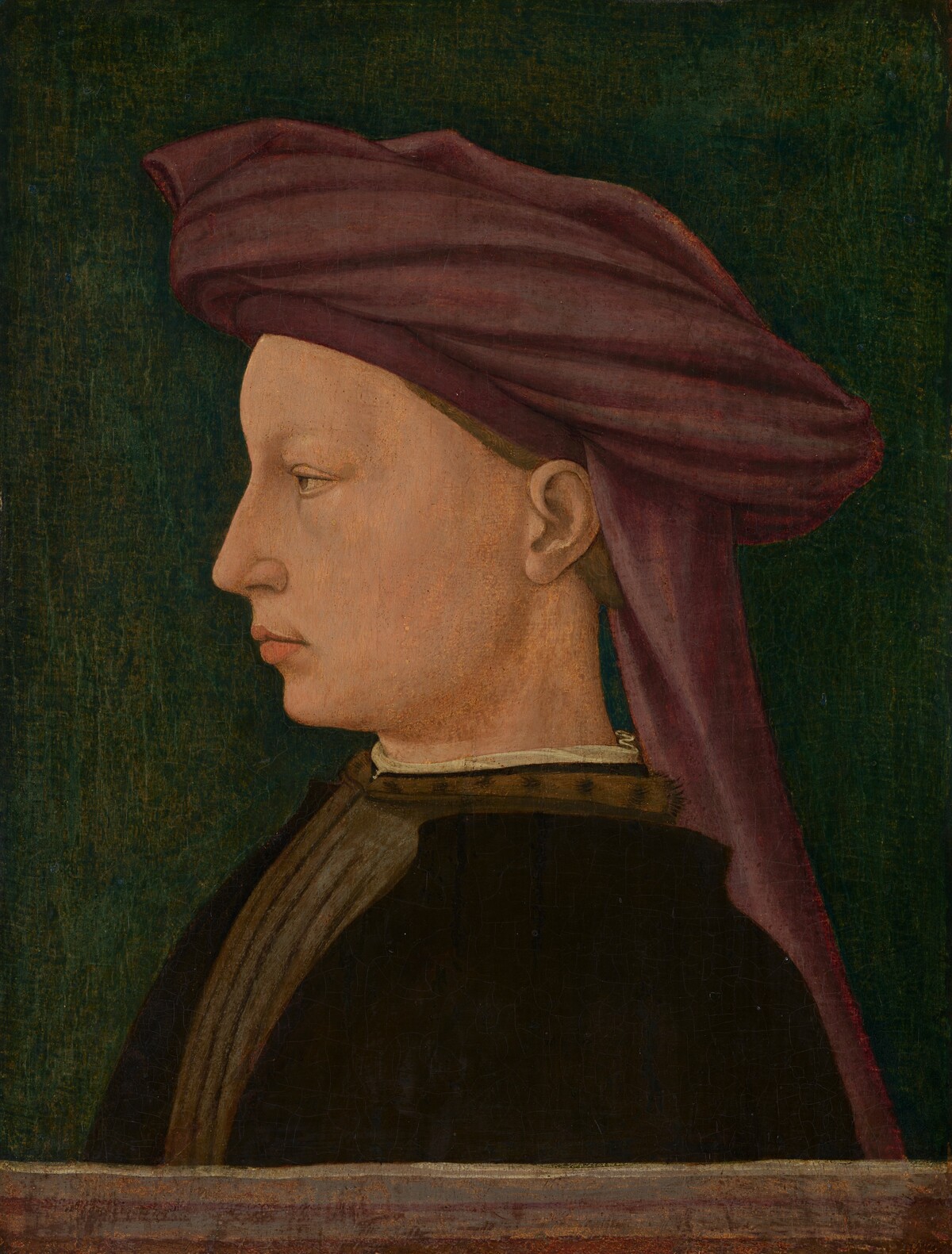
Profile Portrait of a Young Man from 1430-50 is an anonymous Florentine portrait in the profile format that was standard for Florentine portraiture of the early 15th century, derived from the convention of antique cameos and medal portraits. The 1430-50 date places this in the period when Florentine portrait painting was developing from the profile format toward the three-quarter format that Fra Filippo Lippi and others would introduce later in the century. The strict profile pose emphasizes the sitter's features and headdress, and the tempera on panel medium is the standard format for Florentine painting of the period before the adoption of oil.
Cultural Impact
Profile Portrait of a Young Man is important in the history of Florentine portrait painting because it demonstrates the profile format that was the earliest convention of Florentine portraiture, before the three-quarter format was introduced later in the 15th century. The 1430-50 date places this in the transitional period when the profile format was still dominant but would soon give way to the three-quarter format that would revolutionize portrait painting by creating the illusion of three-dimensional presence.
Why It Matters
Profile Portrait of a Young Man is early Florentine portraiture in the profile format: a young Florentine man in strict profile derived from antique cameos and medals, the earliest convention of Florentine portrait painting. The 1430-50 tempera on panel demonstrates the format from which Florentine portraiture would develop before the three-quarter revolution later in the century.