Provenance
The artist; purchased 20 December 1919 by the Corcoran Gallery of Art, Washington; acquired 2015 by the National Gallery of Art.
Accession Number
2015.19.11
Medium
oil on canvas
Dimensions
overall: 132.4 × 107.16 cm (52 1/8 × 42 3/16 in.) | framed: 150.81 × 125.73 × 6.67 cm (59 3/8 × 49 1/2 × 2 5/8 in.)
Classification
Painting
Credit Line
Corcoran Collection (Museum Purchase)
Tags
Painting Early Modern (1901–1950) Oil Painting Canvas American
Background & Context
Background Story
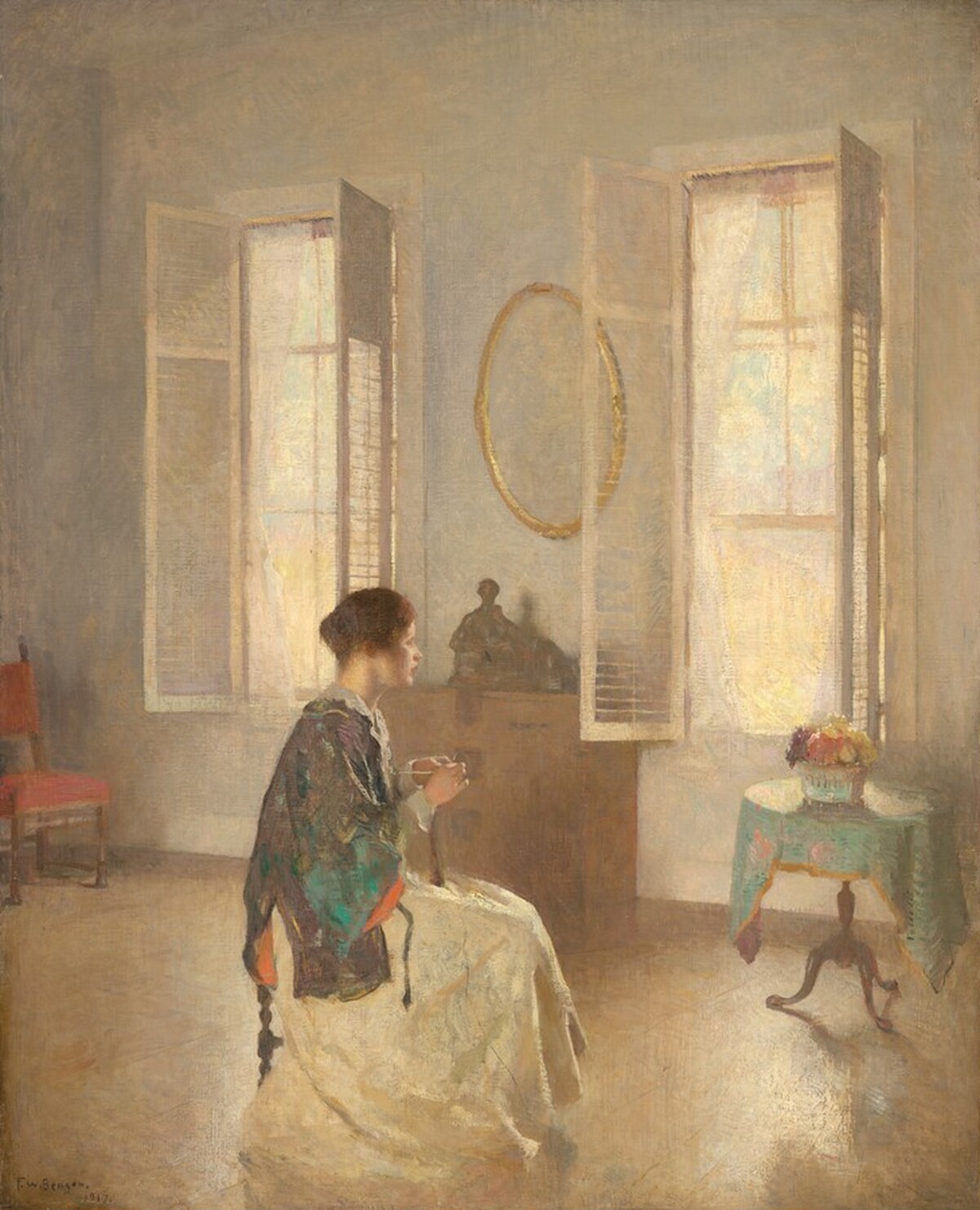
The Open Window from 1917 is one of Benson's most characteristic works, depicting a woman seated by an open window with the New England landscape visible beyond. The painting combines Benson's two great subjects—figurative portraiture and landscape—in a single composition where the open window mediates between the domestic interior and the natural world outside. The 1917 date places this in Benson's mature period, when his Impressionist technique had achieved the balance between figurative precision and atmospheric luminosity that distinguishes his best work.
Cultural Impact
Benson's open window paintings are among the most admired works in American Impressionism because they combine figurative portraiture with landscape in a single composition that mediates between the domestic interior and the natural world. The open window is both a literal element of the composition and a metaphorical device—the boundary between the cultivated space of the home and the natural space of the landscape, between the social world of women and the natural world that lies beyond it.
Why It Matters
The Open Window is Benson's American Impressionism at its most characteristic: a woman, an open window, and the New England landscape beyond, combining figurative portraiture and atmospheric landscape in a single composition. The open window mediates between domestic interior and natural exterior—the cultivated space of the home and the wild space beyond.