Provenance
(Frank K.M. Rehn Gallery, New York): purchased March 1943 by the Corcoran Gallery of Art; acquired 2015 by the National Gallery of Art.
Accession Number
2015.19.69
Medium
oil on canvas
Dimensions
overall: 87 × 114.94 cm (34 1/4 × 45 1/4 in.) | framed: 111.13 × 139.07 × 9.84 cm (43 3/4 × 54 3/4 × 3 7/8 in.)
Classification
Painting
Credit Line
Corcoran Collection (Museum Purchase, William A. Clark Fund)
Tags
Painting Early Modern (1901–1950) Oil Painting Canvas American
Background & Context
Background Story
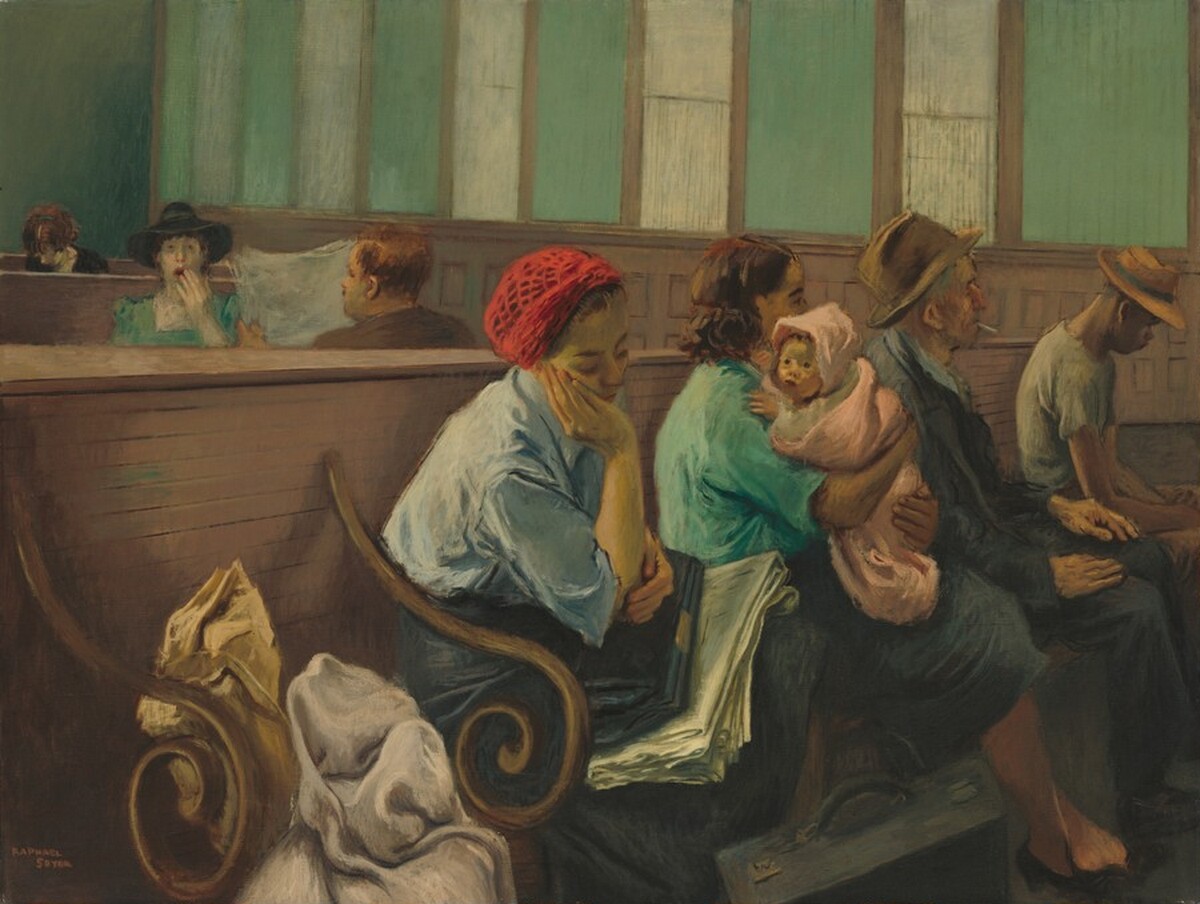
A Railroad Station Waiting Room from c. 1940 is one of Soyer's most characteristic subjects—people waiting in the impersonal spaces of urban life—rendered with the empathetic observation that distinguishes his best work. The railroad station waiting room is one of the quintessential spaces of modern urban life, and Soyer's treatment shows the variety of human types and conditions that the waiting room brings together. The c. 1940 date places this in the period when Soyer was producing the urban genre scenes that are his most accomplished works.
Cultural Impact
A Railroad Station Waiting Room is important in Soyer's oeuvre because it demonstrates his gift for finding the human subject in the impersonal spaces of modern urban life. The railroad station waiting room brings together people of all types and conditions, and Soyer's empathetic observation of their individual humanity within the impersonal space of the waiting room shows his Realism at its most socially aware.
Why It Matters
A Railroad Station Waiting Room is Soyer's Realism at its most socially aware: the impersonal space of urban modernity rendered with empathetic observation of individual humanity. The c. 1940 painting finds the human subject in the most impersonal spaces of modern urban life—the waiting room, the employment office, the audition hall.