Provenance
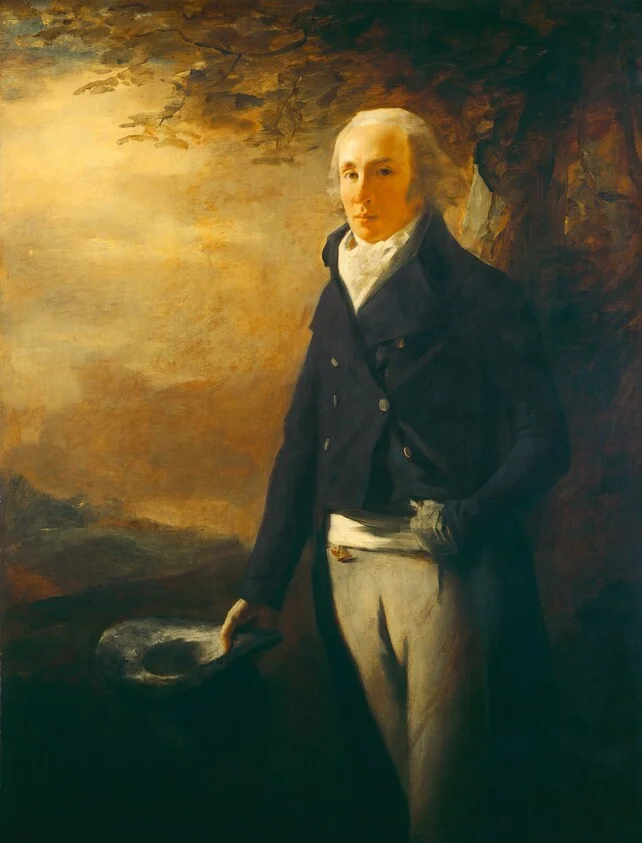
Painted for Warren Hastings [1732-1818], Daylesford House, Gloucestershire, probably upon whose death it was returned to the sitter;[1] by descent to Captain David Anderson [1867-1944], Bourhouse, Dunbar, East Lothian [Scotland].[2] (Dott & Co., Edinburgh); sold 1900 to (P. & D. Colnaghi & Co., London); purchased October 1903 by Dr. Eissler [probably one of the brothers, Dr. Gottfried Eissler, 1862-1924, or Dr. Hermann Eissler, 1860-1953, both Vienna].[3] purchased c. 1924 by Joseph E. Widener, Elkins Park, Pennsylvania; inheritance from Estate of Peter A.B. Widener by gift through power of appointment of Joseph E. Widener, after purchase by funds of the Estate; gift 1942 to NGA.
[1] David Anderson (1750-1825), of St. Germains, near Tranent, East Lothian, served in India with Warren Hastings, the first governor-general. The two became lifelong friends, and when they returned to England in 1785 they agreed to exchange portraits of each other. Anderson wrote to Hastings on 7 July 1790 that he had begun sitting to Raeburn (British Library Add. MS. 45,418:fol. 375). According to Kathleen Bliss, London, who was married to a direct descendant of David Anderson, the Raeburn portrait was returned to David Anderson either after Warren Hastings' impeachment trial, which lasted from 1784 to 1795, or after Hastings' death (letter, Mrs. Bliss to John Walker, NGA chief curator, 16 April 1947, in NGA curatorial files).
Hastings, in turn, had originally wanted Sir Joshua Reynolds to paint his portrait, but eventually commissioned Lemuel Abbot and sent the finished painting to Anderson in early 1797. Although John Hayes (in _British Paintings of the Sixteenth through Nineteenth Centuries. The Collections of the National Gallery of Art Systematic Catalogue_, Cambridge, England, 1992: 194) writes that the original Abbot portrait is now in the Victoria Memorial Museum in Calcutta, this is not the case. Abbot's first portrait of Hastings has remained in the possession of Anderson's descendants, and in 2003 was owned by David Anderson's great-great-great-granddaughter, Margaret Elizabeth Anderson Aynscough (Mrs. James Vernon Aynscough). The painting in Calcutta is one of at least eight copies made by Abbot after the original version, and Hastings also distributed copies by other artists (see correspondence in 2003 with Stephen Aynscough, in NGA curatorial files).
[2] The provenance from Captain Anderson to Dr. Eissler is recorded in James Greig, _Sir Henry Raeburn, R.A._, London, 1911: 37.
[3] Colnaghi's stock books (Roderic Thesiger, letter, 23 September 1969, in NGA curatorial files). The painting was not included in the sale of Gottfreid Eissler's estate in Vienna, 6-7 May 1925. There was also a sale of the Eissler collection at Pisko in Vienna in March 1908 that included a Raeburn, but it has not been identified.
Accession Number
1942.9.56
Medium
oil on canvas
Dimensions
overall: 152.5 x 107.5 cm (60 1/16 x 42 5/16 in.)
Classification
Painting
Credit Line
Widener Collection
Tags
Painting Neoclassical & Romantic (1751–1850) Oil Painting Canvas Scottish
Background & Context
Background Story
Sir Henry Raeburn (1756-1823) was the foremost portrait painter of the Scottish Enlightenment, known for his vigorous brushwork, his insightful characterization, and his ability to convey the personality of his sitters with a directness that distinguishes his work from the more flattery-dependent portraiture of his English contemporaries. David Anderson, painted in 1790, is a characteristically frank portrait: the sitter's face is rendered with the honest observation that Raeburn brought to all his portraits, whether the sitter was a lord or a merchant. The dark background and the focused lighting concentrate attention on the face and expression, which was Raeburn's true subject regardless of the sitter's social status.
Cultural Impact
Raeburn's portraits of the Scottish Enlightenment are among the most important documents of the period, recording the faces of the philosophers, scientists, and merchants who made Edinburgh the intellectual capital of the Anglophone world. His refusal to flatter his sitters—his commitment to honest observation rather than idealization—distinguished his work from the more commercial portraiture of his English contemporaries and made him the preferred portraitist of the Scottish intellectual elite.
Why It Matters
David Anderson is Raeburn's portraiture at its most direct: a face rendered with honest observation rather than flattery, against a dark background that concentrates attention on the sitter's expression. The portrait demonstrates that Raeburn's true subject was always personality, not status—the character behind the face rather than the rank behind the commission.