Provenance
(Camentron, Paris); probably by whom sold to (Durand-Ruel, New York and Paris), from 1899; acquired 1913 by Peter A.B. Widener, Lynnewood Hall, Elkins Park, Pennsylvania; inheritance from Estate of Peter A.B. Widener by gift through power of appointment of Joseph E. Widener, Elkins Park; gift 1942 to NGA.
Accession Number
1942.9.41
Medium
oil on wood
Dimensions
overall: 12.6 x 21.9 cm (4 15/16 x 8 5/8 in.) | framed: 36.2 x 45.4 x 4.4 cm (14 1/4 x 17 7/8 x 1 3/4 in.)
Classification
Painting
Credit Line
Widener Collection
Tags
Painting Impressionist & Modern (1851–1900) Oil Painting French
Background & Context
Background Story
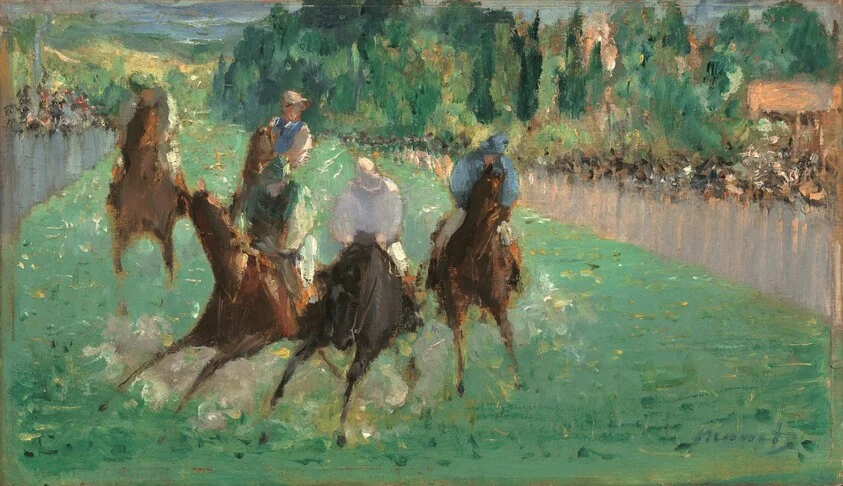
Edouard Manet (1832-1883) was the pivotal figure in the transition from Realism to Impressionism, and At the Races from around 1875 shows him engaging with the same modern leisure subjects that his Impressionist colleagues were exploring. Horse racing was one of the defining social phenomena of 19th-century Paris—a place where the bourgeoisie gathered to see and be seen, and where the rhythms of modern life (speed, spectacle, betting) were most visible. Manet's treatment characteristically focuses on the social dynamics of the racetrack rather than the race itself: the crowd, the fashions, and the atmosphere of modern leisure are his subjects, not the horses.
Cultural Impact
At the Races is Manet engaging with the Impressionist program of painting modern life, but with his characteristic detachment and irony. Where Monet and Renoir painted the racetrack as a spectacle of color and movement, Manet painted it as a social scene—the crowd as interesting as the race, the spectators as important as the horses. The small format (oil on wood) suggests a sketch-like immediacy, as if Manet were recording his impressions directly at the track.
Why It Matters
At the Races is Manet observing the modern world with his characteristic detachment: the racetrack is a social scene, not just a sporting event. The crowd, the fashions, and the atmosphere of modern leisure are the subjects—horses barely visible, society fully present. Manet paints not the race but the racing world.