Provenance
Walther Beyer, Neubabelsberg, before 1928.[1] Conrad Doebbeke [1889-1954], Berlin. Widmer, Winterthur, Switzerland.[2] (Galerie Aenne Abels, Cologne). Mr. [1905-1991] and Mrs. Jaquelin H. Hume, San Francisco, in 1987. Arnold A. [1916-2014] and Joan R. [1919-2019] Saltzman, Sands Point, New York; gift 2020 to NGA.
[1] Martin Urban, _Emil Nolde. Catalogue raisonne of the oil paintings_. 2 vols. London, 1987: I:312.
[2] This could be Hans Widmer [1889-1939] or his son, Urs Widmer [b. 1927].
Accession Number
2020.112.11
Medium
oil on canvas
Dimensions
overall: 74.3 x 88.9 cm (29 1/4 x 35 in.)
Classification
Painting
Credit Line
Collection of Arnold and Joan Saltzman
Tags
Painting Early Modern (1901–1950) Oil Painting Canvas German
Background & Context
Background Story
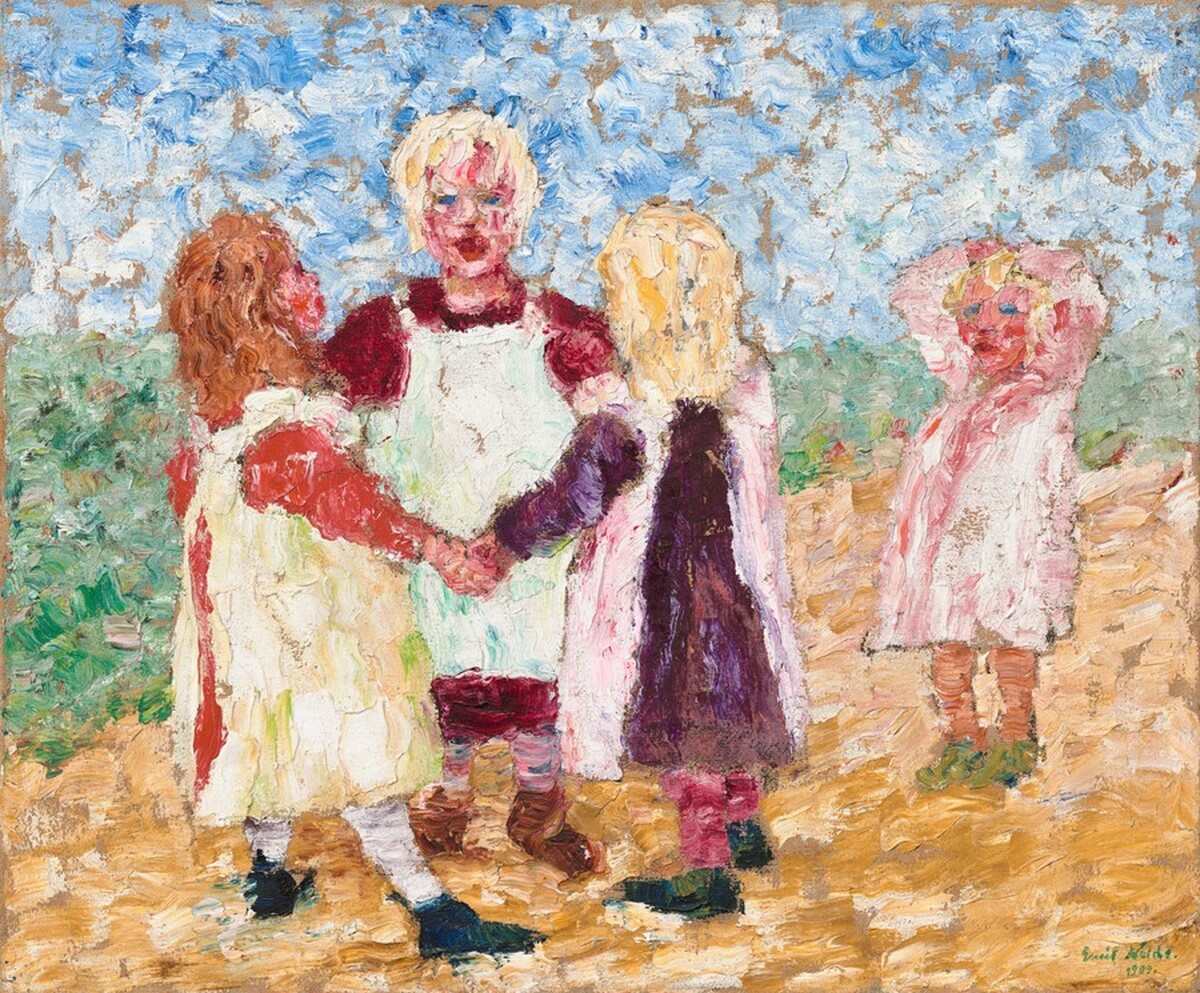
Emil Nolde (1867-1956) was a German Expressionist painter known for the intense color and primitive energy of his paintings and prints. Round Dance from 1909 depicts figures dancing in a circle with the intense color and simplified forms that distinguish Nolde's most characteristic work. The 1909 date places this in the period when Nolde was producing the expressive, intensely colored paintings that made him one of the leading members of Die Brucke and the most radical colorist among the German Expressionists. The round dance subject allows Nolde to exercise his talent for depicting figures in ecstatic movement with the intense color that defines his work.
Cultural Impact
Round Dance is important in the history of German Expressionism because it demonstrates the intense color and primitive energy that distinguish Nolde's most characteristic work. The round dance format—figures dancing in a circle—allows Nolde to combine the ecstasy of movement with the intensity of pure color in a way that defines German Expressionism at its most radical, and the 1909 painting shows Nolde producing the intensely colored work that would make him the most radical colorist among the German Expressionists.
Why It Matters
Round Dance is Nolde's Expressionist color at its most intense: figures dancing in a circle rendered with the primitive energy and pure, unmixed color that define German Expressionism at its most radical. The 1909 painting shows Nolde at the moment when he was producing the intensely colored work that would make him the most radical colorist among the German Expressionists.