Accession Number
1996.129.2
Medium
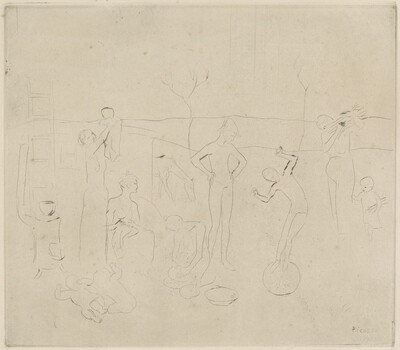
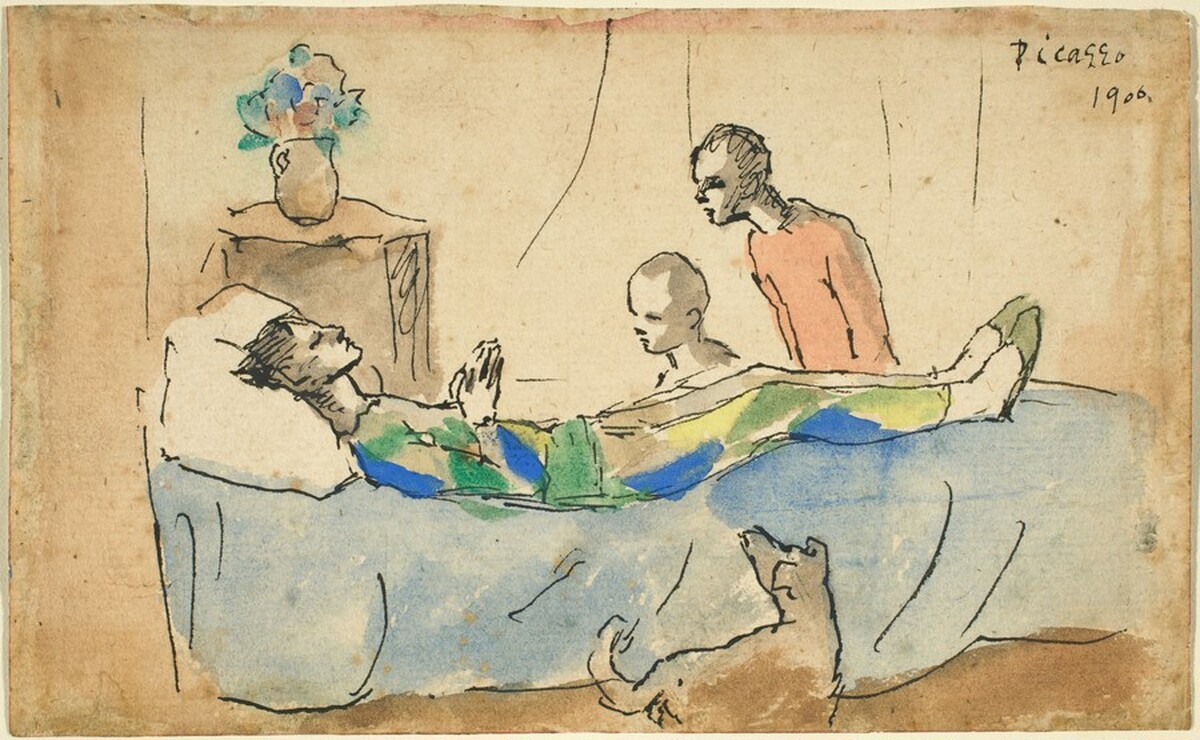
pen and black ink with watercolor on laid paper
Dimensions
overall: 10.4 x 16.8 cm (4 1/8 x 6 5/8 in.)
Classification
Drawing
Credit Line
Collection of Mr. and Mrs. Paul Mellon
Tags
Drawing Early Modern (1901–1950) Watercolor Ink Paper Spanish
Background & Context
Background Story
The Death of Harlequin (1905-1906) is a second version of the subject that preoccupied Picasso during the transition from Blue to Rose Period. This later treatment, painted as Picasso's Rose Period was reaching its fullest expression, may reflect a different emotional register from the earlier version: the harlequin's death, viewed from the perspective of growing success and social acceptance, carried different meanings than it had during the period of poverty and uncertainty. The 1905-06 date spans the end of the Rose Period's saltimbanque subjects and the beginning of the primitivist experimentation that would produce Les Demoiselles d'Avignon. The Death of Harlequin thus represents a concluding as well as a beginning—the end of the Rose Period's engagement with Commedia dell'Arte and the beginning of the more radical engagement with non-Western art that would follow. Picasso's treatment likely combines the Rose Period's warmth with the gravity that the death subject demanded, creating an image where the harlequin's diamond pattern—the signature of his performing identity—becomes a farewell costume. The harlequin's death, in this second version, may represent not just the performer's mortality but the end of a specific artistic identity: the Picasso who had identified with marginal entertainers was dying, and the Picasso who would identify with African masks and primitivist power was being born.
Cultural Impact
Picasso's second Death of Harlequin influenced how the artist's period transitions were understood, marking the end of the Rose Period and the beginning of the primitivist phase. The painting influenced how the theme of artistic death and rebirth was represented in modern art, establishing a tradition of artistic self-obituary that influenced later artists. The subject influenced how Picasso's harlequin imagery was interpreted, connecting the figure's death to the artist's stylistic transformation.
Why It Matters
This painting matters because it represents a specific moment of artistic transition—the death of one artistic identity and the birth of another. The harlequin's death is not merely a theatrical subject but a symbolic event marking the end of the Rose Period's warm engagement with European popular tradition and the beginning of the more radical engagement with non-Western sources that would transform 20th-century art.