Provenance
Possibly John Francis Austen [d. 1893], London and Capel Manor, Horsmonden, Kent, England; probably by inheritance with house and contents to his widow, Mrs. John Fancis Austen [Georgiana F. Pearse]; (Austen sale, Christie, Manson & Woods, London, 10 July 1931, no. 47, as by Cariani); purchased by (Galerie Sanct Lucas, Vienna). (Count Alessandro Contini Bonacossi, Florence and Rome); sold 1936 to the Samuel H. Kress Foundation, New York;[1] gift 1939 to NGA.[2]
[1] See also The Kress Collection Digital Archive, https://kress.nga.gov/Detail/objects/294.
[2] Fern Rusk Shapley, _Catalogue of the Italian Paintings_, 2 vols., Washington, D.C., 1979: I:14-16.
Accession Number
1939.1.350
Medium
oil on panel
Dimensions
overall: 55.9 x 117 cm (22 x 46 1/16 in.) | framed: 75.6 x 136.2 x 8.6 cm (29 3/4 x 53 5/8 x 3 3/8 in.)
Classification
Painting
Credit Line
Samuel H. Kress Collection
Tags
Painting Renaissance (1400–1599) Oil Painting Panel Painting Italian
Background & Context
Background Story
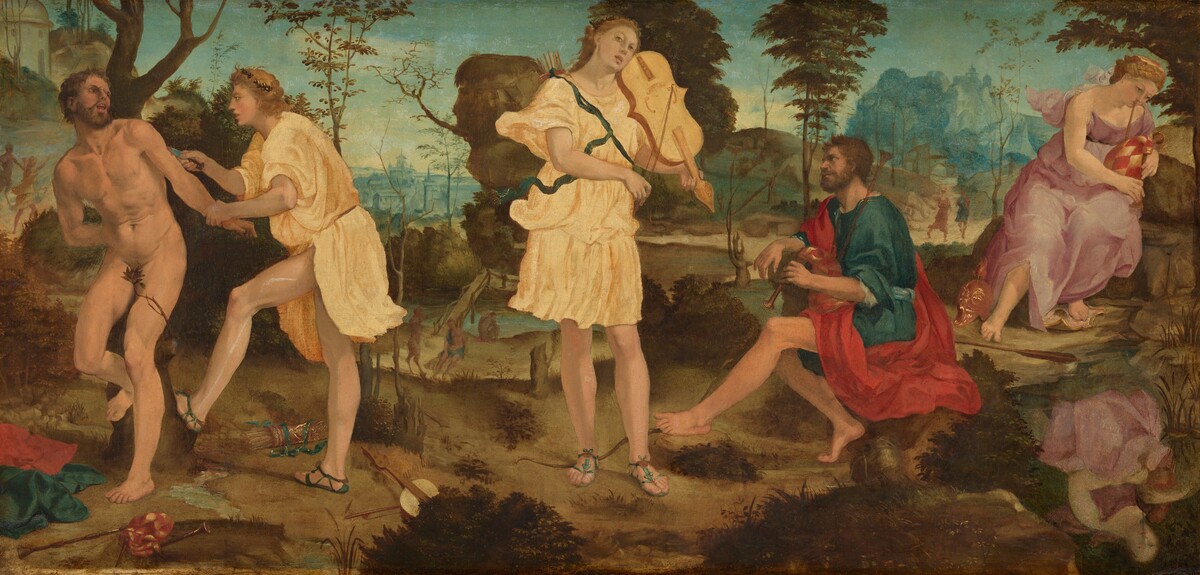
Apollo and Marsyas from c. 1540 depicts the mythological episode in which the god Apollo defeats the satyr Marsyas in a musical contest and flays him alive as punishment for his presumption. The painting is attributed to the Sienese school of the 16th century, possibly Bartolomeo di David, and the mythological subject reflects the Mannerist taste for dramatic, often violent narratives that distinguishes Sienese painting of the mid-16th century from the more serene tradition of earlier Sienese art. The c. 1540 date places this in the Mannerist period, when Sienese painting was absorbing the influence of the Florentine Mannerism that was transforming Italian art.
Cultural Impact
Apollo and Marsyas is important in the history of Sienese painting because it demonstrates the Mannerist transformation of the Sienese tradition in the mid-16th century. The violent mythological subject and the dramatic composition reflect the influence of Florentine Mannerism on what had been one of the most serene traditions in Italian painting, creating a type of Sienese painting that is dramatic and violent in a way that earlier Sienese art was not.
Why It Matters
Apollo and Marsyas is Mannerist Sienese drama: the violent mythological contest rendered in a manner that shows the Florentine Mannerist influence transforming the traditionally serene Sienese tradition. The c. 1540 painting demonstrates how mid-16th century Sienese painting absorbed the dramatic manner of Florentine Mannerism.