Provenance
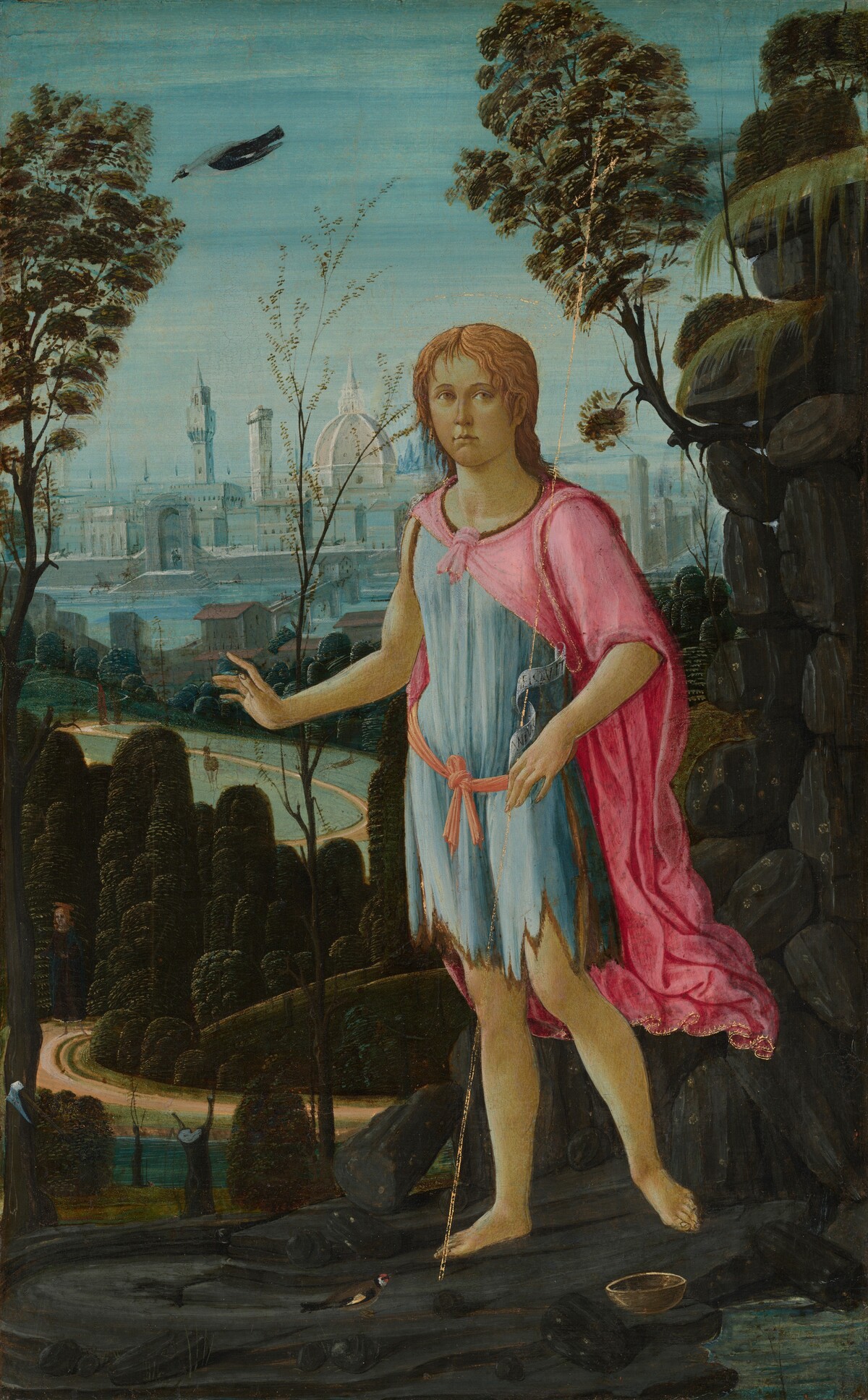
Marquis Pietro Francesco Rinuccini, Florence, by 1852; (his sale, Palazzo Rinuccini Fondacci di Santo Spirito, Florence, 1 May 1852, no. 128, as by Botticelli, possibly bought in); by inheritance to Marianna Rinuccini, who in 1855 married Marquis Giorgio Trivulzio [d. 1856], Milan;[1] Trivulzio family, Milan, until at least 1931.[2] (Count Alessandro Contini Bonacossi, Florence); sold October 1937 to the Samuel H. Kress Foundation, New York;[3] gift 1939 to NGA.
[1] Ellis Waterhouse (note of 22 July 1980 in NGA curatorial files) provided the reference to the sale catalogue and supplied further information about the marriage of Marianna Rinuccini and Giorgio Trivulzio. A letter of 8 September 1986 from the Getty Provenance Index (in NGA curatorial files) notes Waterhouse's identification of the NGA painting with a painting that Otto Mündler describes in the Trivulzio collection in 1856: "Botticelli: S. John the Baptist, as a youth of 12 or 14 years in a landscape, with Florence in the background" ("The Travel Diaries of Otto Mündler, 1855-1858," ed. Carol Togneri Dowd, _Walpole Society_ 51 [1985]: 92, 265).
[2] The painting is cited as being in the Trivulzio collection by Raimond van Marle, _The Development of the Italian Schools of Painting_, 19 vols., The Hague, 1931: 12:387-390, fig. 256. The Contini Bonacossi bill of sale (see note 3) states that the painting was "Formerly in the Collection of Principe Trivulzio, Milan," and refers to van Marle's publication.
[3] The bill of sale was for ten paintings (copy in NGA curatorial files). See also The Kress Collection Digital Archive, https://kress.nga.gov/Detail/objects/1857.
Accession Number
1939.1.283
Medium
oil on poplar panel
Dimensions
overall: 52 x 32.8 cm (20 1/2 x 12 15/16 in.) | framed: 67.3 x 48.3 x 7.6 cm (26 1/2 x 19 x 3 in.)
Classification
Painting
Credit Line
Samuel H. Kress Collection
Tags
Painting Renaissance (1400–1599) Oil Painting Panel Painting Italian
Background & Context
Background Story
Jacopo del Sellaio (1441-1493) was a Florentine painter of the early Renaissance, a pupil of Fra Filippo Lippi and a colleague of Sandro Botticelli, known for his narrative paintings and predella panels in the delicate, linear style that characterizes the Florentine Renaissance at its most refined. Saint John the Baptist from c. 1480 depicts the patron saint of Florence in the graceful, linear style that Sellaio learned from Lippi and shared with Botticelli. The c. 1480 date places this in the period when the Florentine Renaissance was producing its most accomplished devotional paintings, and Sellaio's Saint John the Baptist combines the clarity of early Renaissance composition with the decorative elegance of the Florentine manner.
Cultural Impact
Sellaio's Saint John the Baptist is important in the history of Florentine Renaissance painting because it demonstrates the delicate, linear style that Sellaio shared with Botticelli in the period when the Florentine Renaissance was producing its most refined devotional paintings. The painting's graceful linearity and decorative elegance show the influence of Fra Filippo Lippi's teaching on a generation of Florentine painters who produced some of the most accomplished devotional paintings of the early Renaissance.
Why It Matters
Saint John the Baptist is Sellaio's Florentine devotional painting at its most refined: the patron saint of Florence rendered in the graceful, linear style that Sellaio learned from Lippi and shared with Botticelli. The c. 1480 painting combines early Renaissance clarity with Florentine decorative elegance.
![Saint Bernard and Saint Catherine of Alexandria with the Virgin of the Annunciation [right panel]](https://api.nga.gov/iiif/e6890364-4d99-4684-a62b-5060ee3c3446/full/400,/0/default.jpg)