![The Death of Harlequin [recto]](https://api.nga.gov/iiif/641cc91f-5e9a-46eb-9c43-bdf0f805b5e7/full/1200,/0/default.jpg)
Provenance
Purchased from the artist by Wilhelm Uhde, 1906; (Galerie Caspari, Munich); sold 1915 to Hertha Koenig [1884-1976], Munich;[1] sold 1950 to (Justin K. Thannhauser, New York);[2] W. Somerset Maugham, St.-Jean-Cap-Ferrat; (his sale, Sotheby's, London, 10 April 1962, no. 26); purchased by (Hector Brame, Paris) for Mr. and Mrs. Paul Mellon, Upperville, VA; gift to NGA, 1996.
[1] Christian Geelhaar, _Picasso. Wegbereiter und Foerderer seines Aufsteigs 1899-1939_, Zurich, c. 1993: 73-75.
[2] Correspondence in the Thannhauser files at ZADIK [Zentralarchiv des Internationalen Kunsthandels, Cologne], transcriptions in NGA curatorial files.
Accession Number
1996.129.1.a
Medium
gouache over charcoal on cardboard
Dimensions
overall: 68.5 x 95.7 cm (26 15/16 x 37 11/16 in.)
Classification
Drawing
Credit Line
Collection of Mr. and Mrs. Paul Mellon
Tags
Drawing Early Modern (1901–1950) Charcoal Gouache Board Spanish
Background & Context
Background Story
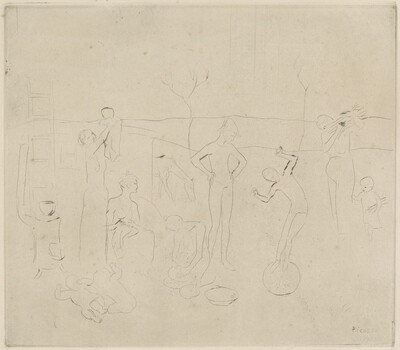
The Death of Harlequin (1905) represents one of the most psychologically intense paintings of Picasso's Rose Period. The harlequin's death—the end of the clever servant who had entertained audiences for centuries—carried autobiographical significance: Picasso identified with the harlequin and his death may represent the artist's fear of creative exhaustion or social irrelevance. The year 1905 was psychologically complex for Picasso: he was emerging from the Blue Period's grief, finding commercial success and social acceptance, yet the harlequin's death suggested that success might bring its own kind of ending. The painting belongs to the saltimbanque series—.group of works depicting itinerant performers that marked Picasso's transition from Blue to Rose Period. The death of the harlequin, at the series' most dramatic extreme, reveals the anxiety beneath the Rose Period's apparent warmth. Picasso's treatment of the dying harlequin combines the period's characteristic pink palette with the solemnity that the subject demanded, creating images where warmth and gravity coexist. The harlequin's diamond-patterned costume—a visual signature that identified the figure regardless of context—becomes in death a symbol of the performing identity's mortality, as though the disguise outlived the person who wore it.
Cultural Impact
Picasso's Death of Harlequin influenced how artists' mortality and creative anxiety were represented in modern art, establishing a tradition of artist-as-harlequin imagery that influenced later painters. The painting influenced how the Commedia dell'Arte tradition was modernized, updating the harlequin's story for an era when popular entertainment was being transformed by technology. The death subject influenced how Picasso's Rose Period was understood, revealing the anxiety beneath its apparent optimism.
Why It Matters
This painting matters because it reveals the fear that accompanied Picasso's growing success—the anxiety that creativity, like the harlequin's life, might be finite. The Death of Harlequin argues that artistic identity is not a permanent possession but a performance that can end, and that the awareness of this ending gives the performance its urgency and significance.