Description
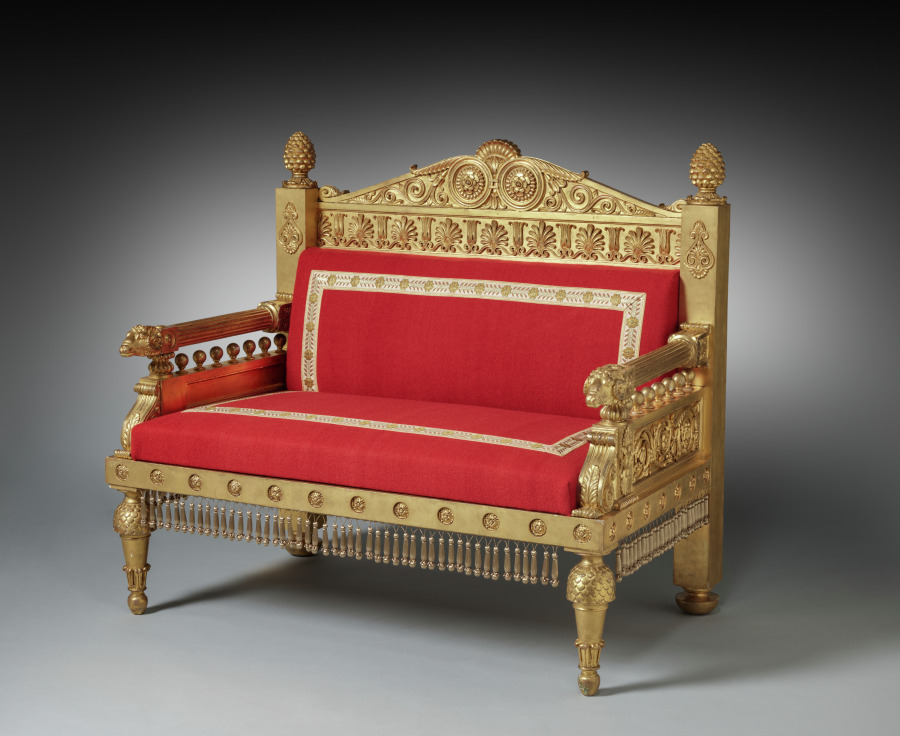
An art collector, designer, and champion of neoclassicism, Thomas Hope designed this settee for display in his London house. Hope’s design exemplifies the continued interest in neoclassical ornament around 1800 through the use of elaborately carved friezes, a central pediment, and a lavishly gilded surface. In 1807 Hope published Household Furniture and Interior Decoration, featuring descriptions of his renowned collection of antiquities and the interior furnishings from his London house, including this settee. Many architects and cabinetmaking firms took inspiration from Hope’s designs, adapting Greek and Roman forms to create bold expressions of neoclassicism in their architecture and decoration.
Provenance
Presumably Thomas Hope [1769-1831], Duchess Street, London and later at Deepdene, Surrey, and by descent to his son; (c.1802-1831); Henry Thomas Hope [1808-1862] and by descent to his wife (1831-1862); Anne Adele Bichat Hope [died 1884], by descent to her grandson (1862-1884); Lord Henry Francis Hope Pelham-Clinton-Hope [1866-1941], later 8th Duke of Newcastle-under-Lyme (1884-1917); (Christie’s, London, July 18, 1917, no. 293; bought by Bridge for £9 9s) (1917); Whereabouts unknown (1917-2001); (Gorringe’s Auctioneers, Lewes, Sussex, June 7, 2001, lot 1204, sold to H. Blairman & Sons and Jeremy Ltd, London) (2001); (H. Blairman & Sons and Jeremy, Ltd., London) (2001-?); Philip Hewat-Jaboor [born 1953]; sold by (Carlton Hobbs, Ltd., New York, as agent) to the Cleveland Museum of Art, Cleveland, OH (-2011); The Cleveland Museum of Art, Cleveland, OH (2011-)
Accession Number
2011.3
Medium
gilt-wood, reproduction wool upholstery
Dimensions
Overall: 102.2 x 113 x 71.1 cm (40 1/4 x 44 1/2 x 28 in.)
Classification
Wood
Credit Line
Leonard C. Hanna Jr. Fund