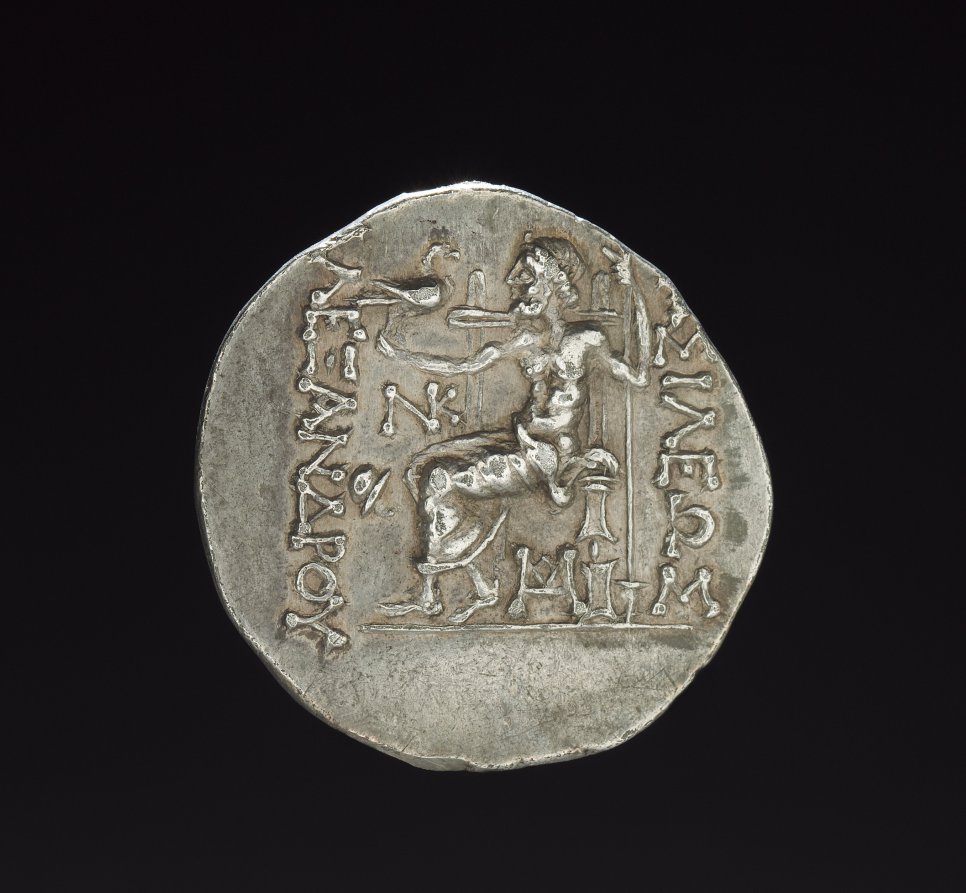
Description
After Alexander of Macedon succeeded in conquering Egypt and Persia in 331 BC, his ambition to rule the known world led him further east across Bactria in Afghanistan, through the Hindu Kush mountain pass, and into India. There he succeeded in defeating all the local kings of the region until his men, on the brink of mutiny, insisted that they return to Greece. Alexander left governors in charge of his territories, and after his death in 323 BC, his governors became independent kings, establishing Hellenistic cities and a Greek cultural base in the region, which lasted for almost 200 years.
The posthumous portrait of Alexander on the front of this coin depicts him wearing the lion scalp. He identified with Hercules, the mortal who became a god as a result of his superhuman feats, including the defeat of the Nemean lion.
The posthumous portrait of Alexander on the front of this coin depicts him wearing the lion scalp. He identified with Hercules, the mortal who became a god as a result of his superhuman feats, including the defeat of the Nemean lion.
Provenance
(Bruce Ferrini [1949–2010], Akron, OH, sold to Dr. Norman Zaworski) (?–c. 2000); Dr. Norman Zaworski [1920–2013], Cleveland, OH, given to the Cleveland Museum of Art (c. 2000–2011); The Cleveland Museum of Art, Cleveland, OH (2011–)
Accession Number
2011.210.b
Medium
silver
Dimensions
Diameter: 3.2 x 0.5 cm (1 1/4 x 3/16 in.)
Classification
Silver
Credit Line
Gift of Dr. Norman Zaworski