Description
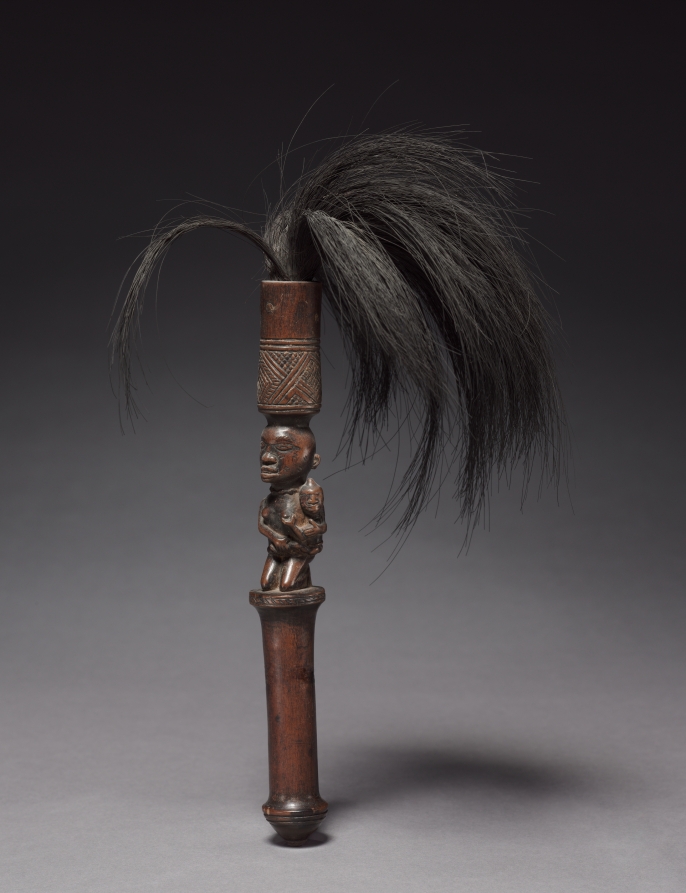
In Central Africa, flywhisks denoted status, rank, and function, rather than used to whisk away flies. Commonly associated with chiefs and titleholders, they were also owned by diviners and healers. Their purpose may also have been used to purify spaces, bless people, places, or things, and settle disputes. Flywhisks rarely depict women; yet this finely carved miniature of a woman kneeling signifies obedience and respect.
Provenance
(René De Wolf, Brussels, BE before 1972, sold to René and Odette Delenne) (?-1972); René [1901-1998] and Odette Delenne [1925-2012], Brussels, BE, 2010, sold to the Cleveland Museum of Art. (1972-2010); The Cleveland Museum of Art, Cleveland, OH, 2010 (2010)
Accession Number
2010.435
Medium
Wood and animal hair
Dimensions
Overall: 30 x 16 x 18 cm (11 13/16 x 6 5/16 x 7 1/16 in.)
Classification
Sculpture
Credit Line
René and Odette Delenne Collection, Leonard C. Hanna Jr. Fund