Description
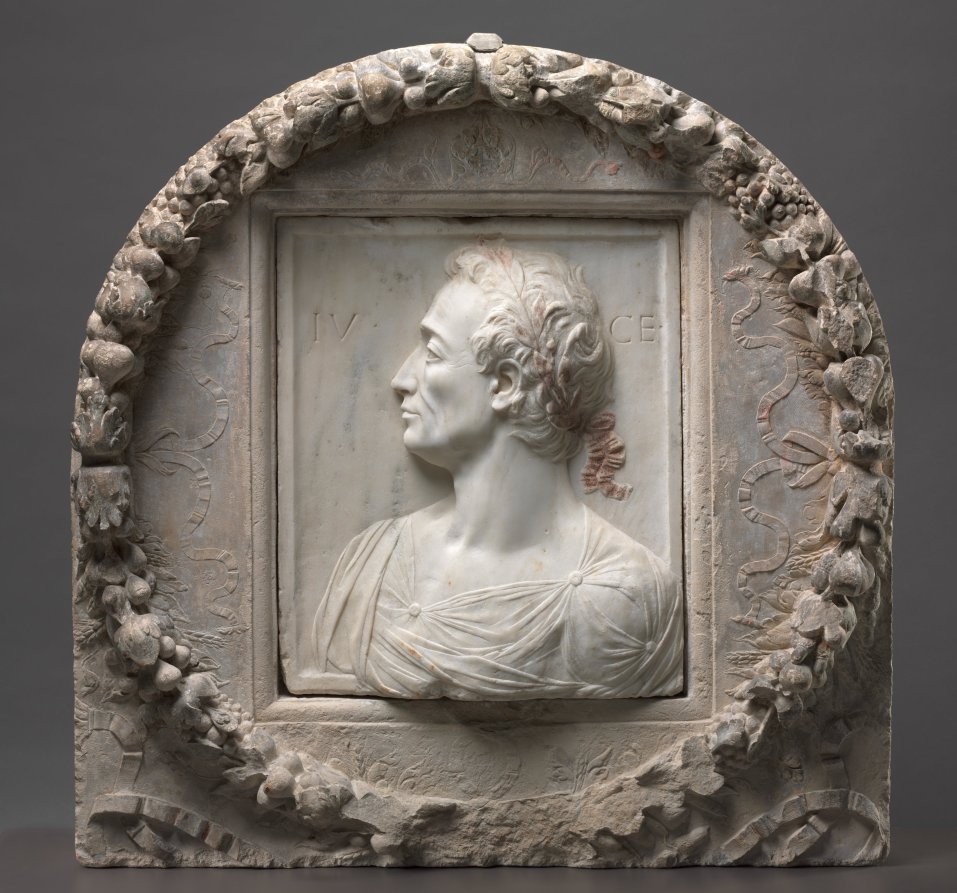
Renowned Roman general and statesman Julius Caesar (100–44 BCE) appears here as a political rather than military leader, worn by the burdens of office, with carefully described signs of aging. Mino probably used ancient coins from the collection of the Medici, Florence's ruling family, as his starting point for this sculpture. However, the complex carving, the clinging drapery, and the psychological intensity all characterize the inventiveness Renaissance artists brought to classical subject matter. In this case, Caesar offered an important model for leadership, masculinity, and composure. The garland is clearly by a different hand, but passages, such as the ribbons and flowers in low relief, correspond to details found in other decorative carvings from Mino's workshop. Initially, the limestone setting was probably put into a wall, perhaps in a lunette over the door, from which it was later removed. However, the relationship between the garland and the relief has not yet been clarified and is the subject of ongoing research.
Provenance
Private Collection (Bourges, France), sold to a private dealer and Gertrud Rudigier; Private dealer and Gertrud Rudigier (Munich, Germany), sold to Gertrud Rudigier, 2008; Gertrud Rudigier, sold to the Cleveland Museum of Art, 2009
Accession Number
2009.271
Medium
marble with traces of bole (red clay) and limestone with traces of paint
Dimensions
Overall: 83 x 84 x 25 cm (32 11/16 x 33 1/16 x 9 13/16 in.)
Classification
Sculpture
Credit Line
John L. Severance Fund