Description
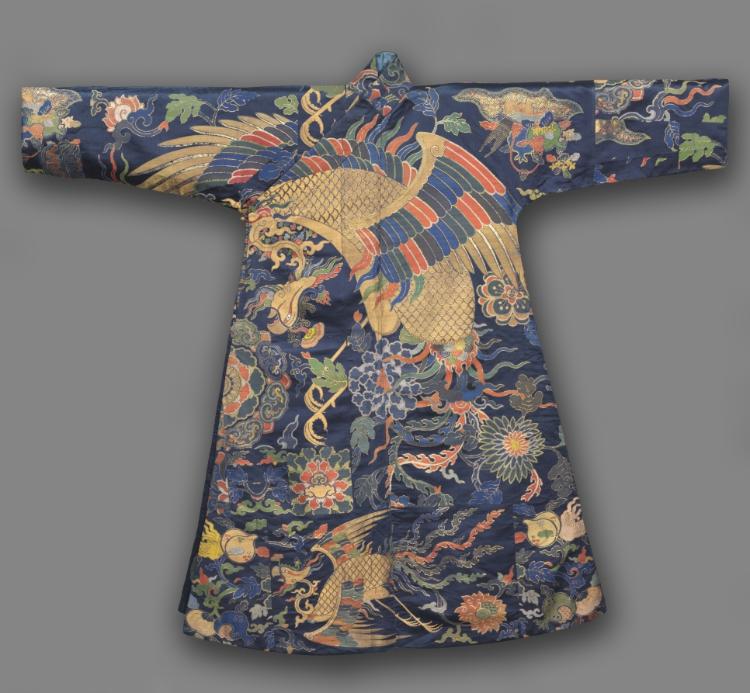
This magnificent robe for a Tibetan lama or an aristocrat was originally a Chinese imperial wall hanging. Tibetan tailors cut it into 60 separate units, reassembling the fabric for a completely new and bold design. The wearer of such a garment must have impressed bystanders by his striking appearance. What you see here is the robe’s back side.
Textiles played an important role in Chinese diplomacy with foreign governments. Diplomatic gifts of silk served to pacify border populations and to maintain balanced power relationships. Over centuries the Chinese court endeavored to keep a stable relationship with powerful Tibetan Buddhists. During the Qing dynasty (1644–1911) the Chinese court began to send gifts of court garments and furnishings to Tibet where they were altered to create Tibetan-style robes.
Textiles played an important role in Chinese diplomacy with foreign governments. Diplomatic gifts of silk served to pacify border populations and to maintain balanced power relationships. Over centuries the Chinese court endeavored to keep a stable relationship with powerful Tibetan Buddhists. During the Qing dynasty (1644–1911) the Chinese court began to send gifts of court garments and furnishings to Tibet where they were altered to create Tibetan-style robes.
Provenance
(Myrna Myers Gallery, sold to the Cleveland Museum of Art) (1980s–2007); The Cleveland Museum of Art, Cleveland, OH (2007–)
Accession Number
2007.216
Medium
Silk, gilt-metal thread of two kinds: satin weave with supplementary weft patterning
Dimensions
width across shoulders: 189.9 cm (74 3/4 in.); length back of neck to hem: 152.4 cm (60 in.)
Classification
Garment
Credit Line
Norman O. Stone and Ella A. Stone Memorial Fund