Description
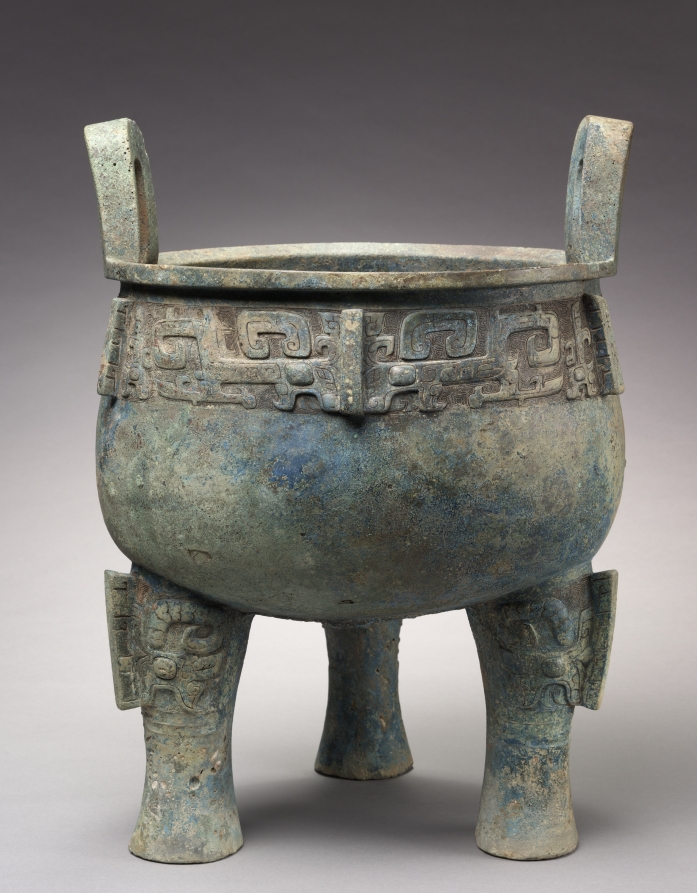
Large and majestic, this tripod gives the effect of overpowering force. Three animal masks (known as taotie) with coiled creatures are aligned in the decorative frieze. With the gaze of the staring eyes, the animal masks assert a religious presence and are meant to instill fear. Bold images of the ram embellish the three legs of the vessel.
Bronze cauldrons (ding) like this were made for offerings of food to ancestral spirits in sacrificial and funerary rites performed by the rulers or members of the aristocracy. The ding, in particular, assumed additional significance as the symbol of political power and legitimacy. As signs of status in a stratified society, such highly valued bronzes were cast by its makers with the wish to be "forever treasured for ten thousand years, by sons' sons and grandsons' grandsons."
Bronze cauldrons (ding) like this were made for offerings of food to ancestral spirits in sacrificial and funerary rites performed by the rulers or members of the aristocracy. The ding, in particular, assumed additional significance as the symbol of political power and legitimacy. As signs of status in a stratified society, such highly valued bronzes were cast by its makers with the wish to be "forever treasured for ten thousand years, by sons' sons and grandsons' grandsons."
Provenance
(Christie's New York, NY, sale 1113, September 20, 2002, lot 220, sold to the Cleveland Museum of Art) (September 20, 2003); The Cleveland Museum of Art, Cleveland, OH (2003–)
Accession Number
2003.2
Medium
bronze
Dimensions
Overall: 57.4 cm (22 5/8 in.)
Classification
Metalwork
Credit Line
Severance and Greta Millikin Purchase Fund