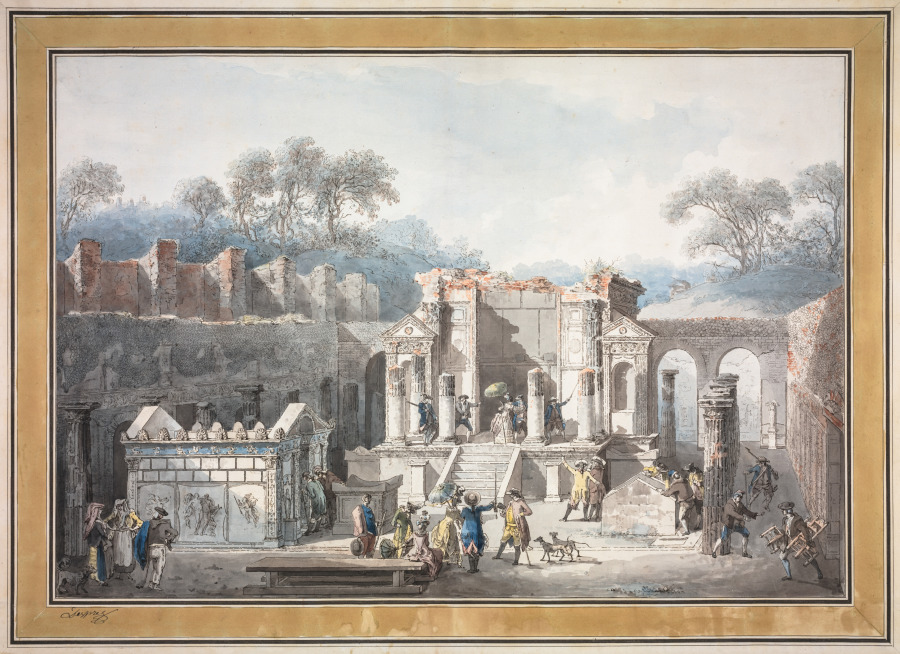
Description
Buried under layers of volcanic ash since the eruption of Mount Vesuvius in 79 CE, the ancient Roman sites of Herculaneum and Pompeii were rediscovered and excavated in the 1700s. Remarkably well preserved, the two cities captured the imagination of Enlightenment Europe. Artists Francesco Piranesi and Louis Jean Desprez capitalized on the popularity of the ancient sites, creating an innovative souvenir of Pompeii. Etched by Piranesi, the prints were based on Desprez’s real-life observations. The latter artist hand colored and signed select impressions that the two advertised as dessins coloriés, or colored drawings, meant only for hommes de goût, or "men of taste."
Provenance
(Hill-Stone, New York, NY, sold to The Cleveland Museum of Art, Cleveland, OH) (?–2001); The Cleveland Museum of Art, Cleveland, OH (March 5, 2001–)
Accession Number
2001.19
Medium
etching, hand-colored with watercolor
Dimensions
Sheet: 47.7 x 69.6 cm (18 3/4 x 27 3/8 in.); Secondary Support: 59.2 x 81.3 cm (23 5/16 x 32 in.)
Classification
Credit Line
John L. Severance Fund