Description
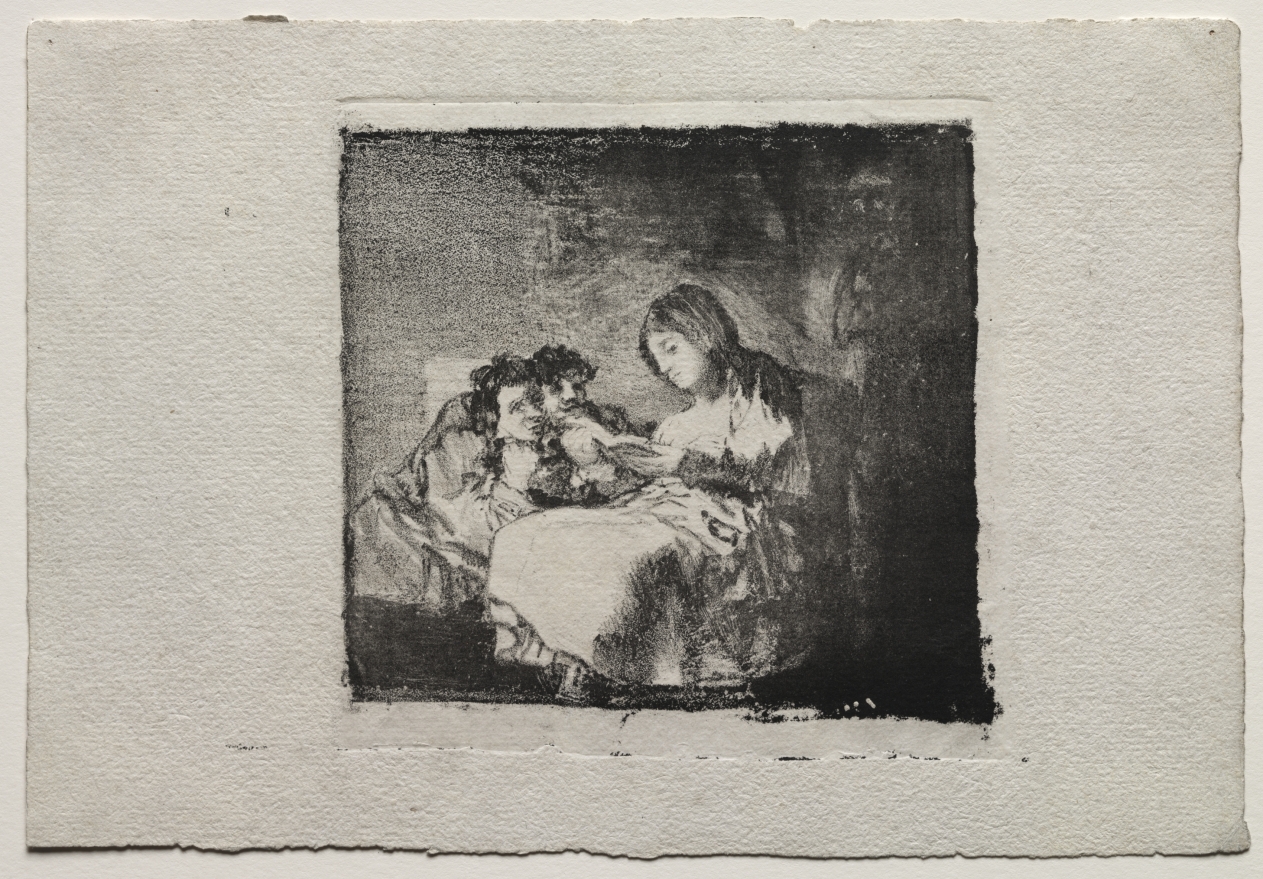
Goya left Spain in 1824 to escape the repressive rule of King Ferdinand VII and settled in Bordeaux, France, where he met Gaulon, an expert lithographer. Working with him, Goya executed Woman Reading to Two Children, where he drew densely with a crayon and then scratched out fine highlights on the woman's arm, skirt, mantilla, and around her head. An onlooker described Goya's methods, "Usually he covered the whole stone with a uniform gray tone and then removed with the scraper those parts which were to appear light. . . . Next the crayon was again employed to strengthen the shadows, the accents." Goya's portrayal of the children's rapt attention and the tranquil figure of the young woman suggests that this charming domestic scene was observed by the artist in his own home. Goya was joined in Bordeaux by his companion Leocadia Weiss and her two younger children, Guillermo and María del Rosario. Only seven impressions of this lithograph are known, all of which are now in museum collections.
Provenance
Otto Schäfer (stamped on verso), sold Kornfeld June 24, 1992, lot 374; Helmut H. Rumbler, Frankfurt-am-Main, Germany (?-1998); The Cleveland Museum of Art, Cleveland, OH (November 23, 1998)
Accession Number
1998.171
Medium
lithograph
Dimensions
Image: 11.5 x 13 cm (4 1/2 x 5 1/8 in.); Platemark: 13.1 x 13.4 cm (5 3/16 x 5 1/4 in.); Sheet: 16.5 x 24.6 cm (6 1/2 x 9 11/16 in.)
Classification
Credit Line
John L. Severance Fund