Description
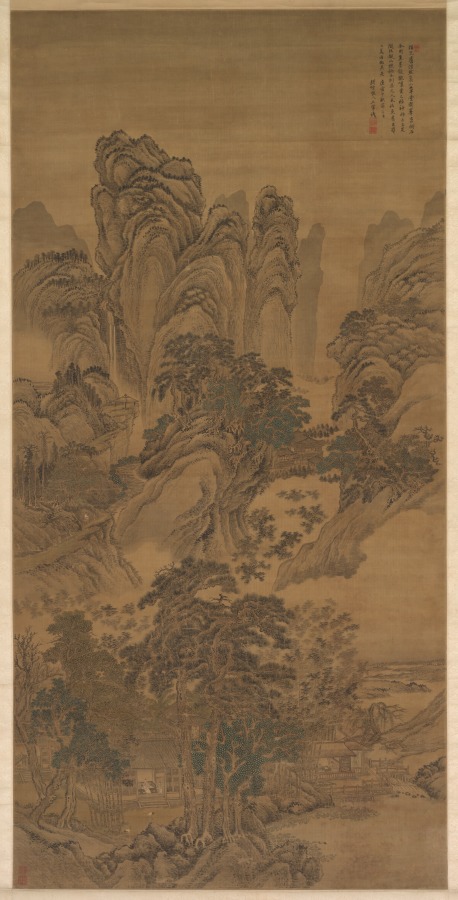
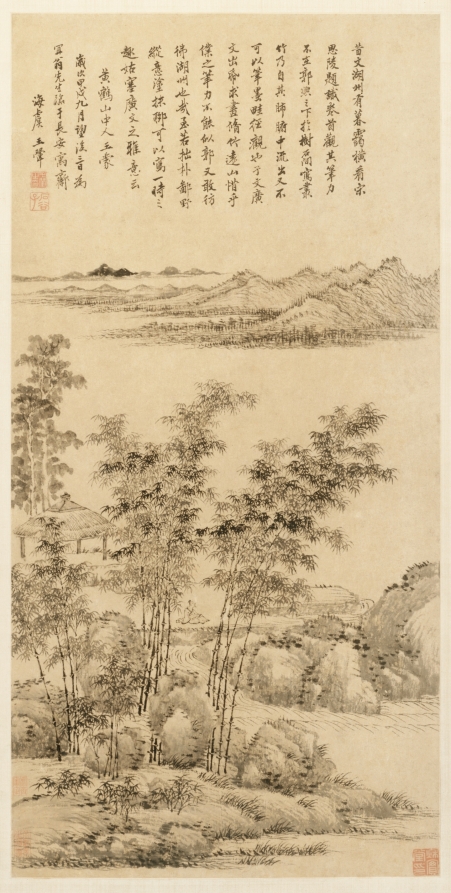
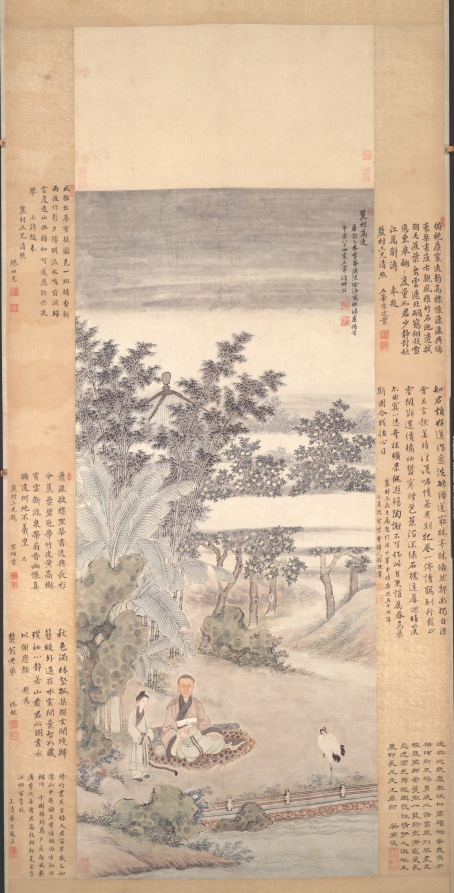
Wang Hui 王翬, a leading painter in the orthodox school of the early Qing dynasty (1644–1911), was commissioned to paint this landscape with a country estate for Li Duna 勵杜納 (1628–1703), vice minister of justice in Emperor Kangxi’s court. The emperor had honored Li by granting him a piece of calligraphy with the name of Li’s retirement retreat, “Hall of Lofty Pines.” He drew a comparison between pines and Li’s upright character, resilience, and longevity. Wang Hui’s painting was supposed to allow Li to imagine living in a beautiful, secluded compound among the hills and pines. Sadly, Li died before seeing the completed painting and before receiving the emperor’s permission to retire.
The landscape begins with peaceful riverbanks and low hills. The pines around the estate in the middle of the handscroll are truly lofty, some stretching even beyond the frame of the painting. Li Duna, the estate’s owner, is shown twice in his serene mountain retreat: first approaching the entrance to the compound with two servants at the right, and then later in the scroll, to the left, reading in the comfort of an inner room.
The landscape begins with peaceful riverbanks and low hills. The pines around the estate in the middle of the handscroll are truly lofty, some stretching even beyond the frame of the painting. Li Duna, the estate’s owner, is shown twice in his serene mountain retreat: first approaching the entrance to the compound with two servants at the right, and then later in the scroll, to the left, reading in the comfort of an inner room.
Provenance
Li Duna 勵杜納 [1628–1703], by descent to Li Tingyi (1703); Li Tingyi 勵廷儀 [1669–1732] (1703-?); Zha Ying 查瑩 [jinshi of 1766]; Li Enqing 李恩慶 [about 1797–about 1858]; Wan-go H. C. Weng 翁萬戈 [1918-2020], Lyme, NH; Mr. and Mrs. A. Dean Perry [Helen Wade Greene Perry] [1911-1996], Cleveland, OH, bequest to the Cleveland Museum of Art; The Cleveland Museum of Art, Cleveland, OH (1997-)
Accession Number
1997.106
Medium
handscroll; ink and color on paper
Dimensions
Overall: 40.7 cm (16 in.)
Classification
Painting
Credit Line
Bequest of Mrs. A. Dean Perry