Description
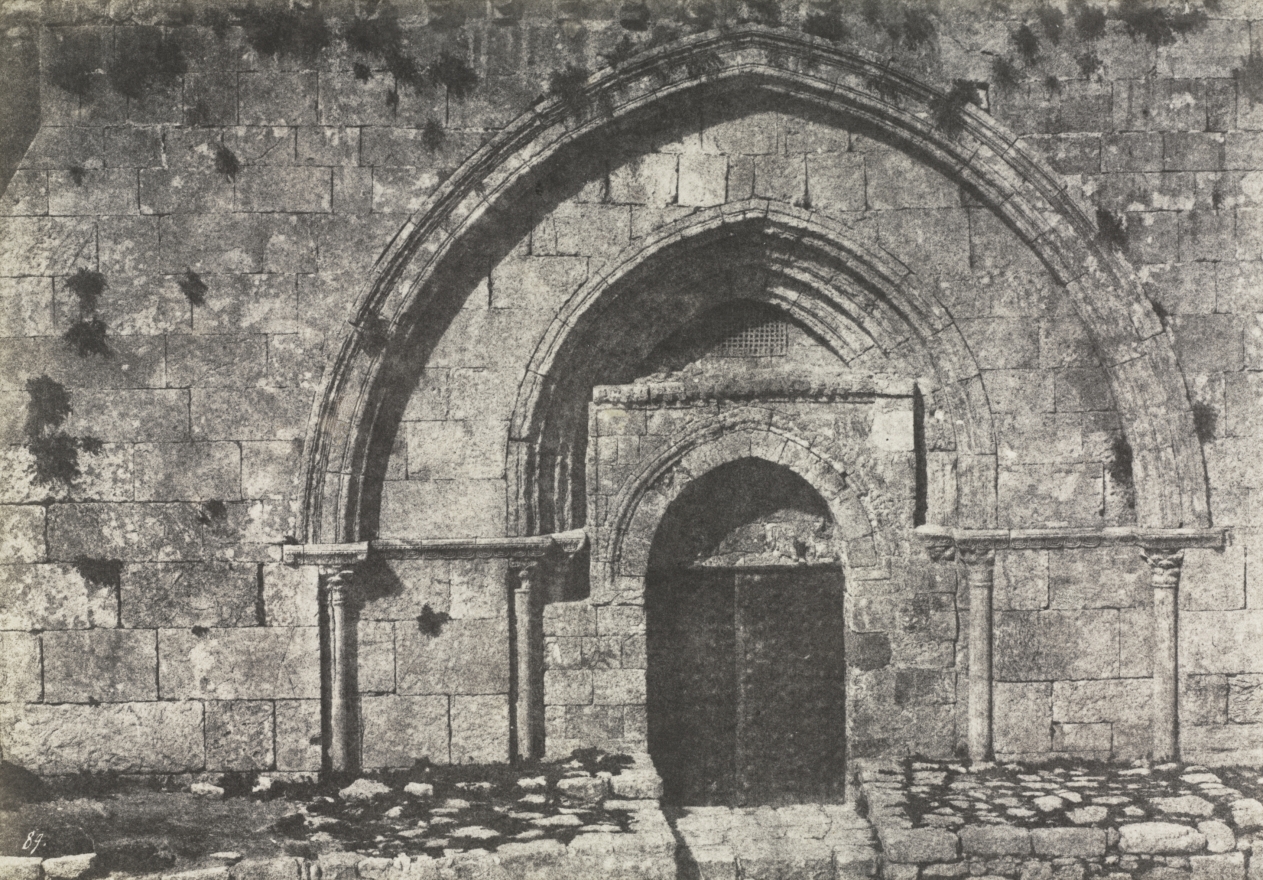
In 1854, Auguste Salzmann was commissioned by the French Ministry of Public Instruction to document the holy city of Jerusalem. His charge was to substantiate the controversial theories about dating ancient ruins proposed by his friend, Louis Félicien de Saulcy, a noted antiquarian. Unlike almost all other photographers documenting architecture in the 19th century, Salzmann relied on extreme close-up views. In this example, he eliminated most of the building, concentrating on the door of the tomb and its surrounding architectural elements. As a result, all indications of scale, terrain, placement, and context normally found in documentary photographs are absent, while the abstract textural and surface qualities of the tomb are emphasized.
Provenance
(Charles Isaacs Photographs, Inc., New York, NY); The Cleveland Museum of Art, Cleveland, OH (March 4, 1996)
Accession Number
1996.10
Medium
salted paper print, Blanquart-Évrard process, from waxed paper negative
Dimensions
Image: 22.7 x 32.8 cm (8 15/16 x 12 15/16 in.); Matted: 50.8 x 61 cm (20 x 24 in.)
Classification
Photograph
Credit Line
John L. Severance Fund