Description
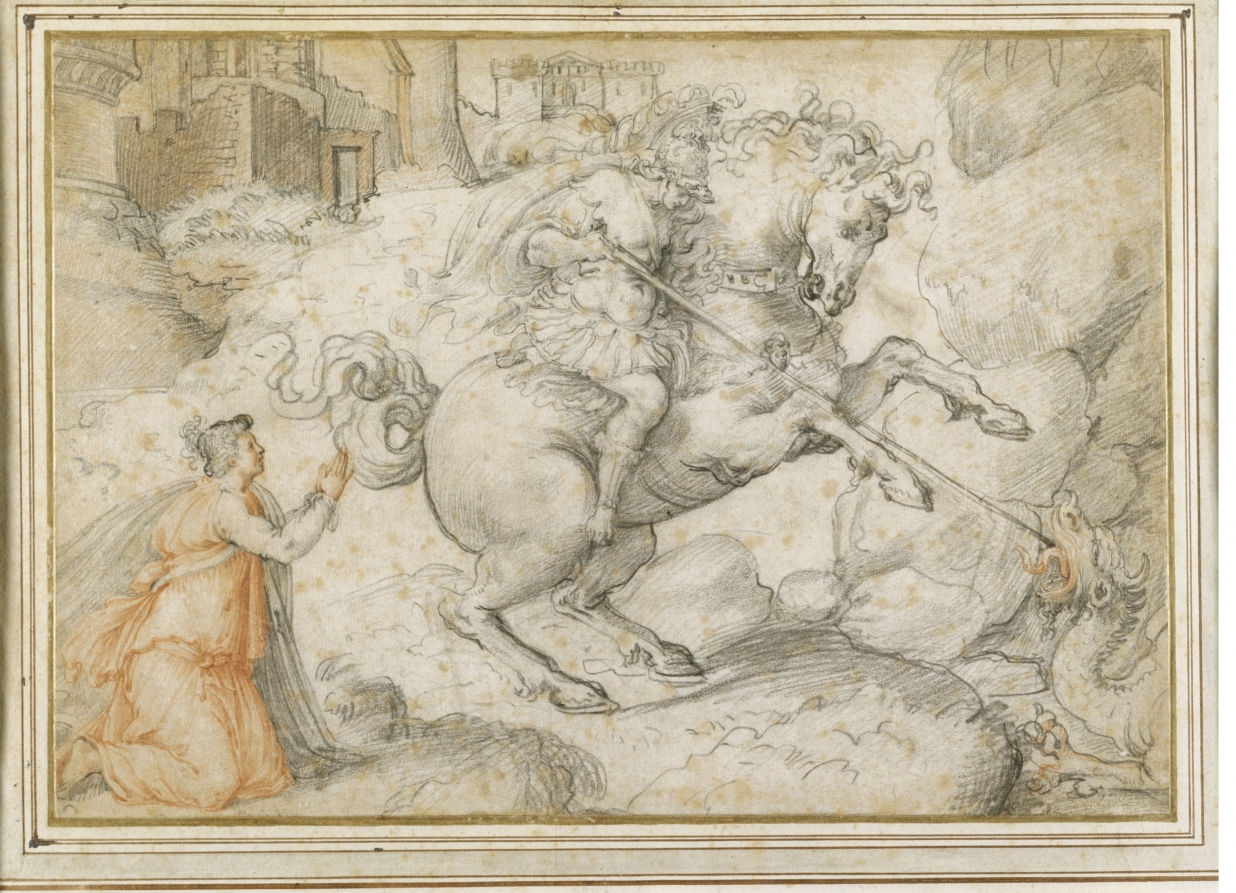
According to a legend based on Greek myth, as Saint George passed through Libya, he rescued a king’s daughter who had been left as a sacrifice to placate a vicious dragon. In gratitude for being delivered from the monster’s tyranny, the king’s subjects converted to Christianity. Here George wears armor in the ancient style based on Roman sculpture. Classical armor in Renaissance art was reserved for elite male subjects as a sign of their virtue. As a military saint, George’s attire conveys his antiquity as an early Christian hero (died about AD 303), conferring on him a sense of Roman authority and gravity.
Provenance
Thomas Coke, 1st Earl of Leicester (1697-1759), Holkam Hall, Norfolk, England; by descent within the Coke family; [their sale, Christie's, London, 2 July 1991, p. 25, lot 6]; [Artemis Fine Arts, Ltd., London (David Carritt, Ltd., London)]
Accession Number
1992.60
Medium
black chalk with red chalk, stumped
Dimensions
Sheet: 30.3 x 43.2 cm (11 15/16 x 17 in.); Secondary Support: 43.3 x 55.1 cm (17 1/16 x 21 11/16 in.)
Classification
Drawing
Credit Line
John L. Severance Fund
![a) Nude Woman [recto]; b) Nude [verso]](https://api.nga.gov/iiif/f2cf9a99-717e-4bc5-8d2d-42d7c06764ff/full/600,/0/default.jpg)