Description
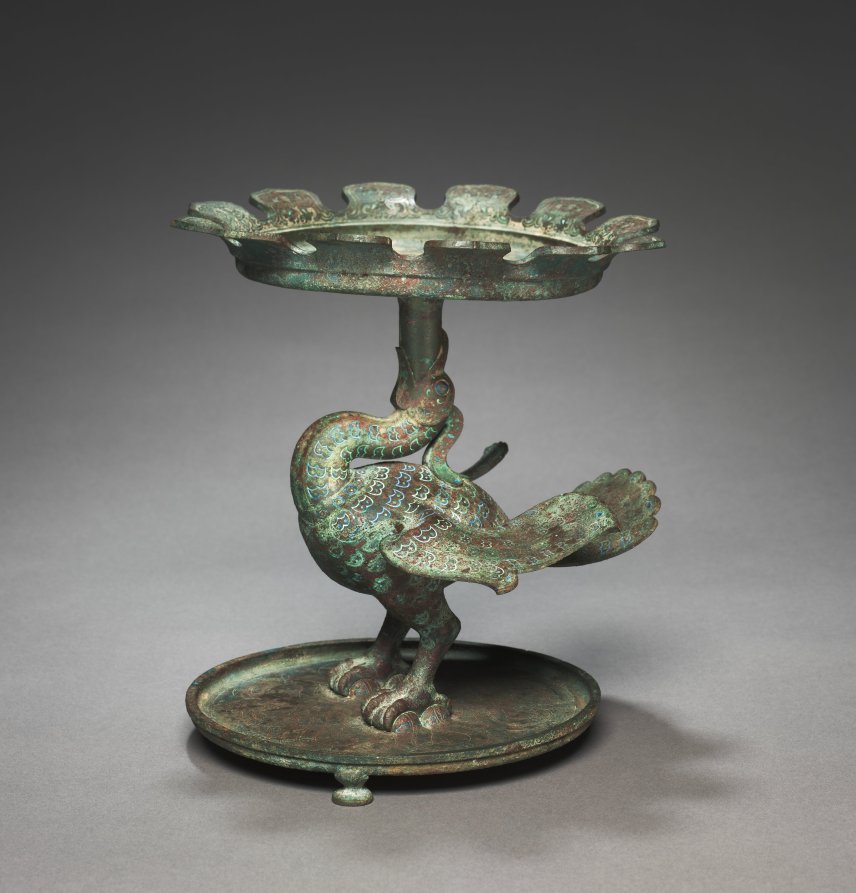
The bird, in its graceful and dignified pose, firmly grasps a pair of intertwined serpents cast in the lower basin. This composition of the bird's triumph over the serpent has been given various interpretations.
The Chinese ethnographers regard this as a totemic symbol—a suggestion of a specific clan's superiority over contending neighboring peoples. Other scholars interpret this as good creatures warding off evil influences or as an early manifestation of the concept of complementary pairing (yin-yang, heaven-earth) in Chinese cosmology.
The original appearance of this vessel was brilliant and colorful due to the use of malachite and azurite in inlaid decoration, producing red, green, and blue against the bronze surface.
The Chinese ethnographers regard this as a totemic symbol—a suggestion of a specific clan's superiority over contending neighboring peoples. Other scholars interpret this as good creatures warding off evil influences or as an early manifestation of the concept of complementary pairing (yin-yang, heaven-earth) in Chinese cosmology.
The original appearance of this vessel was brilliant and colorful due to the use of malachite and azurite in inlaid decoration, producing red, green, and blue against the bronze surface.
Provenance
(Robert H. Ellsworth, Ltd., New York, NY, sold to the Cleveland Museum of Art) (?–1991); The Cleveland Museum of Art, Cleveland, OH (1991–)
Accession Number
1991.8
Medium
bronze inlaid with powdered malachite and azurite
Dimensions
Overall: 23.3 cm (9 3/16 in.); Diameter of base: 18.3 cm (7 3/16 in.)
Classification
Metalwork
Credit Line
Leonard C. Hanna Jr. Fund