Description
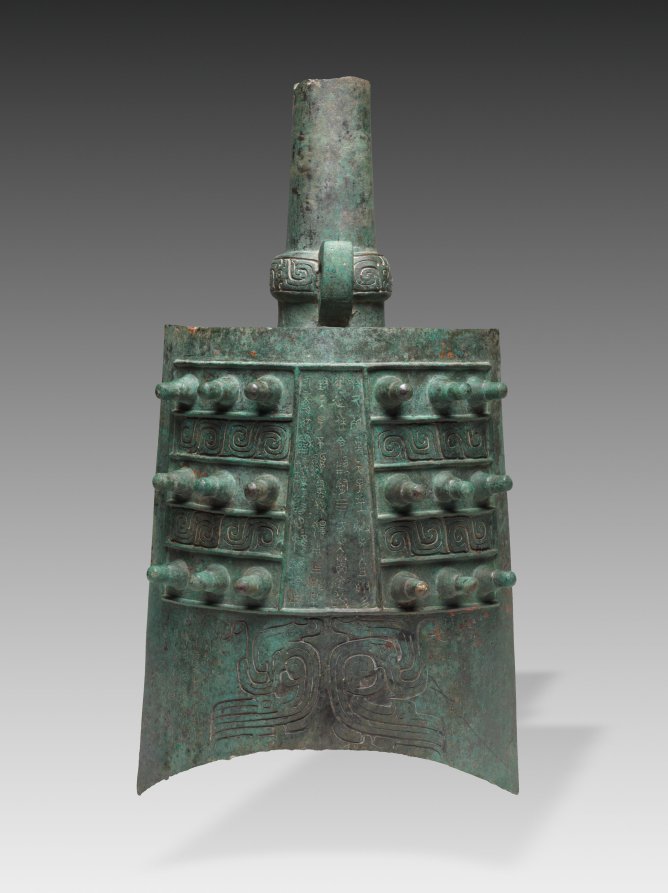
In ancient China, music and ritual had political significance and were linked inseparably to the power of states. During the Zhou dynasty, bronze bells were made in sets of eight to sixty bells. This bell is the second largest from a set of eight.
This bell bears an inscription of 118 characters about its owner, Lai, and why it was cast. Lai's ancestors dutifully served the Western Zhou royal court, and he was granted a hereditary position by the "Son of Heaven" (the ruler). To express filial piety, Lai commissioned a set of bells as an offering to his father, Gongshu, in the hope that they would be forever treasured by future generations. This important inscription also provides an early example of Chinese calligraphy highlighting the purely abstract lines and construction of characters.
This bell bears an inscription of 118 characters about its owner, Lai, and why it was cast. Lai's ancestors dutifully served the Western Zhou royal court, and he was granted a hereditary position by the "Son of Heaven" (the ruler). To express filial piety, Lai commissioned a set of bells as an offering to his father, Gongshu, in the hope that they would be forever treasured by future generations. This important inscription also provides an early example of Chinese calligraphy highlighting the purely abstract lines and construction of characters.
Provenance
(Robert H. Ellsworth, Ltd., New York, NY, sold to the Cleveland Museum of Art) (?-1989); The Cleveland Museum of Art, Cleveland, OH (1989-)
Accession Number
1989.3
Medium
bronze
Dimensions
Overall: 70.3 x 37 x 26.6 cm (27 11/16 x 14 9/16 x 10 1/2 in.)
Classification
Metalwork
Credit Line
Leonard C. Hanna Jr. Fund