Description
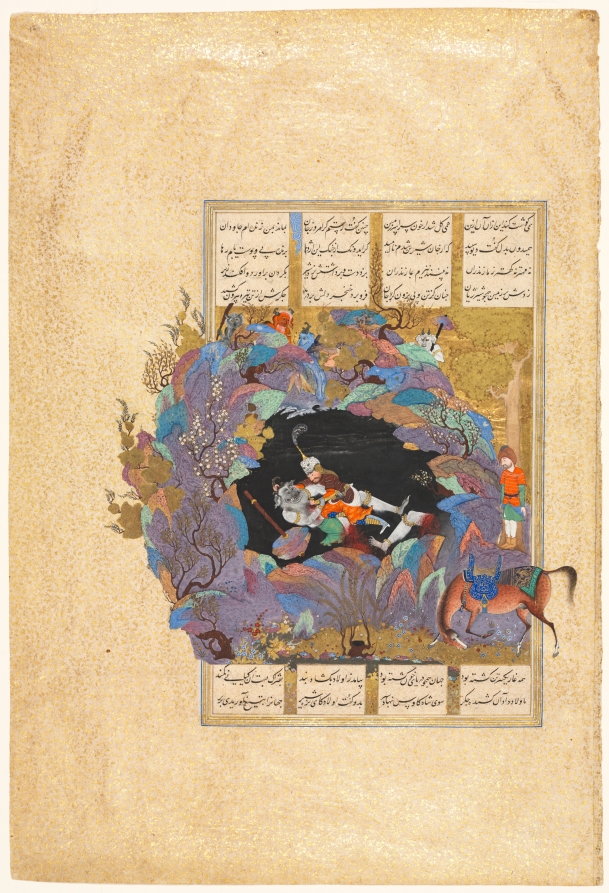
The legendary hero Rustam brutally takes the demon chief’s liver blood, needed to cure his king of blindness. Paintings from the Shah-nama made for the Persian ruler Shah Tahmasp (reigned 1524–76) were acclaimed in their day for their brilliant coloring and refinement. Seven of the artists who contributed to this book moved to India to lead the new Mughal painting workshop in the 1550s. They introduced to the Indian artists a more complex color sensibility and preference for presenting faces in three-quarter view, as opposed to in profile.
Provenance
Shah Tahmasp شاه تهماسب یکم [1514–1576], Iran, given to Ottoman Sultan Selim II (1520s–1567); Ottoman Sultan Selim II [1524–1574], Istanbul, Ottoman Empire (1567–?); Topkapı Palace library, Istanbul, Ottoman Empire (until early 1900s); Baron Edmond de Rothschild [1845–1934], Boulogne-Billancourt, France (early 1900s–?); Arthur A. Houghton, Jr. [1906–1990] (?–October 14, 1988); (Christie's, London, England, sold to the Cleveland Museum of Art) (October 14, 1988); The Cleveland Museum of Art, Cleveland, OH (1988–)
Rustam's seventh course: He kills the White Div, folio 124 from a Shah-nama (Book of Kings) of Firdausi (Persian, about 934–1020)
1522–37
Accession Number
1988.96.a
Medium
Gum tempera, ink, gold, and silver on paper
Dimensions
Sheet: 47.5 x 32.2 cm (18 11/16 x 12 11/16 in.); Image: 28.4 x 18.5 cm (11 3/16 x 7 5/16 in.)
Classification
Manuscript
Credit Line
Leonard C. Hanna Jr. Fund