Description
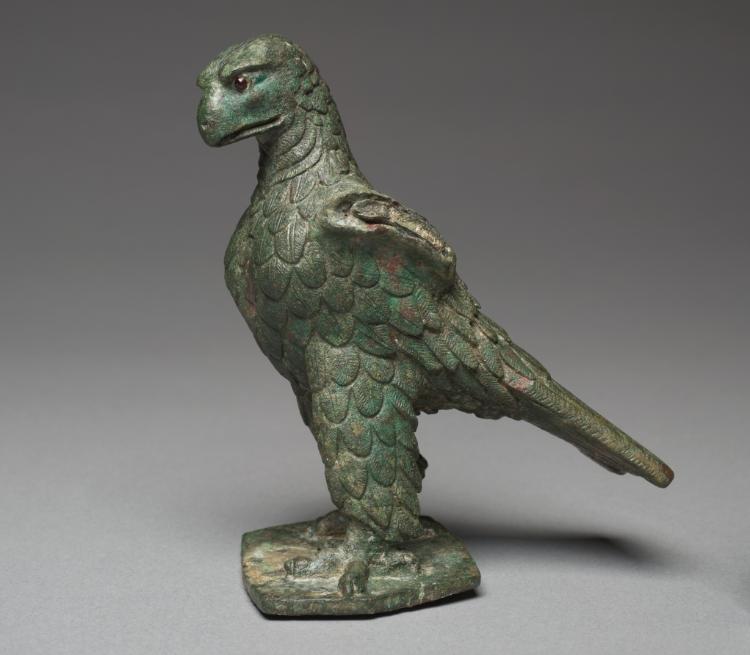
This eagle stands on an integrated bronze base with overlapping ovoid-shaped feathers creating a layered pattern across its body, and its tail feathers fanned out. The wings, now lost, were likely cast separately in bronze and then soldered or welded to the bird’s body. The eyes are inlaid with red stones believed to be garnets. The eagle is associated with Jupiter, king of the gods, and the Roman poets Virgil and Horace described the birds as the bearers of his thunderbolt. While eagles were often depicted on Roman coins, the bird is rarely depicted in the round in Roman art.
Provenance
Robert Haber & Associates, New York, NY, sold to the Cleveland Museum of Art (-1988); The Cleveland Museum of Art, Cleveland, OH (1988-)
Accession Number
1988.40
Medium
bronze with garnet inlays
Dimensions
Overall: 12.1 x 6.9 x 9.7 cm (4 3/4 x 2 11/16 x 3 13/16 in.)
Classification
Sculpture
Credit Line
John L. Severance Fund