Description
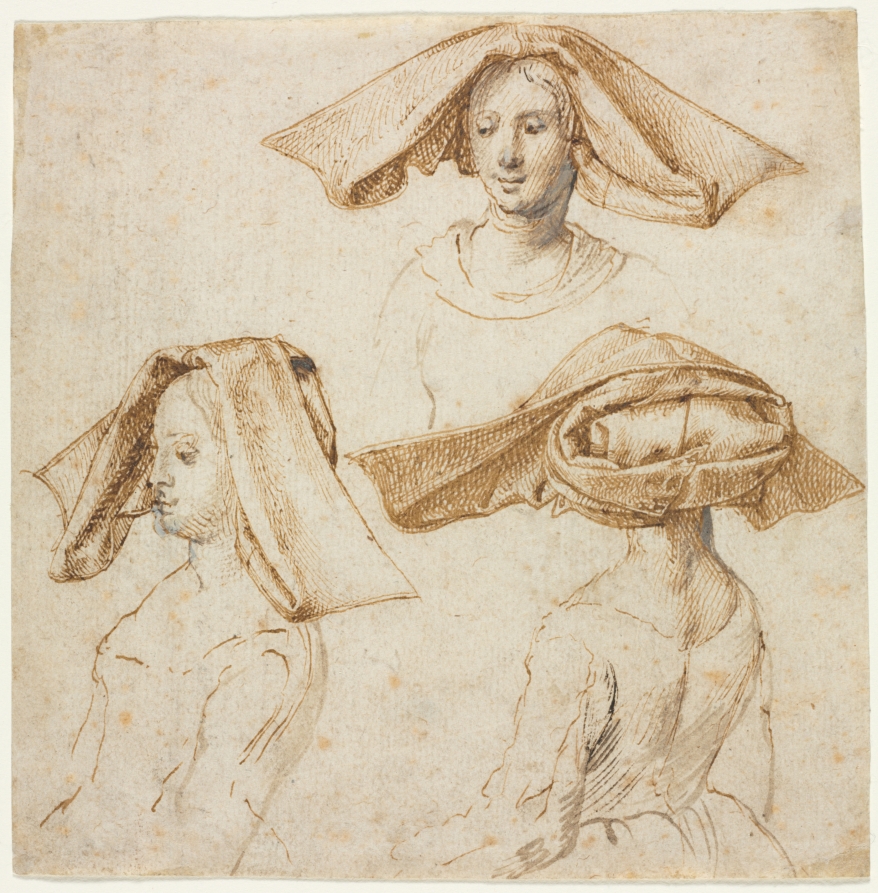
This young woman’s long, conical hood is tucked under and pinned, with the front folded over to create wide, sloping flaps. Such headgear kept heat and cold away during outdoor labor, but around 1475, the style was adopted as a fashion statement by middle- and upper-class women, with the fabric starched for exaggerated effect. The drawing was likely made for a model book in an artist’s workshop of costume details for reference. More than 100 years later, the Antwerp artist Rubens acquired the drawing for his own model book and even drew over it.
Provenance
Sir Anthony Westcombe, London, died 1752 (early 1700s); Robert Prioleau Roupell, London, 1798-1886 (Lugt 2234) (?-1887); his sale, Christie, Manson & Woods, July 12, 1887, lot 891 (as Van Eyck) (1887); George Salting, London, 1835-1909 (1887-1909?); A.W.M. Mensing, Amsterdam, 1866-1936 (1910?-1936); his sale, Mensing & Fils, Amsterdam, April 27-29, 1937, lot 614 (as Rubens) (1937); Mrs. Leo van Bergh, Wassenaar (?-1985); Sold, Christie's Amsterdam, Nov. 18, 1985, lot 4 (as Flemish School, early 16th century, retouched by Rubens) (1985); Alexander Converse? (?-?); with Baskett and Day, London, 1987 (1987); The Cleveland Museum of Art, Cleveland, OH (1987-)
Accession Number
1987.31
Medium
Pen and brown ink; retouched with brush and brown wash, lead white (partially oxidized)
Dimensions
Sheet: 12.9 x 12.8 cm (5 1/16 x 5 1/16 in.)
Classification
Drawing
Credit Line
John L. Severance Fund