Description
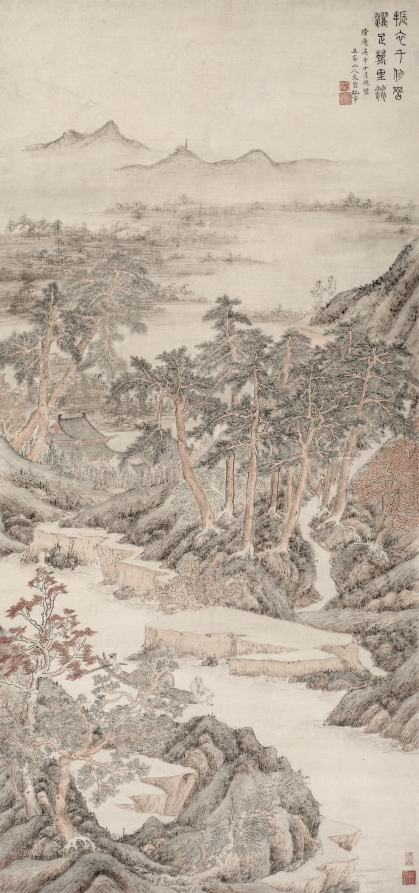
In the autumn of 1570, Wen Boren painted this seemingly unemotional scene of low-lying marshlands with a chain of rounded mountains in the background. A fishing boat is nestled on the shore near the village. Although paths and bridges traverse the landscape, only two people are visible in the stillness.
From the restrained atmosphere of this landscape, one would never guess that Wen Boren was known as the “bad boy” of the Wu School for his explosive temper. As a younger man, he was even embroiled in a contentious lawsuit with his own uncle, Wen Zhengming (1470–1559), a master of Ming dynasty painting with whom he had trained. The ideal of the scholar-painter, or literati, was that an artist’s moral character is reflected in his paintings, so there was great incongruity between Wen Boren’s difficult personality and his restrained landscapes. A contemporary, Wang Shizhen, wrote this about him:
"This gentleman is prone to behave odiously and screamed accusations at people. How is it possible for him to carry in his bosom such a wealth of scenic wonders?"
Who knows what effort it took to subdue his fractious spirit to project an image of coolness and refined taste in his paintings?
From the restrained atmosphere of this landscape, one would never guess that Wen Boren was known as the “bad boy” of the Wu School for his explosive temper. As a younger man, he was even embroiled in a contentious lawsuit with his own uncle, Wen Zhengming (1470–1559), a master of Ming dynasty painting with whom he had trained. The ideal of the scholar-painter, or literati, was that an artist’s moral character is reflected in his paintings, so there was great incongruity between Wen Boren’s difficult personality and his restrained landscapes. A contemporary, Wang Shizhen, wrote this about him:
"This gentleman is prone to behave odiously and screamed accusations at people. How is it possible for him to carry in his bosom such a wealth of scenic wonders?"
Who knows what effort it took to subdue his fractious spirit to project an image of coolness and refined taste in his paintings?
Provenance
(Cheng Qi 程琦 [1911–1988], Tokyo, Japan, sold to Mr. and Mrs. Kelvin Smith) (?–1975); The Kelvin Smith Collection, Cleveland, OH, given by Mrs. Kelvin [Eleanor Armstrong] Smith [1899–1998] to the Cleveland Museum of Art (1975–1985); The Cleveland Museum of Art, Cleveland, OH (1985–)
Accession Number
1985.370
Medium
handscroll; ink and light color on paper
Dimensions
Overall: 26.7 x 183 cm (10 1/2 x 72 1/16 in.)
Classification
Painting
Credit Line
The Kelvin Smith Collection, given by Mrs. Kelvin Smith