Description
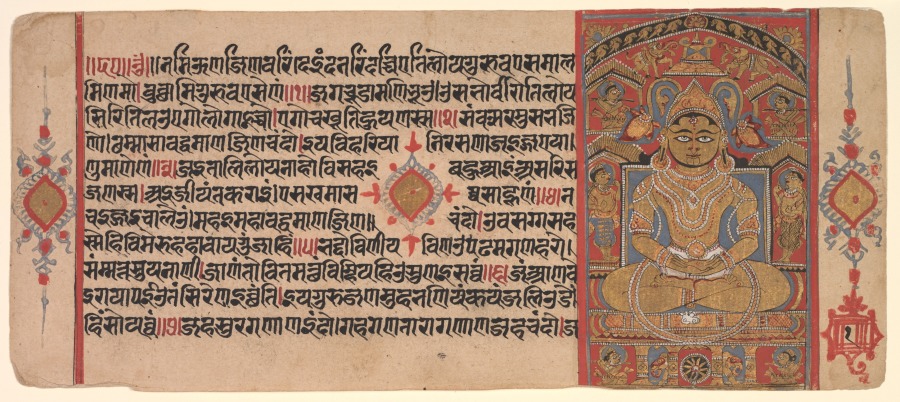
By the 1400s, paper had replaced palm leaves as the primary support for Jain manuscripts. Although binding strings were no longer passed through holes in the manuscript, since they would tear the paper, the location of the holes was maintained by means of ornamented gold lozenges. Followers of Jainism commissioned copies of sacred manuscripts in order to accrue spiritual merit for themselves and their families; adorning the manuscript with paintings increased the merit.
The main figure, painted in gold, sits in eternal meditative bliss, bejeweled to denote his success in reaching liberation. His long hair and the tiny, white bull beneath his crossed ankles identify him as Rishabha.
The main figure, painted in gold, sits in eternal meditative bliss, bejeweled to denote his success in reaching liberation. His long hair and the tiny, white bull beneath his crossed ankles identify him as Rishabha.
Provenance
William E. Ward [1922–2004] and Ellen Svec Ward [1921–1989], Solon, OH, given to the Cleveland Museum of Art (?–1983); The Cleveland Museum of Art, Cleveland, OH (1983–)
Accession Number
1983.1047
Medium
Gum tempera, ink, and gold on paper
Dimensions
Paper: 11.1 x 25.9 cm (4 3/8 x 10 3/16 in.)
Classification
Painting
Credit Line
Gift of Mr. and Mrs. William E. Ward