Description
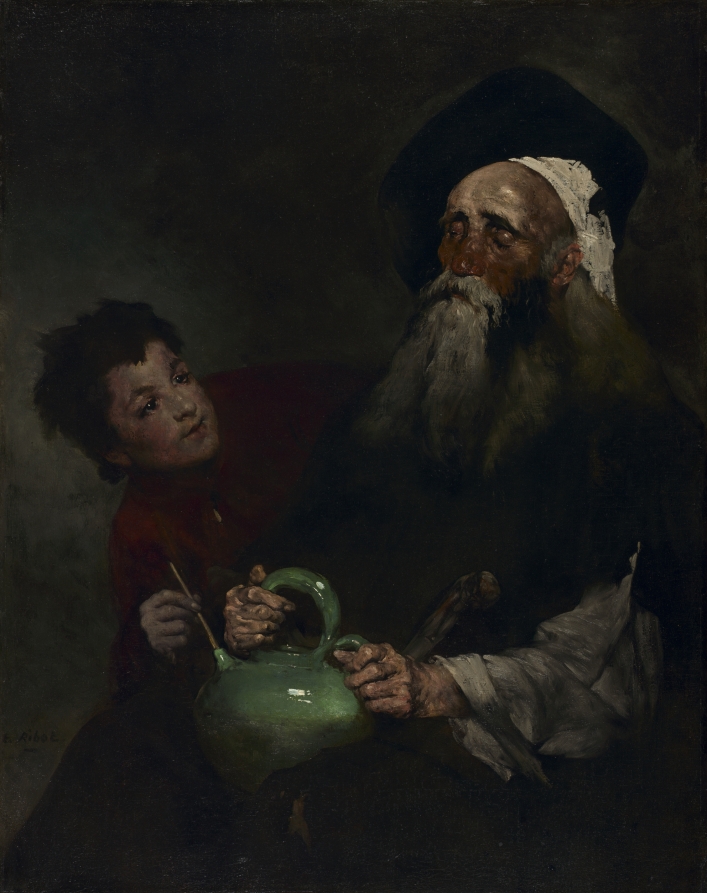
The subject of this painting comes from the 16th-century Spanish novel Lazarillo de Tormes. This tells the story of Lazarillo, a poor servant boy who worked for an impoverished blind man. Abused by his master, and never given enough to eat or drink, Lazarillo is forced to fend for himself. According to the story, he steals wine by drinking it from a straw directly from the blind man's jug. This painting relates to a cultural movement known as espagnolisme, the French interest in Spanish art and literature. Especially popular during the 1850s, espagnolisme focused upon realistic, often down-trodden characters such as Lazarillo. Instead of finding them naïve or foolishly humorous, artists such as Ribot related to their alienation from society and found inspiration in the detailed descriptions of their rough, lowly lifestyles.
Provenance
(E. Oppenheim sale, Hôtel Drouot, May 11, 1897, no. 22, unsold (1897); (Possibly Bernheim-Jeune, Paris) (1911); (Sale, Galerie Georges Petit, Paris, December 4-5, 1918, no. 8) (1918); (Hôtel Drouot, Nov. 7, 1973 [no lot number, reproduced on page 3], sold to Peter Wengraf on behalf of Noah L. and Muriel S. Butkin) (1973); Noah L. [1918-1980] and Muriel S. Butkin [1915-2008], Cleveland, OH, bequeathed to the Cleveland Museum of Art as a result of disclaimer by Muriel S. Butkin (1973-1980); The Cleveland Museum of Art, Cleveland, OH (1980-)
Accession Number
1980.282
Medium
oil on fabric
Dimensions
Framed: 108 x 90 x 7 cm (42 1/2 x 35 7/16 x 2 3/4 in.); Unframed: 91.5 x 73.7 cm (36 x 29 in.)
Classification
Painting
Credit Line
Bequest of Noah L. Butkin