Description
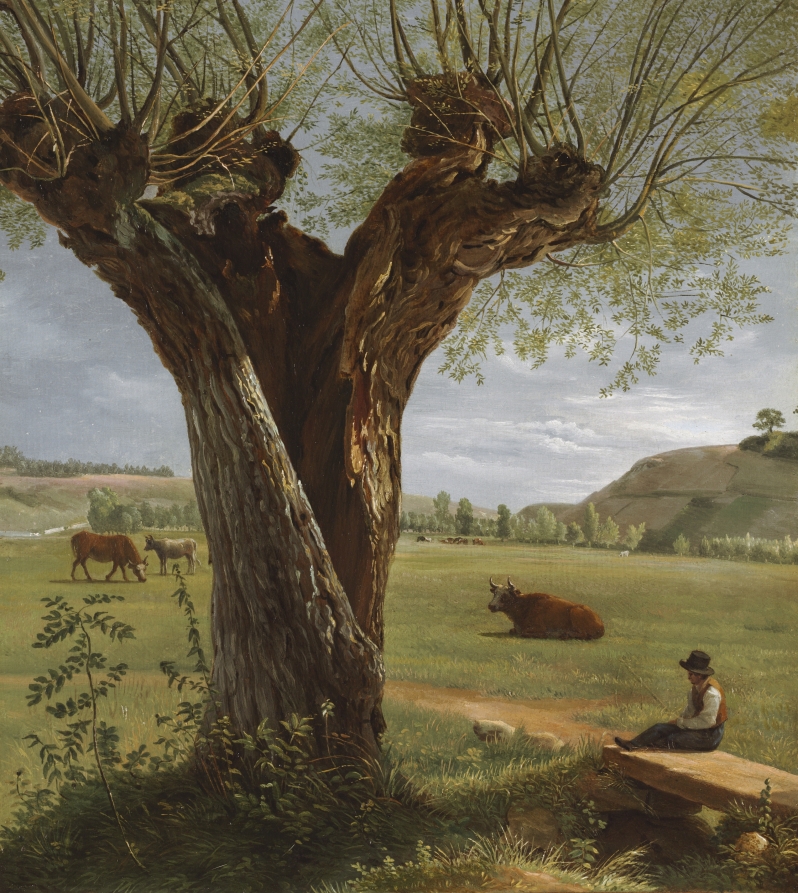
Little is known about Boquet's life, and his artistic origins remain obscure. His style and technique suggest that he received formal training, but where and with whom is unclear. An inscription on a painting attributed to Boquet implies that he spent time in Rome, where he would have seen works by 17th-century French artists such as Claude Lorrain. This may explain the gentle, bucolic atmosphere and the warm, golden light in Pollard Willow, characteristics of which recall the paintings of Lorrain and his contemporaries. The severe pruning or pollarding of trees, especially willows, was a common practice before the Industrial Revolution (about 1750–1850). The procedure allowed the tree to produce large numbers of shoots, which were used in basketry, fence construction, and as fodder for farm animals.
Provenance
Georges Martin du Nord at Galerie B. G. Verte, Paris. Sold in 1977 to Noah L. Butkin, Cleveland. Bequeathed to the CMA in 1980.
Accession Number
1980.237
Medium
oil on paper, mounted on canvas
Dimensions
Unframed: 29.6 x 26.8 cm (11 5/8 x 10 9/16 in.)
Classification
Painting
Credit Line
Bequest of Noah L. Butkin

![Saint Bernard and Saint Catherine of Alexandria with the Virgin of the Annunciation [right panel]](https://api.nga.gov/iiif/e6890364-4d99-4684-a62b-5060ee3c3446/full/400,/0/default.jpg)