Description
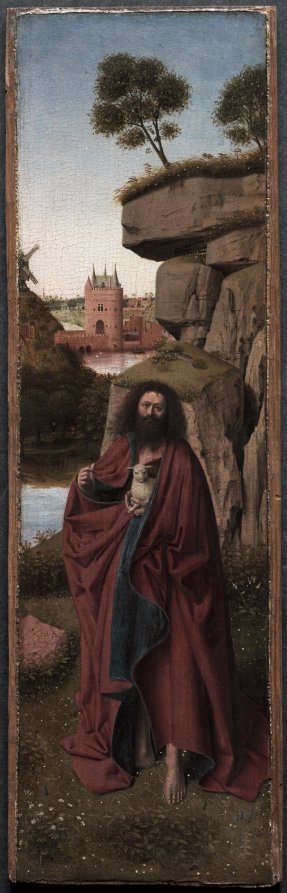
The overall style of this painting suggests that it was painted by an artist closely associated with the Netherlandish painter Jan van Eyck. The facial structure of the saint as well as the artist’s treatment of his cloak are typical of van Eyck’s follower, Petrus Christus. Christus was active in the city of Bruges and was a probable pupil and successor to Jan van Eyck, with whom his paintings have often been confused. Here, Christus depicts John the Baptist as an isolated, monumental figure without his typical hairshirt or other references to his life. This approach is derived from Claus Sluter’s monumental image of Saint John from the portal at Champmol and from manuscript illuminators working for Philip the Bold and his brother Jean de Berry. Here, John holds the Lamb of God, a symbol of Christ’s sacrifice and a reference to John’s proclamation of Christ’s redemption of humankind. Upon his death, Christus was succeeded by Hans Memling as the next great painter in Bruges.
Provenance
Herederos de John Frere (1740-1807), Royal Hall, Norfolk, England; (E.V. Thaw, sold to the Cleveland Museum of Art) (?-1979); The Cleveland Museum of Art, Cleveland, OH (1979-)
Accession Number
1979.80
Medium
oil on panel
Dimensions
Unframed: 40.2 x 12.5 cm (15 13/16 x 4 15/16 in.); Painted surface: 39.6 x 11.5 cm (15 9/16 x 4 1/2 in.)
Classification
Painting
Credit Line
Leonard C. Hanna Jr. Fund
![Saint Bernard and Saint Catherine of Alexandria with the Virgin of the Annunciation [right panel]](https://api.nga.gov/iiif/e6890364-4d99-4684-a62b-5060ee3c3446/full/400,/0/default.jpg)