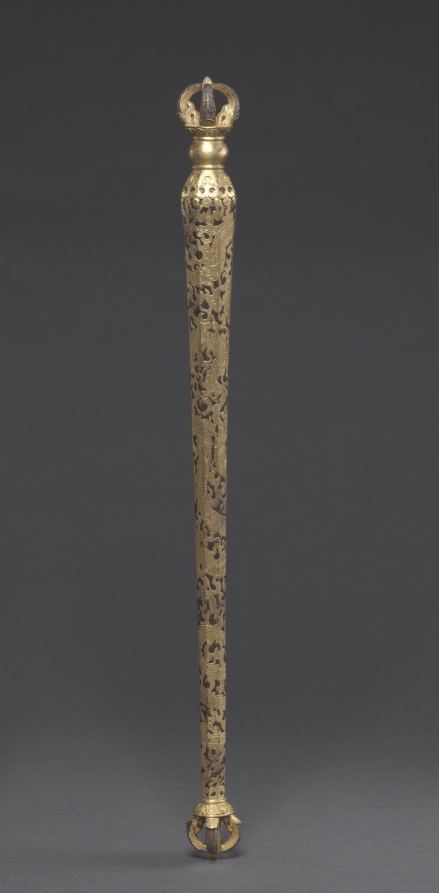
Description
Ceremonial weaponry was used in tantric rituals to combat obstacles to enlightenment, such as ignorance and uncontrolled passions. In 1407 a high-ranking Tibetan monastic patriarch visited the emperor of the Ming dynasty, known as Yongle. The Yongle emperor presented him with a number of gifts, of which the axe, mace, flaying knife, incense burner (1983.154), and the gilt bronze Virupa (1972.96) appear to have been a part, since the sculpture and the axe bear his identifying inscription in a cartouche. Imperial Chinese workmanship is noted in the lush rendering of the lion heads from which the blades emerge, the calligraphic serpentine forms, and the cloud motifs.
Provenance
[]
Accession Number
1978.9.2
Medium
iron alloy with gold inlay
Dimensions
Overall: 38.5 cm (15 3/16 in.)
Classification
Metalwork
Credit Line
John L. Severance Fund