Provenance
Probably Thomas Duncombe [d. 1799], Duncombe Park, Yorkshire, England; probably by inheritance to his brother, Charles Slingsby Duncombe [d. 1803], Duncombe Park; probably by inheritance to Charles Duncombe, 1st baron Feversham [d. 1841]; probably by inheritance to William Duncombe, 2nd baron Feversham [d. 1867], Duncombe Park; probably by inheritance to William Ernest Duncombe [d. 1915], 1st earl of Feversham, Duncombe Park, until at least 1880. Sir Charles A. Turner, London, 1892; (his sale, Christie, Manson & Woods, London, 16 March 1908, no. 7); purchased by (Thos. Agnew & Sons, London); sold two days later to (Charles Fairfax Murray [1849-1919], London and Florence). (sale, Sotheby's, London, 19 July 1922, no. 101); possibly purchased by Christie. (Count Alessandro Contini Bonacossi, Florence and Rome); sold 1933 to the Samuel H. Kress Foundaton, New York[1]; gift 1939 to NGA.
[1] See also The Kress Collection Digital Archive, https://kress.nga.gov/Detail/objects/2065.
Accession Number
1939.1.126
Medium
oil on canvas
Dimensions
overall: 106.1 x 82.6 cm (41 3/4 x 32 1/2 in.) | framed: 131 x 106.7 x 10.6 cm (51 9/16 x 42 x 4 3/16 in.)
Classification
Painting
Credit Line
Samuel H. Kress Collection
Tags
Painting Renaissance (1400–1599) Oil Painting Canvas Italian
Background & Context
Background Story
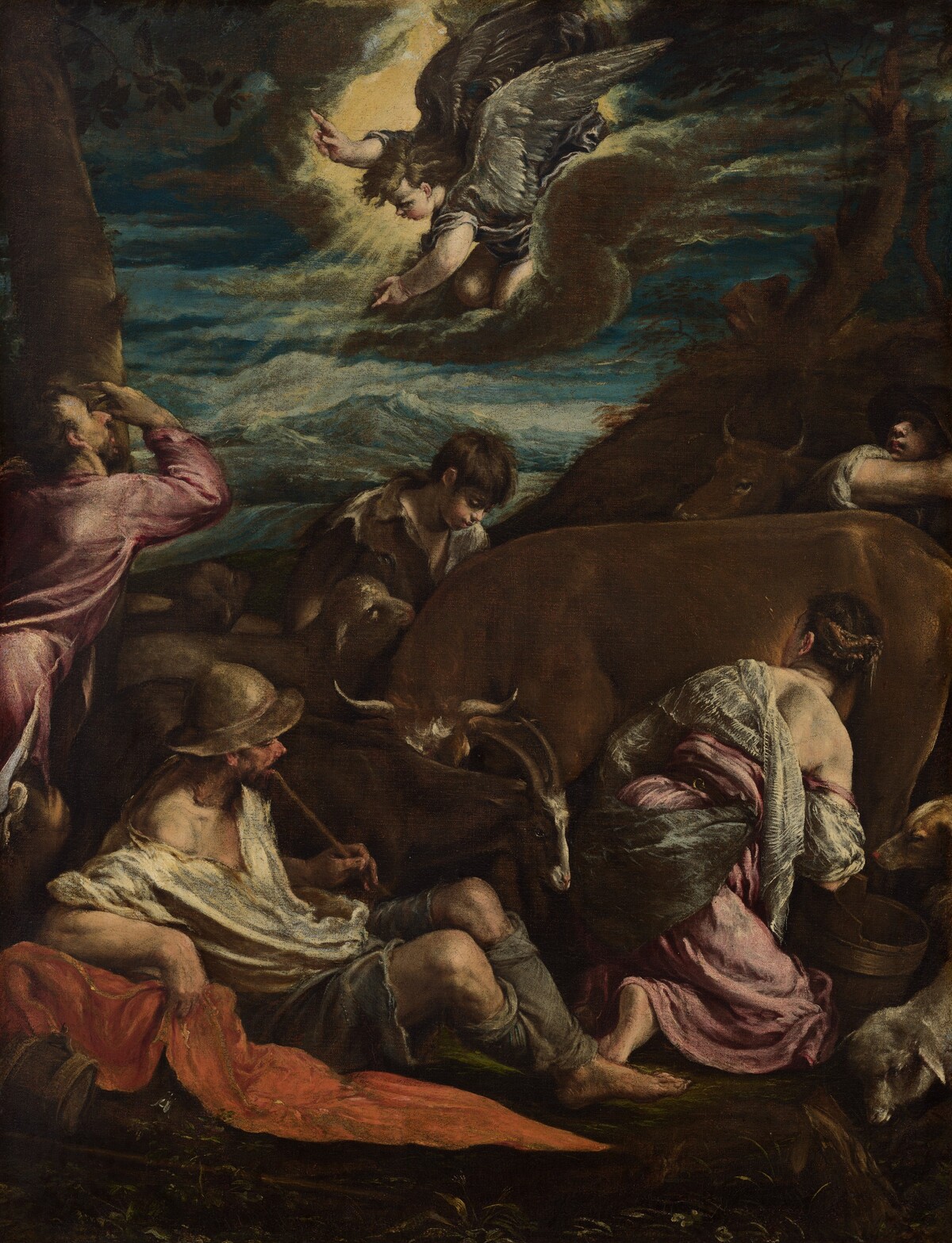
Jacopo Bassano (c. 1510-1592) was a Venetian painter known for his religious subjects set in rustic landscapes with the naturalistic detail and dramatic lighting that distinguish his work from the more grandiose manner of his Venetian contemporaries. The Annunciation to the Shepherds from probably 1555-60 depicts the biblical episode in which angels appear to shepherds in the fields to announce the birth of Christ, set in a rustic landscape with the animals and everyday objects that make Bassano's religious subjects uniquely accessible. The shepherds' shocked reactions and the pastoral setting transform the divine announcement into a scene of everyday life disrupted by the miraculous.
Cultural Impact
Bassano's Annunciation to the Shepherds is important in the history of Venetian painting because it demonstrates the naturalistic treatment of religious subjects that distinguishes his work from the more grandiose manner of Titian and Tintoretto. The rustic setting and naturalistic detail create a religious painting that is simultaneously divine and everyday, and the dramatic lighting of the angelic announcement disrupting the shepherds' nighttime routine shows Bassano's ability to find the miraculous in the ordinary.
Why It Matters
The Annunciation to the Shepherds is Bassano's religious subject in rustic landscape: the biblical announcement set among everyday shepherds with their animals, the miraculous disrupting the ordinary. The probably 1555-60 painting demonstrates Bassano's unique ability to find the divine in the rustic, setting religious narrative in the familiar landscape of Venetian pastoral life.
![The Entombment [recto]](https://api.nga.gov/iiif/fa3124eb-3ac8-4671-8ff8-52114aefe583/full/400,/0/default.jpg)